Blog Archives
Getting Started – Pain Cycle
Somewhere deep down inside, we all know that moving more, that exercising more, will make us feel better.
However, many of us are stuck in the Pain/Injury Cycle, which prevents us from every consistently working out.
Pain Cycle:
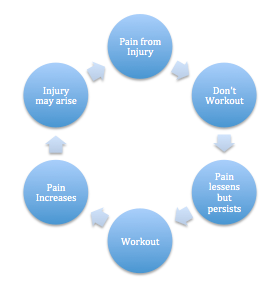
Many people, at one point or another, attempt to start a new workout program.
They don’t really know where to start or what to, but they give their workouts 110% effort.
And then they get injured. So they take some time off.
During the time off, the pain does lessen yet they may suffer from other aches and pains. So they again start working out in an attempt to get rid of their pain.
But because they haven’t really improved their movement patterns or rehabbed their injuries, their pain increases and may even lead to further injury.
That in turn leads to them quitting their exercise program yet again and leads to continued chronic pain.
This cycle of pain and injury is why it is hard for many people to even get started on a healthy lifestyle program.
Most of us don’t like doing things that are uncomfortable. Most of us doing like being in pain.
Actually most of us will do a lot to ever avoid suffering pain, which unfortunately can cause us to never truly feel good.
So how do you get started when you are suffering from pain and exercise just seems to cause more pain?
YOU LEARN TO MOVE WELL!
Don’t worry about lifting a ton of weight. Don’t worry about doing crazy cool stuff.
Deal with the pain first!
Start with the boring tedious stuff that everyone wants to avoid.
Start with the foam rolling. With the stretching. With the activation moves. With the strengthening moves.
THEN learn to move correctly before you worry about adding weight or doing brutal workouts.
BABY STEPS!
If we try to run before we can walk, we may be able to run for a bit but we are probably not going to be running for long because our body doesn’t truly know how to run. So it will get injured.
BE PATIENT. Allow your body to grow and to learn.
Don’t skip those first ESSENTIAL steps. No, that first rehab/prehab stuff isn’t glamorous, but it is essential if you want to run and run without pain.
It is essential if you want to stop that pain cycle from repeating itself over and over again.
I know we all want to just jump right in and use all the cool equipment and do all the crazy “badass” workout moves so we can post our gnarly workouts on Facebook, but if you want to MOVE BETTER AND FEEL BETTER, if you want to make working out a way of life, you’ve got to EARN those moves.
Start with the basics. Learn to move well and you will earn the fun stuff! Plus you will break the pain cycle and really start feeling good!
Here are a few posts about EARNING your exercises and progressing your workouts. Plus if you want some great stretches, foam rolling and activation moves, check out Redefining Strength!
Develop Workouts to Move Better and Feel Better
Yes, lifting makes you feel strong and empowered. Yes, working out makes you healthier and helps you lose weight.
Yes, taking on new physical challenges can be fun and invigorating.
But the real reason most people workout is because they want to MOVE BETTER AND FEEL GOOD.
That is what HEALTH is. That is what YOUTH is.
And whether or not you recognize it as your motivation to workout, moving well and feeling better is the underlying goal of a diet and exercise program.
The question then is, “How do you develop workouts to help you move better and feel better?”
Too often these days I hear about people getting injured when training. About people feeling more worn out or broken down.
While it can be fun to do “brutal” workouts where you feel absolutely destroyed, this shouldn’t be an everyday occurrence.
If you want great results (be healthier, fitter, stronger), if you want to FEEL BETTER AND MOVE BETTER, you can’t just beat yourself down each and every workout.
Here are 5 tips to help you develop workouts that will make you move and feel better!
1. WARM UP – A good warm up consists of MORE than just walking or jogging on a treadmill or elliptical for five minutes. A good warm up is key to preventing injuries, which is key if you want to feel better and move better!
A proper warm up with loosen up overactive and tight muscles through foam rolling and dynamic stretches. It will also activate weak and/or inhibited muscles through activation exercises.
A proper warm up is important because it will make sure your body is truly ready to move so that you don’t get injured during your workout!!
Here are 15 great dynamic warm up moves.
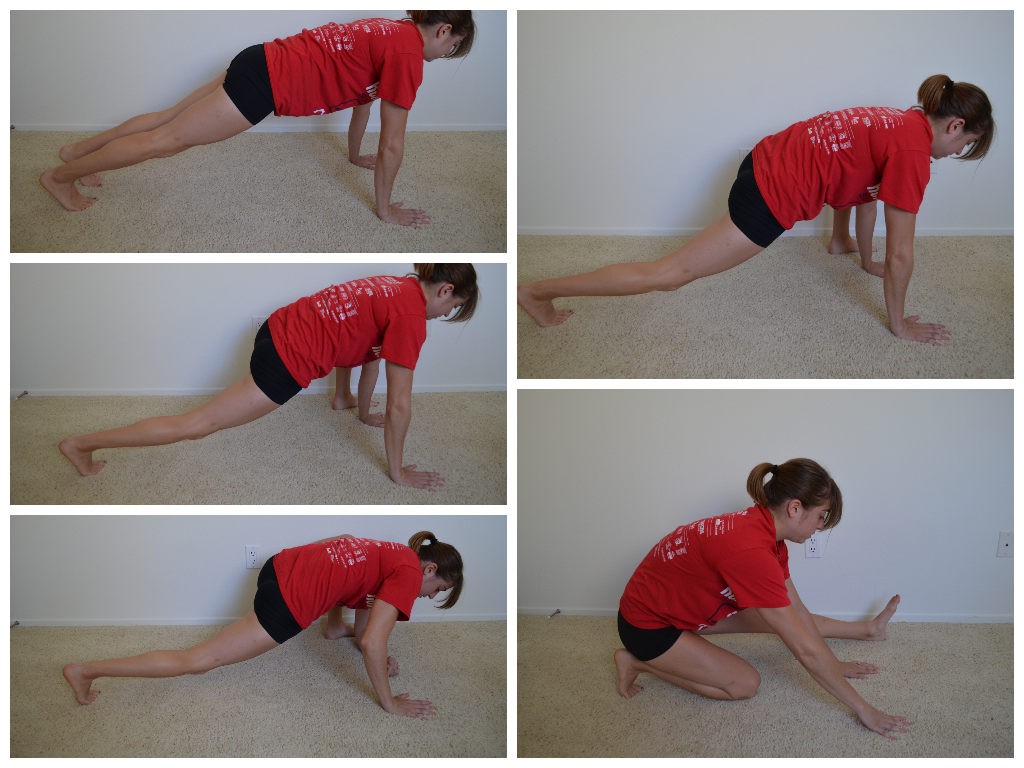
Before you workout, you don’t need to stretch and roll out every area of your body. You just need to focus on the areas you will be using during the workout. You will also want to target areas that are perpetually tight or are prone to problems and injuries.
2. Build Up Slowly – Just because you CAN lift something or DO something, doesn’t mean your body is truly READY to do it. You’ve got to build slowly so that you don’t push your body too quickly and too far.
Injuries often occur when our body is forced to do something it isn’t mobile or strong enough to do.
If we build up slowly, making changes over time, we can prevent injury while getting great results!
Slowly build up and adjust your loads, speeds, intensity and repetitions. Don’t up everything all at once!
For example, if I have a new client who hasn’t really ever worked out before, I’m not going to have them doing jump squats on their first day (even if other people are doing jump squats). And maybe the client can technically do the jump squats.
But because the client has never done them and the client doesn’t even have much of a workout base, I’m not going to have them do jump squats.
I’m going to have them first start out with bodyweight squats. Then bodyweight squats quickly. Then bodyweight squats where they raise up onto their toes as they come back to standing.
Then I will finally have them perform a very VERY small jump off the ground. Then a bigger jump and finally a bigger, quicker jump.

Everything can be progressed or regressed to help someone build. This move helps you build toward a single leg squat!
They will BUILD UP SLOWLY because their body needs to learn the movement pattern and adjust to the load and explosiveness of the move.
An important part of working out isn’t just to do it…It is to do QUALITY movements!
Build up slowly and prevent undo stress being placed on your body which will lead to injury.
3. Work to Correct Imbalances – While my goal is to get everyone moving and having fun as quickly as possible, you can’t ignore the need to do all those supposedly boring corrective exercises.
Muscle imbalances lead to injury or may even be the result of an injury and can lead to further future problems.
Muscle imbalances usually mean that a muscle is doing work that it shouldn’t be doing because something is overactive, underactive, weak and/or tight.
Foam rolling, stretching and activation and strengthening exercises are all essential to correct the imbalances so that you can properly perform exercises during your workout and move better in everyday life.
When you start an exercise program, corrective exercises and stabilization exercises will make up the bulk of your workout.
However, even an advanced exerciser needs to do some corrective and stabilization exercises. Foam rolling, stretching and activation moves should be included in every warm up, especially if you have or have ever had an injury or imbalance.
And stabilization exercises are great for even elite athletes to do as recovery and to ensure that their movements are correct when they move onto some of their more demanding workouts.
Don’t wait to deal with your muscle imbalances until after you’ve become injured. Address the problem before serious symptoms arise!
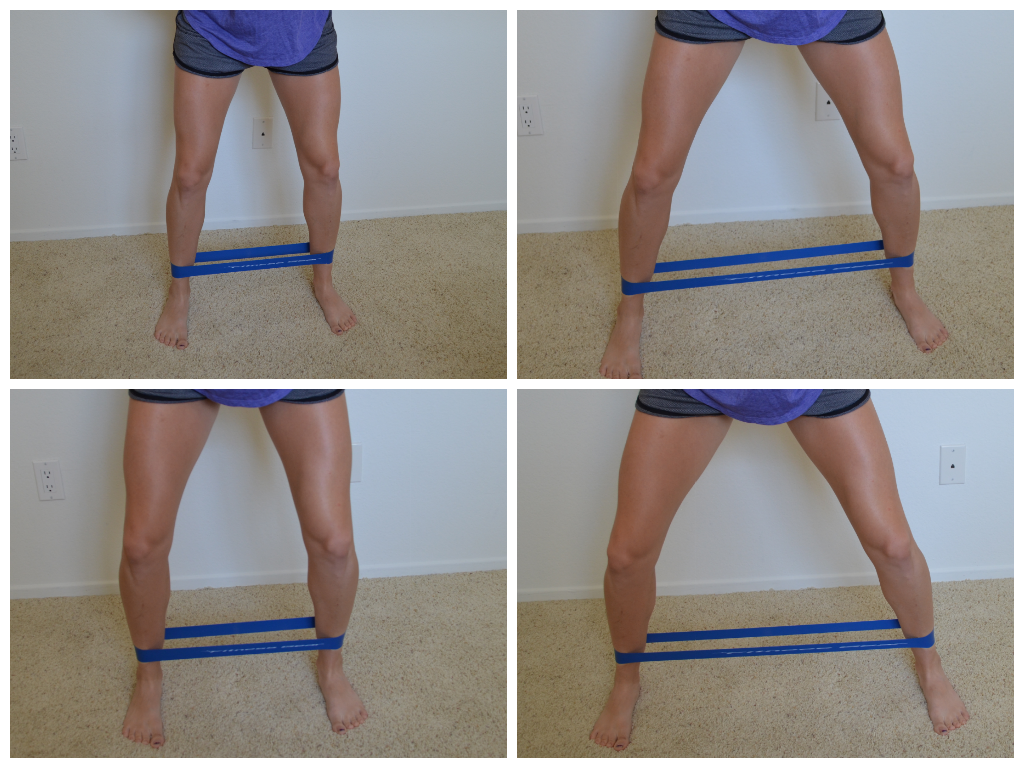
A glute activation exercise since a very common weak and underative area is our glutes!
4. RECOVERY – Your body can’t handle working out intensely ever single day. If you workout too much and too intensely, your body may be overtrained and you may stop seeing progress. Also, if you never cycle your workouts, you may find yourself plateauing because your body is no longer challenged by the workouts.
PROGRESSION is key. And a huge part of PROGRESSION, is proper RECOVERY.
Not only do you want to slowly build up and constantly challenge yourself by mixing up your workouts, but you also want to make sure that you cycle back through weeks of RECOVERY no matter your level.
Recovery is when our bodies rebuild. Recovery weeks though don’t have to mean that we completely take the week off.
Recovery workouts are a great time to do those exercises that help us prevent injury and correct any imbalances that may have developed during our intense training. Recovery weeks are also a great time do to injury prehab and to work on our weakness.
I also use recovery weeks as chances to improve my mind-body connection with exercises that require more stabilization and less load. The better the communication between our mind and body, the better our movements will be.
Also, if you’ve suffered an injury in the past, it is especially important to include exercises that really work on improving our mind-body connection since injuries can damage that connection. And a damaged mind-body connection can lead to further injury!
Recovery weeks are necessary to give our body a chance rebuild so that we don’t become injured. They are also a great chance to add in all those boring exercises that keep us moving well!
And recovery allows us to unwind…Be it a full week or just a day off. RELAXING is not only good for the body but also for the mind. Move better and FEEL BETTER.
Basically recovery is essential.
All of your hard work will be for nothing if you don’t take enough time for your body to rebuild. During our workouts we break down our body. When we RECOVER, we rebuild the damaged muscles. No recovery means perpetual breakdown.
Perpetual breakdown leads to feeling bad and injury!
Here is one of the types of recovery workouts that I do. It is all isometric holds, which is far from easy, but puts a different strain on the body. I also love doing workouts with single limb movements during recovery weeks.
5. Focus on Your Goals – Workout with a goal in mind.
When we workout with a goal in mind, we develop a program and a progression to get us there. When we workout with direction, we are more likely to do things that will help us move better.
We are more likely to include warm ups. To include recovery.
We are more likely to pick exercises with a purpose, not just because they are hard.
We are less likely to just throw together workouts with the hardest variables we can think of so that it will be BRUTAL.
Each exercise variable (how many exercises, types of exercises, reps, sets, rest, load, speed, intensity…) all can be manipulated to help us reach or goals.
We can’t just randomly throw them together. We must consider HOW they will HELP us reach our goals.
If your goal is to deadlift 500lbs, pick exercises and variables to match that.
Don’t waste time doing workouts with a bazillion burpees just because you know they will make you exhausted!
And on top of that, whatever your goal is, whether it is to be the best at your sport, lose weight or bench press four adult human beings, you first need to move well to accomplish it.
Therefore, when you focus on your goal, no matter what it is, you are going to work to move better!
Your plan to help you reach your goal is going to need to include all of the four other tips above even if that means not every workout you do will be so hard you have to lie on the ground completely exhausted.
Not every workout can be the hardest thing you’ve ever done!
Stop wasting your time being so focused on making every workout hard! Stop ignoring how important it is to move well!

I know lots of people have become obsessed with doing BRUTAL WORKOUTS and therefore skip the boring prehab stuff in favor of doing gnarly crap.
But I’m sorry…All that does is lead to injury.
While hard workouts are fun, working out is about more than being gnarly.
Start working out to move better and feel better!
You may find that once you start working out for those reasons, you may actually start hitting some of your other goals more easily (and feeling even better while you do it!).
Common Injuries – Shin Splints and Plantar Fasciitis
I’ve gotten a ton of people recently coming to me with shin splints and plantar fasciitis.
There is a close relationship between the two so I’m not surprised when runners end up having troubles with both. They can be due to improper footwear, over-pronation of the foot, incorrect running/walking form or just plain-old OVERUSE.
Below is a quick breakdown of each injury and then some prehab/rehab stuff you can do to make the pain go away!
Shin Splints
Shin splints are not your bone splintering apart. Shin splints are actually pain in either the anterior or posterior tibialis, the muscles of your shin.
Shin splints can occur from improper footwear, improper gait mechanics (overstriding), over-pronation (when your foot rolls inward) and just plain-old overuse. (Today I will not get into proper gait mechanics or discuss the shoes you should wear, but you should be aware that these two things MAY be a potential cause of your pain.)
Here are some ways you can help alleviate the pain and even start correcting the muscle imbalances that may be occurring because of one of the issues above.
How many of you runners that suffer from shin splints roll out the muscles of your lower legs, other than potentially your calves?
Don’t lie. I know not many of you do.
The fronts and sides of our shins are often forgotten when we roll out.
To roll out your shins, sit on the ground with one foot flat on the ground and your knee bent. Take a tennis ball or other small ball and dig it into the muscle down the front of your shin. Start right below your knee. Make small circles, digging the ball in as much as you can. After making circles in one spot, move the ball down lower on your leg toward you ankle. Work your way all the way down your shin.
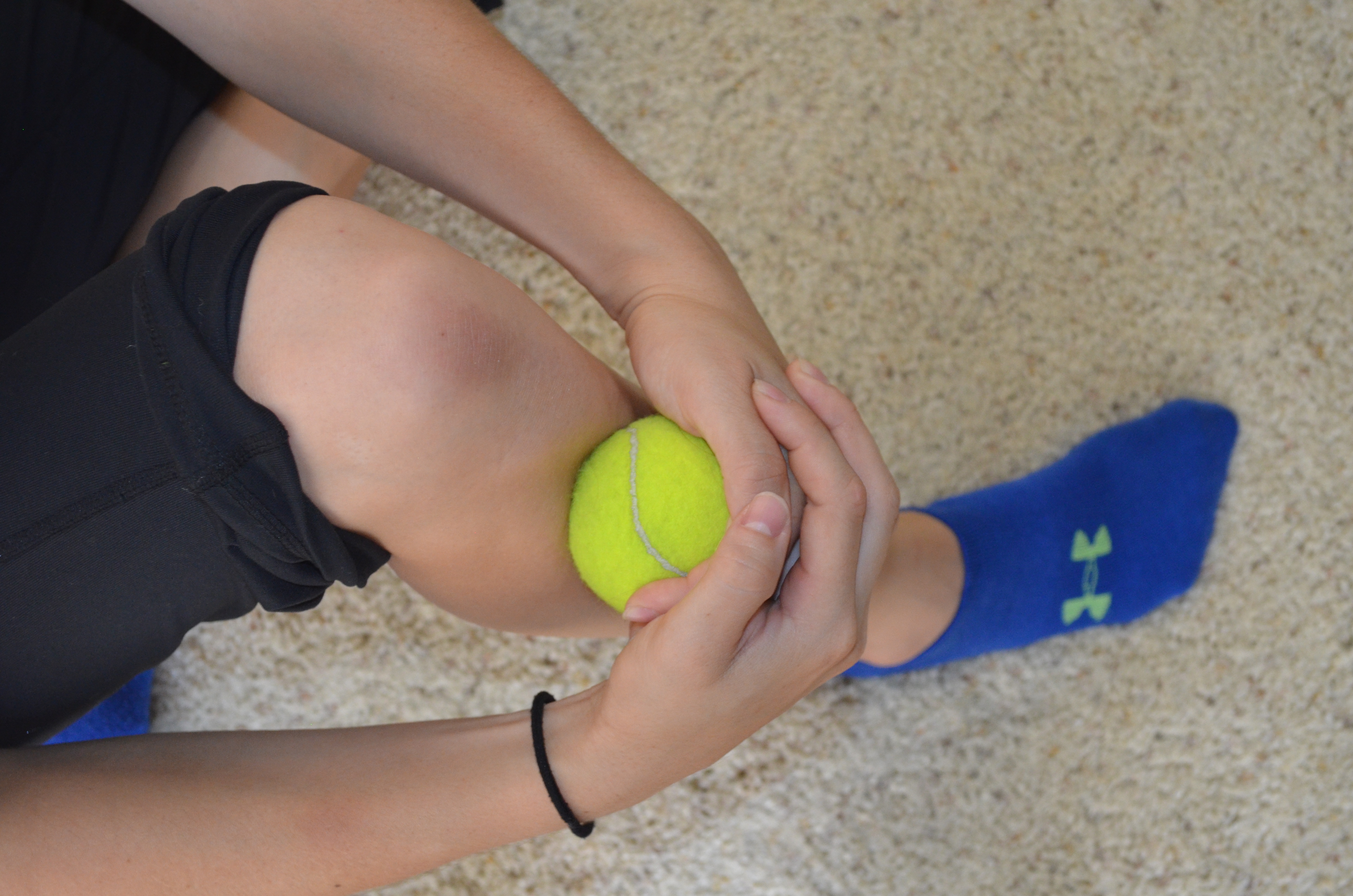
You can also use a roller or tennis ball to hit the outside of your shin. Place the roller or tennis ball on the side of your lower leg right above your ankle. Press your leg down into the roller and roll up toward your knee and then back down. Hold on any tight spots and rock your leg side to side to dig in deeper to those spots.
Here is a link to a full video library that includes a few different ways to roll out your shins and your entire lower leg.
STRETCHING
Stretching can also help alleviate the pain of shin splits by lengthening potentially overactive muscles.
You can hit your shins from a couple of different angles using one basic stretch. Standing, point your toe. Place your big toe on the ground and let your foot fall forward, pressing the top of your foot toward the ground. You can change exactly what angle you hit based on how you point your toe. Your big toe can point straight ahead or out to the side or even inward.
You can also make circles with your foot in that position to loosen up your shin and improve ankle mobility.
You should also make sure to stretch your calves as they me tight and part of the problem!
STRENGTHENING
A good way to stretch and help strengthen is by doing heel walking. Flex your feet and walk around on your heels. This could be a great part of your pre-run warm up.
Also, ABCs are a great ankle mobility and lower leg muscle strengthening exercise. Sit or lie down and point your toe. Draw the alphabet with your big toe.
If you do have shin splints from overuse, make sure to also rest up and then start a rehab program.
If you have shin splints from over-pronation, you may also need to loosen up other muscles like your adductors while strengthening your glutes.
Ice and anti-inflammatories can also help alleviate pain BUT they will not “cure” the problem.
The best “rehab” program is a prehab one. If you know you are going to be upping your mileage and have suffered from shin splints in the fast, stop the problem before it happens. Foam roll before and after workouts and make sure to stretch and warm up properly. Work on your ankle mobility even if you aren’t having pain at the moment. Also include the proper strengthening exercises in your program.
Take care of your body BEFORE you have pain so that an injury doesn’t sideline you later!
Plantar Fasciitis
Plantar Fasciitis is pain on the bottom of your foot and can occur along with heel spurs or even because of heel bone spurs.
It is a common overuse injury in runners and has a lot to do with over-pronation and lack of calf flexibility. You are more at risk if you are overweight, have high arches, do repetitive high-impact activities or suddenly start or up your activity level.
Usually your plantar fasciitis feels the worst when you wake up or after you’ve been sitting for a while. It tends to feel better when you’ve warmed up.
The quickest way to get rid of plantar fasciitis is by rolling out all the tight muscles involved.
Roll out your calves with either a tennis ball or roller. Start at the base of your calf right above your ankle. Rock side to side and then move the roller or ball up higher on your calf. Hold on any tight spots.
You can also flex and relax your foot to dig in deeper to any trigger points. Or you can make small circles with your foot. Both help apply more pressure to the tight area.
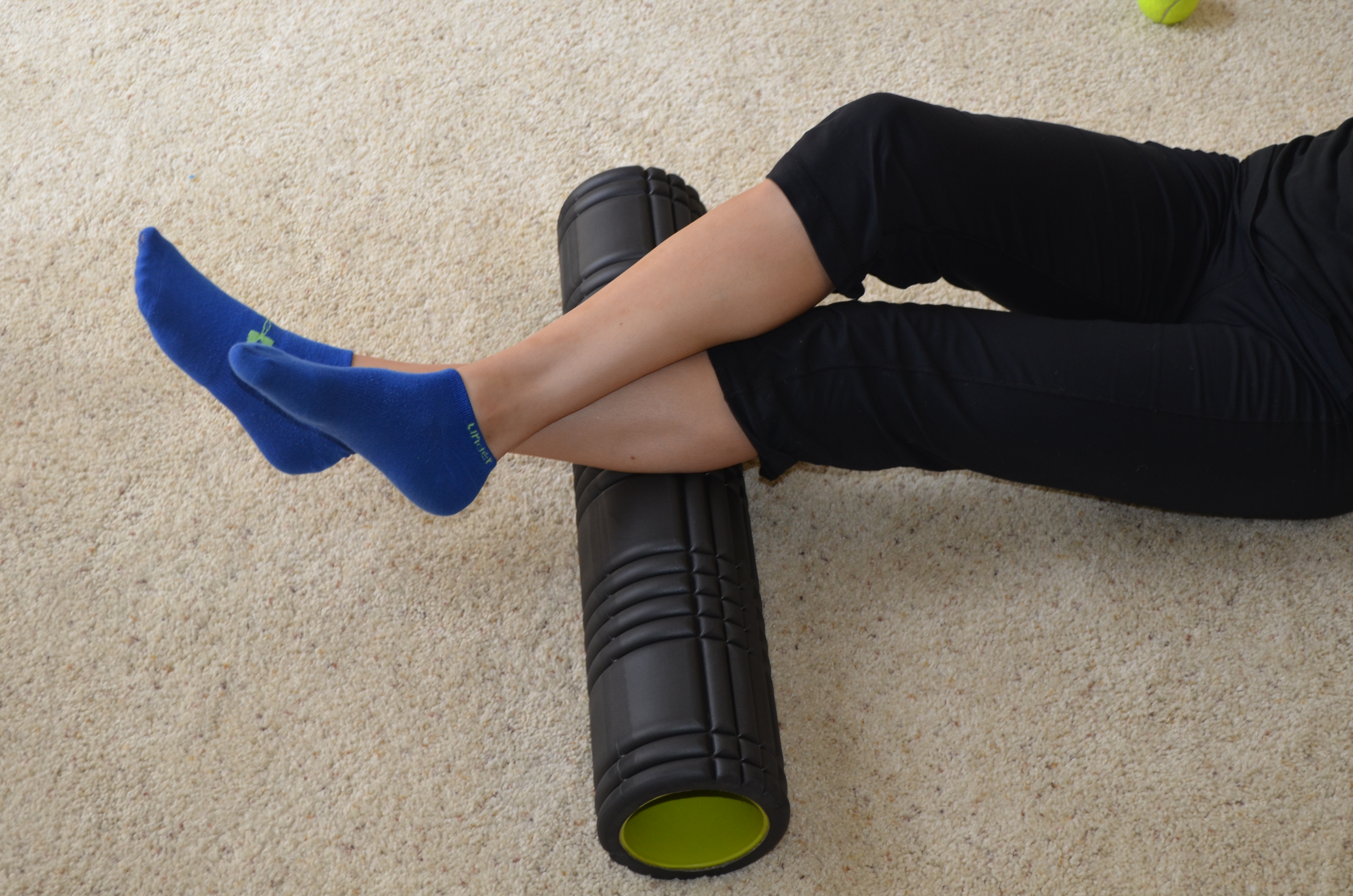
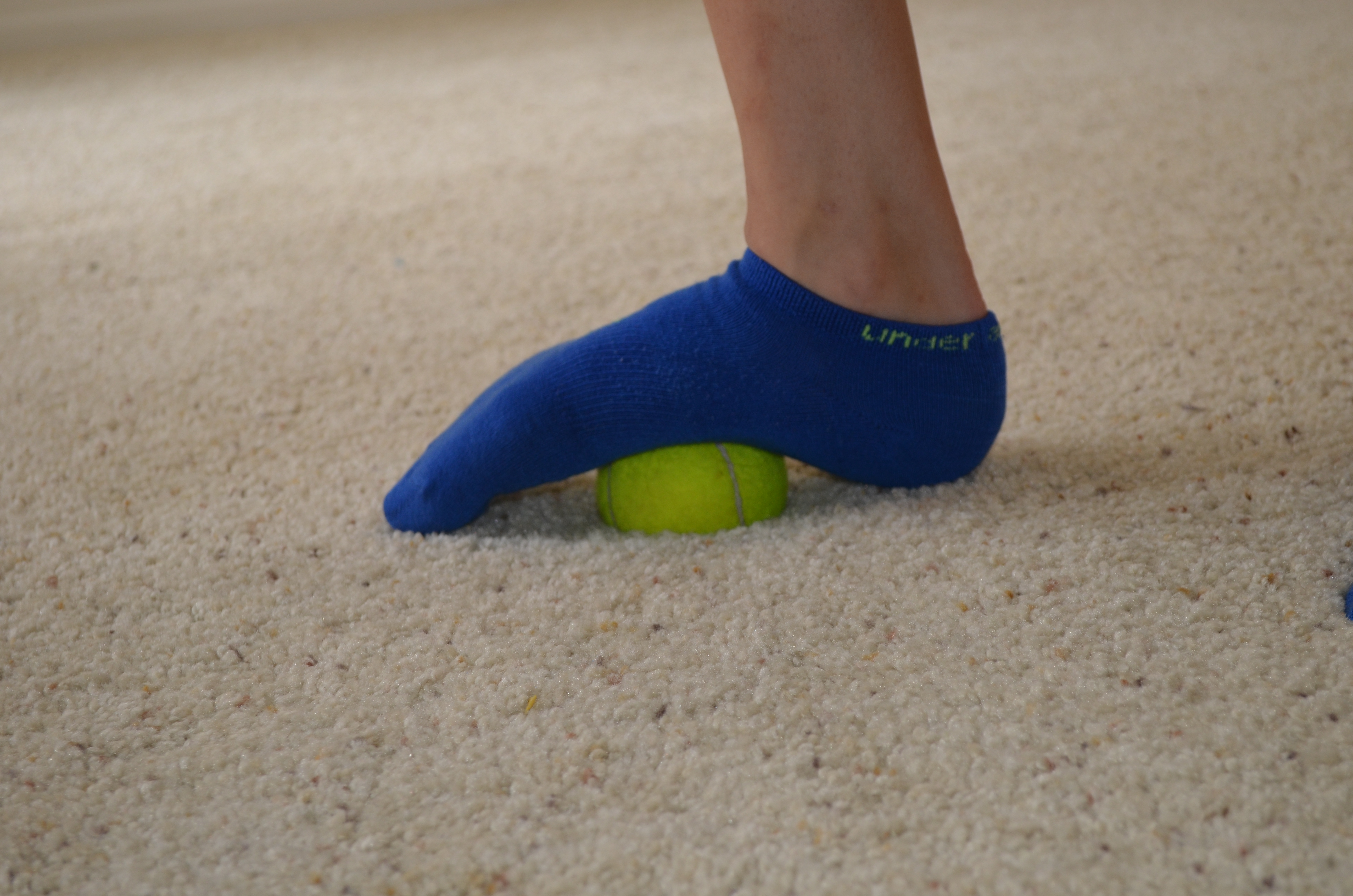
You also need to roll out the bottom of your foot no matter how much it hurts. The smaller and harder the ball you use, the more you dig in and the quicker you will get everything loose (AKA the quicker everything will feel better!).
Standing, place the ball under your arch. Press down into the ball and roll it all along the bottom of your foot. Hold on any tight areas. BONUS: Take a small water bottle in the refrigerator and freeze it. Then use the cold bottle to roll out your foot! The cold really helps alleviate the pain (both from the injury itself and the actual rolling out haha).
STRETCHING
You must stretch your calves AND the bottom of your foot.
To stretch your calves you can do Bear Squats or more traditional static calf stretches. To do a bear squat, start on your hands and knees. Then press back off your knees, driving your butt up to the ceiling and your heels down into the ground. Hold for a second and then relax back down to your hands and knees. Repeat for 10 to 20 reps. A great dynamic warm up stretch!
To stretch your feet, you can put your toes against a wall while keeping your heel on the ground. Lean forward into the wall.
Or you can flex your feet and sit back on your heels while kneeling on the ground. This stretch can even be added to the beginning of the bear squat so that you can stretch both your feet and your calves.
STRENGTHENING
A great foot strengthening exercise requires only a towel. Place a towel on the ground. Using your bare foot, scrunch the towel with your toes. You can also practice picking up the towel with your foot.
Doing these moves always remind me of the movie Die Hard….when the guy tells Bruce Willis to take off his shoes and makes fists with his toes. (Am I weird? Probably.)
For both of these injuries, you will want to use a lot of the stretches and mobility exercises outlined in the Ankle Mobility post (This post shows the stretches discussed here)! They will help you strengthen and stretch your feet and lower legs so you can move pain-free!
For more foam rolling techniques, check out this Trigger Point Video Library. And for a great recovery workout for runners, click here! This workout will help you prevent injuries and develop great strength to run further, faster.
NOTE: This post doesn’t include all of the prehab/rehab options out there. It also doesn’t address all the causes of these two injuries. See a PT if your pain is sever or persists without lessening while trying some of these easy home remedies.
Accepting Pain aka STUPIDITY
So there are all sorts of “pain” related discussions that really get on my nerves.
One is when clients who are working hard for the first time in their life tell you that an exercise “hurts” when, upon further investigation, you find out that it is merely making their muscles fatigued and that they aren’t used to the burning sensation of a muscle working.
While I don’t like the phrase “no pain, no gain,” being sore and working hard isn’t always “comfortable.”
But at the same time having the attitude “no pain, no gain” and never recognizing when something hurts isn’t good either.
While I can get annoyed when someone can’t recognize the difference between “injury pain” and “discomfort from muscles working hard,” I get way more annoyed by the client who thinks they are cool because they push through the pain.
And honestly this “no pain, no gain” client WAY worse than the client that mistakes muscles working for pain.
You may be shaking your head and going, “Heck no! They aren’t near the same! You have to work through the pain sometimes! You are TOUGH if you just push through!”
Uhm no…I’m sorry….You don’t…and you aren’t.
You are stupid.
Period.
Yep that’s right…STUPID.

Oh yes…Let’s put some sexy people on a poster working hard and say “no pain, no gain.” That way when people get injured they will think it is all just part of the process to look and perform like the attractive people in the photo! ARGH!
I can say this as someone who has been stupid one too many times in her past. I have the torn muscles and scar tissue to prove it.
And guess what I have now?
Improperly rehabbed injuries that years later I’m now having to deal with.
Trust me…injuries aren’t cool.
You aren’t “bad-ass” if you push through.
Honestly, unless you are a highly paid athlete, there is never a reason to push through true pain and injury. And even if you are a highly paid athlete, there is a very fine line between stupid and something you push through because it is your job.
When you work through the pain, generally all you do is make the injury worse. And then you are either eventually going to have to take time off, and probably MORE time than if you had rested and rehabbed it immediately, OR you are going to have something that restricts your movement and causes pain for the rest of your life.
Doesn’t sound like great options if you don’t just DEAL with the pain immediately.
But rehab and pre-hab aren’t “cool.”
It is way cooler to be like, “I can’t do push ups because of my shoulder.”…Right!?!
AH!
I can’t tell you how many people recently I’ve encountered coming from other gyms who say they “can’t do” something because of an injury they’ve never dealt with and just “worked through.”
And every time I say to them the same thing, “Well what have you been doing for rehab?”
And I always get the same answer…NOTHING.
Can someone please explain this to me?
Why is pain cool and rehab not cool?
Don’t we workout to feel BETTER!?! Don’t we go to look BETTER? Perform BETTER?
If we want exercise to make us BETTER, how do we expect to do that if we are restricted and in PAIN?!
If you have an ankle injury, even one from decades ago, and you never rehabbed it, it may be causing problems up your leg. It may be why you have low back and hip pain. It may be why you have balance issues. It may be why you can’t lift as much as you want to. It may be why your butt isn’t as strong and perky as you would like!
It may be causing a whole load of problems that aren’t even related to the initial injury!
But it is better to just push through…huh?
Ok here is your chance to stop being an idiot and stop accepting pain.
Take five minutes at the beginning of your workout and add in an exercise or two to rehab or better yet “pre-hab” any weak points or areas of past injury. (Just because at one point in your life you did some rehab for an injury doesn’t mean you are just now done with it now. That area may always need some extra TLC.)
Here are a couple quick things you can do for four common areas of injuries…
- ANKLE/FOOT PAIN/INJURY (Heck these are even good for some knee and hip problems) – Roll out the bottom of your foot, your shin and your calf with a roller or small ball. Then work on your balance. My favorite balancing drill is when you either stand on one foot on the ground or on a foam pad and then you swing the other leg. Do swings forwards and backwards, side to side and even rotational (like you are lifting your foot to step back over a fence and then bringing it back forward over the fence without touching down). Then do glute activation drills. Pick one or two from this list and do 1-2 rounds of 10-20 reps.
- LOW BACK/HIP PAIN/INJURY – Low back pain is a super common problem. While rolling out the whole leg is ideal to find all trigger points, you can start with your hips, glutes and low back. A great way to roll out your hips, can be to take a bigger, foam ball and lay over it. The ball will actually be pressing into your abs right above your hip and beside your belly button. Relax over the ball as much as you can. You will also want to stretch your glutes and hips. Here are some more great trigger point release tips for your hip area. You will also probably want to do some stretches and trigger point release for your thoracic spine and lats. We can sometimes compensate and use our low back because our thoracic mobility is bad. A great thoracic stretch is one you do when kneeling. Kneel on the ground with one hand planted on the ground under the shoulder. Then reach your other hand back over your head with your finger tips pointing down your spine. Then rotate your elbow of the hand down your spine, under your arm that is down. Then rotate open, reaching the elbow up toward the ceiling. Again, glute activation exercises are key. If our glutes aren’t firing, we are going to use our low back and hamstrings more than we should!
- WRIST/ELBOW PAIN/INJURY – Yup…you can even roll out your forearms. If you have wrist or elbow pain, rolling our your forearms, triceps and biceps can help, especially if you target the areas of insertion. Wrist/forearms stretches are also important. We sit at computers all day with our wrists flexed and never really think to do anything to extend and release the muscles. One of my favorite wrist stretches is, when I kneel down and place my hands on the ground under my shoulders. I then turn my finger tips to face my knees with my palms flat on the ground. I then rock back and sit on my heels, keeping my palms flat on the ground, and then return back to kneeling and release. To also help activate the extensors of my wrist and forearm, I use a trick I was taught by Corey…The rubber band extension. Take a rubber band and place it around the outside of your fingers when they are all together. Then spread your fingers out as wide apart as you can before bringing them back together. This really helps with a lot of elbow pain!
- SHOULDER/UPPER BACK/NECK PAIN/INJURY – Roll out your traps, chest and lats. You will also want to stretch your chest and neck. You can easily stretch your chest using a wall or doorway. Place your hand and even your forearm on the wall or door frame and then step forward till you feel a stretch. To stretch your neck, lean your head to one side and gentle pull your head down toward your shoulder, making sure you keep your shoulders relaxed. To change exactly which muscles you hit, look up, down and straight ahead. Then you will want to do a scapular wall hold. If you do it correctly, you will activate your lower traps which will help you relax your upper traps and usually helps with neck pain. YTWLs are great too to activate the muscles in your upper back and strengthen your rotator cuff. Check out this video by Nick Tumminello on how to do them.
Here is another article with some essential mobility drills that can help you move better!
You don’t have to do these every day, but you do want to make sure that spots that need improvement get attention! So stop accepting pain and start doing something about it. It really doesn’t take that much time.
Be smart…It’s way more “bad-ass!”
NOTE: If you are suffering from an injury, it is best to get checked out by a doctor. Most of these drills are meant for already diagnosed injuries or minor recurring injuries/pains. Also, this list is by no means comprehensive. It is just to give you an idea that there are some quick things you can do before your workouts, to correct problems!
Recovery
The more intensely you work out, the more attention you must pay to your recovery.
Our bodies can get run down by daily life especially when we are working out hard on top of everything else. If we don’t take care of our bodies, then we won’t reap the rewards of all of our workout, and even dieting, efforts!
But recovery doesn’t simply mean taking time off and laying on the couch doing nothing.
Recovery can be active and includes more than just sleep and relaxing. Recovery means stretching and SMR. Recovery means eating correctly and staying hydrated. It can mean contrast showers and icing or applying heat.
It means taking care of any places that need extra TLC.
And it doesn’t mean five seconds of stretching or rolling out. If you actually have areas that feel worn out from the week or bug you from time to time, you have to take care of them.
Ice, stretch, roll out. Do all three and not just every once in a while. Do them every day, numerous times a day to help the problem correct itself more quickly.
More isn’t always better but not enough won’t get you anywhere. If you are a tight person, or have imbalances, rolling out the few times a week you go to the gym (for like a minute before you workout), isn’t going to be enough.
You need to spend time correcting the imbalances. You need to create a program and probably spend time every day for at least a few weeks to help correct the problem.
That can mean activation exercises for the muscles that are underactive. It can mean stretching tight muscles and rolling out knots. It can mean icing muscles that are particularly worn out or areas that get inflamed from lots of use.
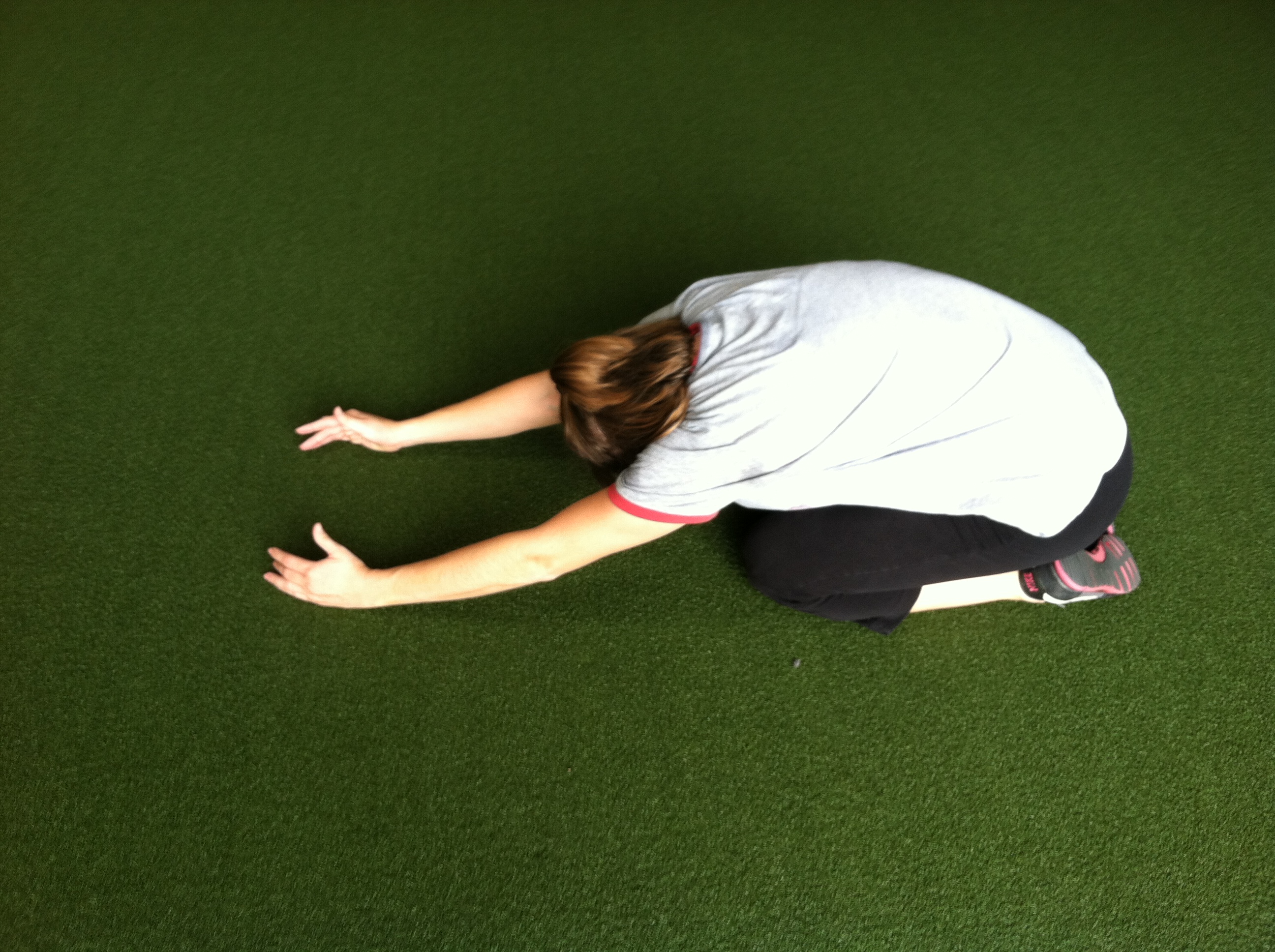
One of my favorite recovery moves….child’s pose with attention on the lat stretch!
It doesn’t mean ignoring the issue or just dealing with the pain. It also doesn’t mean not going to the doctor if your pain is severe or chronic.
BUT it does mean taking care of yourself so that some pain doesn’t become an injury – so that a little tightness or soreness doesn’t turn into an overuse injury or strain.
Even injuries you supposedly “rehabbed” can have long-term consequences if you don’t take care and make sure they are truly recovered. An ankle injury years ago could be the reason why you are now having knee pain, especially if you don’t take care to make sure everything has been rehabbed.
The best recovery program is the one that does something BEFORE you actually have issues!
The better your recovery program, the quicker you will heal from any injuries (or even prevent them from happening in the first place) and the more ready your body will be each week to handle the challenges you throw at it.
So what areas are tight on you? Where do you get knots and soreness? How is your posture? And remember, just because you have low back pain doesn’t mean your low back is tight…it could be a trigger point somewhere else around the area causing the pain!


 Man Bicep