Category Archives: Man Biceps
I LOVE MYSELF – When did we lose the courage to believe?
When was the last time you did this? When was the last time you looked at yourself in the mirror and was like, “I love everything about myself.”
Heck when was the last time that you looked in the mirror and didn’t instantly start focusing on all the things you would like to change?
Probably never or at least not very recently I’m guessing.
And that is just sad.
So often as adults all we focus on are the things about ourselves that we want to change – the things about ourselves that we don’t like.
When did we lose the courage to say, “I love myself?”
Because, honestly, I don’t believe it isn’t that we don’t see our good points. We do recognize our good points, we just don’t focus on them because we are afraid that everyone else sees our flaws and will think that we are cocky or full of ourselves or delusional if we say we love something about ourselves.
When in reality, we focus way more on our flaws than ANYONE else out there does.
We are our own harshest critics. And I firmly believe that.
We set our own limits. We push ourselves down.
We can say that magazines present unrealistic body images. We can can say society presents unrealistic standards.
And yes, those societal standards do seep into our brains as we age so that we can’t, with the same abandon as Jessica, say we love ourselves.
But despite what society tells you, I guarantee that there are traits that aren’t deemed beautiful or wonderful by society that you love about yourself. Yet, because society doesn’t value them, you are too afraid to admit your beauty out loud.
YOU hold yourself back.
When will it stop?
When will you muster the courage to admit that you love yourself? Flaws and all.
When will you stop picking and pushing and start enjoying and celebrating?
When will you stop setting boundaries and limits and instead look at the world and yourself for all that you have to offer?
Society isn’t going to change. Magazines. TV. Ads. Aren’t going to change….
Until we do.
So start creating change by changing your opinion of yourself. Tomorrow, look in that mirror and focus on what you LOVE not what you’d change…
And if you happen to do a little dance while looking in that mirror…well that is fine too!
No one’s judging except you.
Reasons why you should keep your workouts shorter
So I’ve been asked numerous times recently about how long your workout should last. In case you had the same question, my answer is…Keep it short! Maximize the time you have in the gym.
Honestly, your workouts really never need to go over an hour and here is why:
Many of us think that the more we do, the better our results will be.
But more isn’t always better.
Longer, harder workouts…extra reps…don’t always equal greater results.
People will even tell you that you aren’t doing enough if your workouts aren’t at least an hour or two.
But who is really focusing the entire time or working as hard as they can when they spend two hours in the gym?
NO ONE!
And if they are really working at 100% the entire time, they are probably overtraining and hindering their strength and size gains even further!
Sometimes too long, too hard, too much can end up hindering your progress and even cause you to go backwards – it may be the reason why you’ve been stuck looking the same way and lifting the same weight for the past few months or even years!
While hour-long or even two-hour long workouts have their place and time, most of your workouts shouldn’t last that long.
Sometimes less is actually more!
It is about being efficient in the gym, using compound lifts, shorter rest periods, heavier weights, and optimizing the time you spend there because the hormones that our bodies produce work to our advantage when we keep our workouts under 60 minutes and can actually hinder our progress when we go over.
When you start training, your body will boost testosterone levels significantly and around 30 minutes into your workout, testosterone levels in your body will peak. By about 45 minutes, your testosterone levels are returning back to normal.
So all those guys and gals spending two hours in the gym have been working without the aid of a key muscle-building hormone for about an hour and 15 minutes. They would have gotten more benefit out of 45 minutes of intense, compound, heavy lifting and optimal testosterone levels.
And on top of the fact that at about 45 minutes your testosterone levels are returning to normal, at about 60 minutes, your body will start producing more cortisol than testosterone and cortisol is a catabolic hormone, meaning it breaks down tissue instead of building it up!
When your workouts go over 60 minutes in length, you hormones are no longer helping you build muscle and burn fat. Your body is instead producing more cortisol, which breaks down muscle tissue, reduces protein synthesis, and increases body fat storage. Your body begins to fight against all of the hard work you are doing!
So instead of lifting heavy one set and wandering around the gym for five minutes “resting,” why not stay focused and get some high quality work done while your testosterone is raised?
Also, if you keep your workout shorter but more intense with compound movements, heavy weights and varied rest periods, you will optimize your hormone levels even more.
By lifting heavier with compound movements, you will maximize your testosterone response especially if you do enough volume. Working in the hypertrophy rep range of 8-12 reps for 4-5 sets at about 75% of your one rep max has been shown to result in significant increases in testosterone levels and other hormones that result in better protein synthesis.
And to get even more out of every rep, play with your tempo especially on the eccentric portion of your lifts. The eccentric portion of a lift, when the muscle lengthens, is where you can cause the most muscle damage. Studies also suggest that more protein synthesis happens after lifts with an emphasis on eccentric training. So between causing more muscle damage and more protein synthesis, focusing on the eccentric lift will cause bigger and better size and strength gains!
Also, while so many of the muscled guys and gals around the gym spend just as much time lifting as they do resting, long rest intervals may not be the best way to maximize your growth hormone response, a hormone that increases protein synthesis and muscle mass. Short rest intervals have been shown to create a strong growth hormone and testosterone response. Short rest intervals actually increase growth hormone levels higher than longer rest intervals.
However, don’t ignore the benefit of adding in some longer rest intervals especially when lifting super heavy and intensely. High intensity exercise does raise cortisol levels and longer rest intervals do allow for more complete recovery and also increase testosterone levels to counteract cortisol levels. Make sure to VARY your rest intervals.
So stop wasting your time in the gym doing two-hour, non-efficient workouts when your cortisol levels are working against you.
Not only are you not getting the most out of your time in the gym, but you are also causing yourself to not recover as well or as quickly.
Work SMARTER not LONGER!
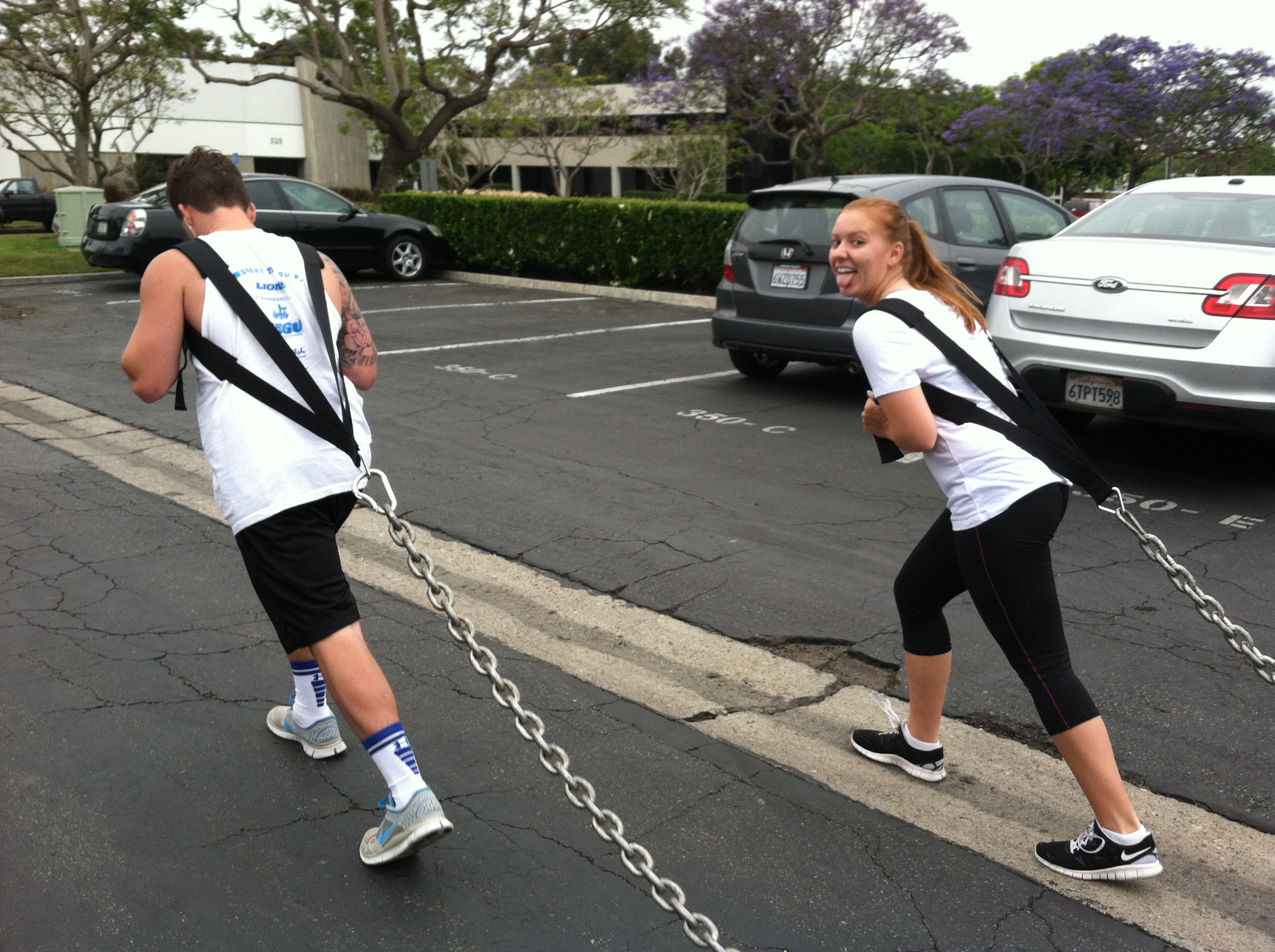
30 minutes and one killer workout…chain drags around the block…And one very happy Carla haha
So yea…That is my answer when it comes to how long your workouts should be.
Got another question? Let me know!
Real Role Models
So as I’ve been preparing for this Women’s Conference this weekend, I’ve been thinking a lot about female role models and the transformative power of exercise/sports.
And then the other week, when Ryan and I were watching TV, I stumbled across a woman who’d undergone a great transformation and was also a GREAT role model – Nicole Eggert.
So I don’t know how many of you have seen the show “SPLASH”…And it is actually really really stupid but for some reason we watched it anyway…And now I’m sort of glad we did because I came across Nicole…
But anyway, it is a diving show in which celebrities who have never dived before compete.
And Nicole Eggert, a lifeguard on Baywatch, was one of the participants.

Nicole in her Wonder Woman suit. YES!
I’ve said this before and I’ll say it again – sports and exercise are incredibly empowering.
Over the course of the show, you saw a huge transformation in Nicole. She became stronger, more confident and empowered as she overcame physical challenges day in and day out.
At the beginning of the show, you could tell that she wasn’t confident in her body or in her abilities. But she had decided to compete and didn’t want to give up with her daughter looking on. She even bounced back after suffering a bad fall when practicing one of her dives publicly before the show.
She could have given up and even done an easier dive when she fell from the board in warm up.
But she didn’t.
She had worked hard and she was willing to risk everything to prove to herself that she COULD do it.
And guess what!?!
She did do it!
And each week, her dives got better and you could see her confidence grow.
Nicole wasn’t a world-class athlete competing for huge rewards. Many people won’t even remember what she did because she didn’t end up evening winning the Splash title.
But she was a REAL woman working hard to overcome challenges she’d never faced before. She was a REAL woman battling the same self-doubt that most of us women struggle with daily.
Nicole did probably the hardest thing that many of us could do – she put herself out there and risked failure…and in this case…very public failure.
She put herself outside her comfort zone and didn’t give up when the going got rough. She competed to the very end.
Nicole was a REAL woman who found REAL STRENGTH through sports.
Nicole is a REAL role model.
So this weekend, decide to become your own real role model. Set some goals and take a risk to achieve something you previously thought impossible.
ESPN 30 for 30 – 26 Years: The Dewey Bozella Story
So occasionally Ryan and I will watch the ESPN series 30 for 30.
They are always interesting and while some are uplifting, many of the stories are about athletes that weren’t able to live up to the hype or that were in some way prevented from living up to their full potential – many are stories of “what if?”.
What if the person hadn’t gotten injured? What if the person had gotten another shot? What if….?
For me stories of “what if?” are always a slight bit depressing and leave me rambling on to Ryan for hours after about all of the “what ifs?”.
But last night I watched one of the most motivational documentaries I’ve seen in a long time – one that really spoke to me.

It was the Dewey Bozella Story. Below is his basic biography. I took it from his website as I didn’t want to leave anything out.
In 1983, Bozella’s life took a dramatic turn when he was convicted of a murder he did not commit. Sentenced to 20 years to life in Sing Sing prison, Bozella maintained his innocence and exhausted every appeal. He was offered more than four separate chances for an early release if he would only admit guilt and show remorse, but Bozella consistently refused to accept freedom under such conditions. Anger at his imprisonment gave way to determination and instead of becoming embittered, he became a model prisoner: earning his GED, bachelors and masters degrees; working as a counselor for other prisoners; and eventually even falling in love and getting married. Through it all, Bozella found strength and purpose through boxing, becoming the light heavyweight champion of Sing Sing Prison.
Unyielding in his innocence, Bozella never gave up fighting in or out of the ring. He wrote to the Innocence Project daily in his quest for a ray of hope. The law firm WilmerHale eventually took on Bozella’s case and uncovered new evidence that exonerated him. After being in prison more than 26 years, he was finally released in October 2009. Today, Bozella devotes his life to helping others, working with a non-profit that helps recently released prisoners rehabilitate back into the world. He has also returned to boxing as a trainer to kids and aspiring fighters, all the while maintaining his dream to fight one professional fight as a free man.
On July 13th, 2011, Dewey Bozella was honored with the Arthur Ashe Courage Award at The 2011 ESPYs. The 2011 ESPYs celebrated the courage and conviction that lead Bozella to the ultimate path of freedom after 26 years of imprisonment. Following the awards, Dewey Bozella realized his dream of becoming a professional boxer, winning his first pro fight on October 15th, 2011 on the undercard for Bernard versus Dawson.
Just reading this story again touches me.
I don’t know what it is…Maybe it is his un-wavering determination or his refusal to give up hope. Maybe its the fact that he worked to always make the best of his situation. Maybe it is the fact that he never comprised his integrity and refused to lie even for his freedom. Maybe it was his courage and conviction. Maybe it was the fact that he found empowerment and strength through sports.
Maybe it was the fact that he never gave up and got, at least a little, to realize “what if?”.
No, he will never know if he could have been one of the best professional boxers had he not been imprisoned during his prime, but at least he knew he could have been great…and there is some peace in that.
At least he never gave up on his dream and did everything he could to get it.
“Never let fear determine who you are,” said Bozella. “Never let where you come from determine where you’re going.”
Some of us never get started because we hate failing, we fear failing, maybe even more than we love winning.
Bozella failed time and time again and never gave up because he knew that winning was worth it.
While we may not be fighting for our freedom or our chance to compete in a professional sport, we are all fighting for some victory no matter how small.
The question is…will we let our fear of failure get in the way or will we realize that always asking “what if?” is far worse?
NOTE: I would like to take a second and also recognize some of the really inspiration things going on in athletics right now. We have some really brave athletes on our hands. Whether or not they will be recognized for their bravery or burned for it has yet to truly be seen, but I will continue to hope for the best!
Metabolic Monday
So today is a “metabolic” workout day – aka…MY TYPE OF CARDIO!
A metabolic workout is a high-intensity workout where you do compound movements back to back with as little rest as possible between them.
That doesn’t mean stringing together the hardest exercises you know of and just doing them back to back to back for an hour only resting when you feel like you either can’t function or are going to puke.
The point of a metabolic workout isn’t just to destroy you – it is to raise your metabolic rate both during and AFTER the workout so that you can burn some serious calories and more importantly some serious FAT.
It is also super good for athletic performance since it can improve your cardiovascular capacity. It can help improve your lactic threshold and VO2 max.
Yup…If you want to be able to run faster for longer or do well in any endurance sports, you may want to incorporate metabolic training into your workout routine!
So how do you design a metabolic workout?
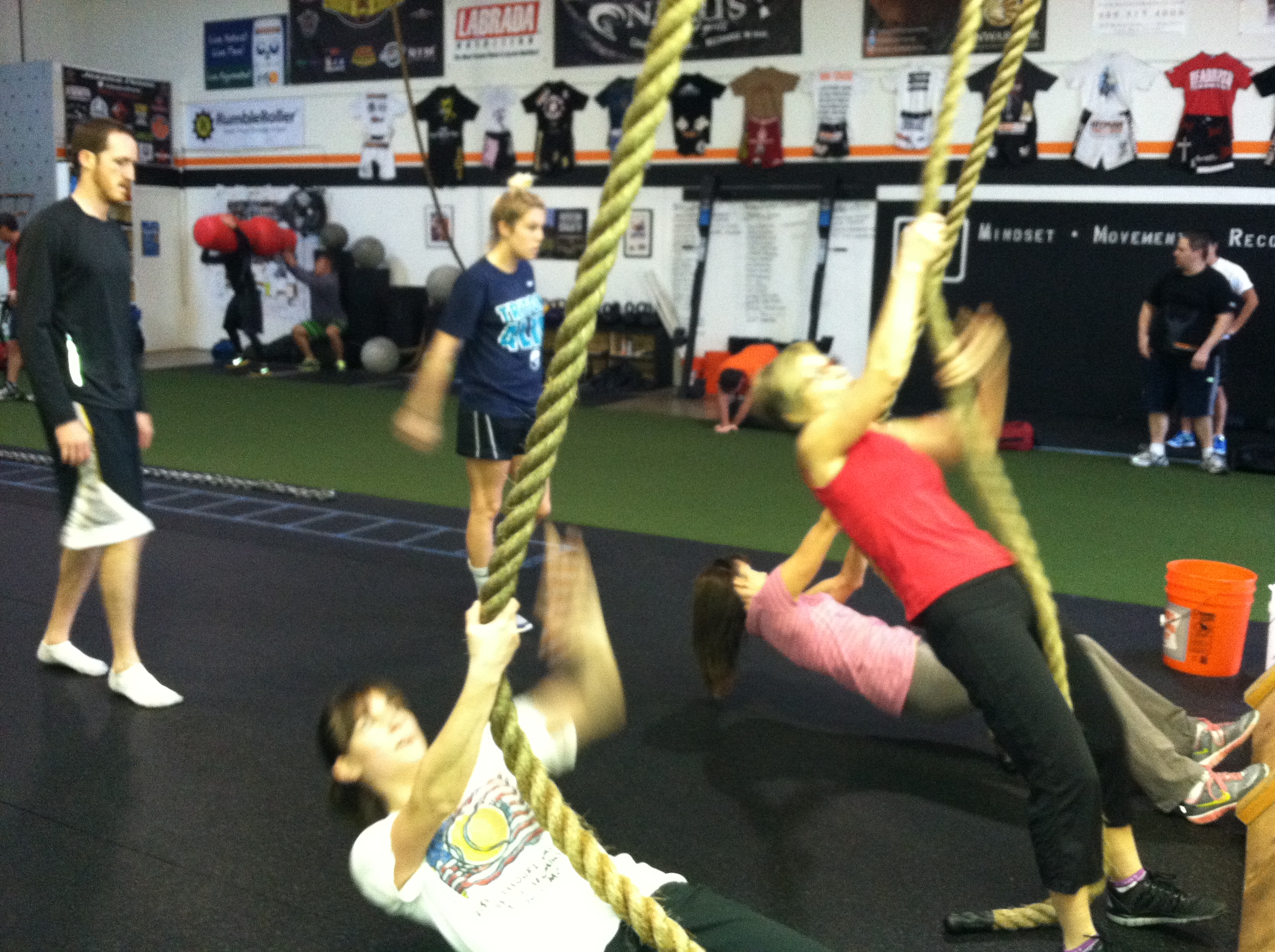
My mom and sister in town for a metabolic workout around the holidays!
Well..there are a ton of different ways. The key points to consider are…
- Include compound moves – aka work the BIG muscles groups…Bicep curls and such are pointless moves to include.
- Use some resistance. You don’t need to use the max weight you can handle, but you do want to incorporate challenging weights to make your muscles work to their max!
- Add in rest – The key here is to teach your body to recover as quickly as possible. HOWEVER, if you don’t include any rest in your workout, you AREN’T going to be working at a max effort the entire time. To really get some of those cardiovascular capacity benefits, you need to be working near a maximal effort as much as possible, which means you NEED to rest and recover! When you start, you may want to rest 3 to 5 times the time you work. As your fitness level improves, cut the rest until you even hit a ratio of 5 times the work to rest.
- Keep the intervals short – When you get into the 2 minutes and above range, you start to work the aerobic energy system. If you really want to focus on improving your lactic threshold, keep your intervals of work between about 30 seconds and a minute thirty. Honestly, I even prefer keeping the work between 30 seconds and a minute.
- Don’t throw in the kitchen sink! – Don’t just combine 30 hard exercises and do them each once. Balance what you are working. If you pair up exercises, or even go through a circuit, make sure that you vary what you are working. Think about movement patterns (push vs. pull) as well as hemispheres (upper vs. lower body). If you vary how and what you work, you will find that you are more able to work to your full potential each round EVEN if you feel a bit fatigued and out of breath.
Below is a sample Metabolic Workout. While we love using sleds and ropes and sandbags, I do realize that not every gym or household contains those things so I tried to stick with bodyweight or more traditional equipment. (If you don’t have any medicine balls you could mimic with a dumbbell or even a cable machine with a double-handed overhead chop down toward the ground. Make sure though to use your lats for the pull over as well as your abs and legs!)
Metabolic Workout
WARM UP (make sure to do dynamic stretches, foam rolling and activation. Very important to be WARM!)
40 seconds of work, 20 seconds of rest between each exercise. Rest for 1-2 minutes after each round of all 5 exercises.
Repeat anywhere from 3-5 times depending on your fitness level.
Front Squats (add dumbbells or kettlebells in a front rack…light but challenging)
Medball Overhead Slams (Bring the medball back overhead and then slam it straight into the ground)
Crawling (Table top position..Forwards and backwards)
Lateral Hops (aka Skater hops…So hop as far as you can to the side off of one foot onto the other)
Russian Twist (Hold a weight plate and rotate side to side as QUICK as possible)
If you are a beginner, you may want to start with less work and more rest…Even say 20 seconds of work, 40 seconds of rest and work your way up to 40 seconds of work and 20 seconds of rest. For lateral hops, you can also sub side shuffles as long as you stay LOW and move quickly!
Yay! Metabolic workouts…what a great way to start the week!
Everyday Super Heroes
So over the past few weeks, I’ve been searching for super hero t-shirts.
I wanted to get ones for Jodie and I to wear during her first 10k race. A Wonder Woman shirt just felt appropriate because Jodie IS a wonder woman!
But honestly, it was near impossible to find super hero t-shirts for women, let alone t-shirts with female super heroes on them!
The only few I could really find that weren’t impossible to get were just a tad bit too ridiculous for me.
So in the end I settled on a couple of men’s t-shirts with The Flash logo on them (which I did feel was appropriate for our race!).
But I was still surprised and disappointed that there wasn’t more female super hero apparel easily available for women (let alone more female super heroes show by mainstream media!). There were Barbie t-shirts and “Girl Power” t-shirts…but no SUPER HEROES.
I know this is a random thing to complain about, but it really bothered me.
Why aren’t our girls encouraged to be super strong. Super Fast. Super POWERFUL!?!
And then I realized WHY I had become obsessed with finding a super hero shirt for Jodie…
Because I wanted to express to her that I thought that all of her hard work, strength and determination made her a “SUPER HERO!”
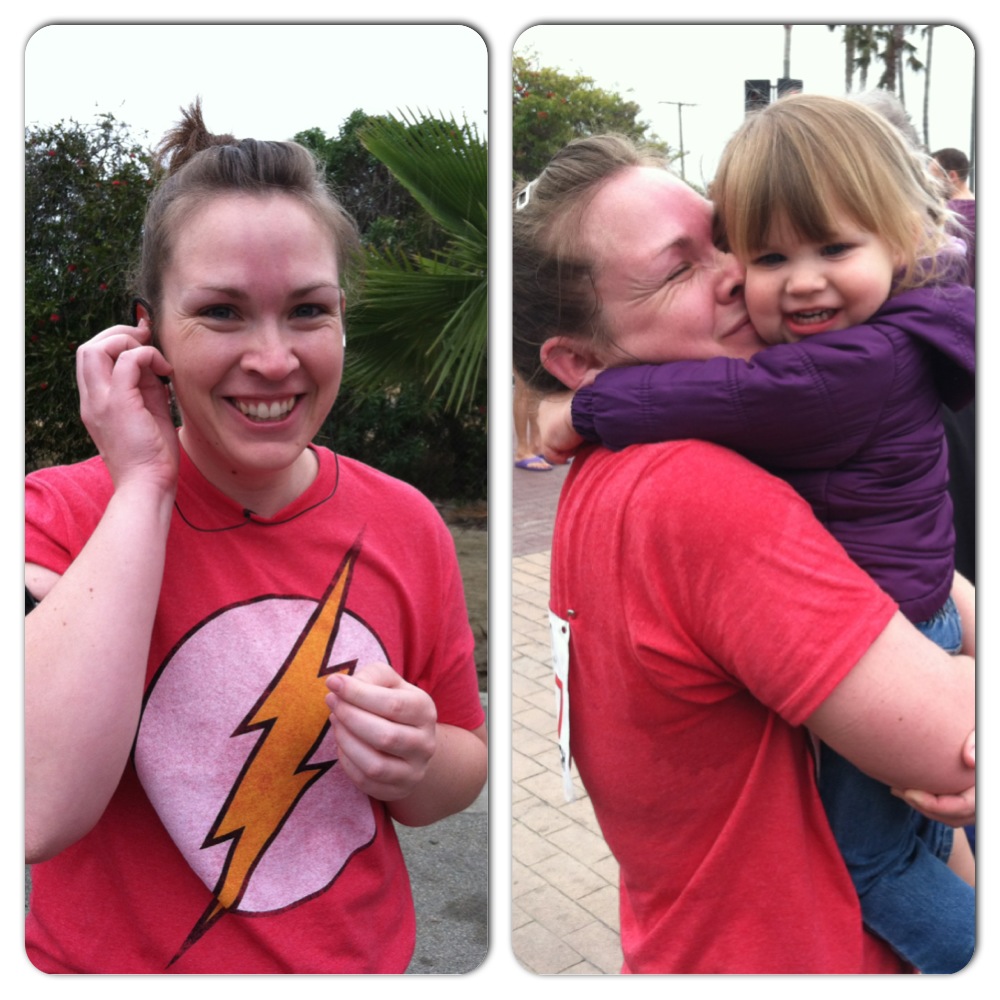
Super Hero Mom Jodie!
For the last month, if even that long, we’d been training for a 10k race.
Before this past month, we hadn’t really done any running. Lots of weight training…a few sprints, but no real running of any length.
She was nervous to commit to a 10k knowing that we had only a few weeks to train. The last time she’d run that far, she’d spent months working up to it and training hard. And here I was telling her that she was going to go from never really running to running 6.2 miles straight.
I told her that she would be fine, but, while she trusted me, there was definitely doubt in her eyes.
But despite her doubt, she threw herself whole-heartedly into the training.
She focused on eating clean and sticking to her eating program even during stressful days. She stepped up her weekly workouts and pushed herself harder and further than she had before.
She made time for a healthy lifestyle even when there wasn’t time to spare between work and taking care of her beautiful two-year-old daughter.
Jodie committed to the 10k and didn’t let anything deter her from success.
And today all of her hard work paid off.
While there were no big awards…No huge paychecks….No huge public praise…Jodie did run her first official 10k race with a personal best average mile time.
But what is more important than the fact that she ran a fast mile time is what she proved to herself.
I think that during all of the training, Jodie began to believe more and more in herself. Her confidence climbed.
And today…she just gained concrete proof of how incredibly strong she truly is.
Today Jodie proved something to herself. Today Jodie became her daughter’s personal super hero (whether or not Jodie or her daughter know it).
While Jodie’s daughter won’t remember this race, she will witness other of her mother’s super hero feats. She will witness her mother’s strength, determination and perseverance throughout her life as she grows up.
And these feats of strength that she’ll witness, will lead her to become a super hero herself.
There may not be many female super heroes out there in the mainstream media or on girls’ and women’s t-shirts, but there are plenty of female super heroes that live among us every day…
They are fighting every day to become stronger, healthier, and more confident individuals. They are pushing themselves to accomplish things that they didn’t previous believe possible.
They face fears and risk disappointment and failure…
These everyday super heroes don’t have any super powers and most don’t even have a super hero suit (unless their friend does happen to buy them a The Flash t-shirt….)
And, unfortunately, everyday super heroes don’t always get “the bad guy.”
But the crazy part is…despite all the risks, fears and failures…despite all the setbacks and disappointments, these everyday super heroes never give up!
And honestly, the fact that these female super heroes accomplish such great feats without any super powers makes them even more awesome!
Jodie…You are an amazing and strong woman! You are an inspiration to all of us and more importantly, you are an inspiration to a future generation of women!
Part 5: Bootilicious – The Kettlebell Swing
So the swing that I would like to discuss is the one that is best for your butt – the Russian swing.
The Russian kettlebell swing is a hip hinge just like a glute bridge or deadlift. The main muscle working in the hip hinge is the glutes with help from the hamstrings (and of course other stabilizer muscles).
And while you see everyone and their mother’s uncle attempting some sort of hinge exercise, most people don’t do it correctly – People either turn the hinge into a reach with their back (aka back rounding) or a squat.
It’s interesting…the hip hinge should be an easy movement for us to do but it is actually the one that most people have trouble with.
So how do you teach this easy but hard movement?
I start most people out with glute bridges. Once they have mastered the two leg, bodyweight glute bridge, I move them to a standing hip hinge near a wall.
The key with the standing hip hinge near the wall is to use the wall as a guide. You want to make sure that they keep their back flat and reach their butt toward the wall.
If they have trouble keeping their back flat, you can have them hold some sort of dowel down their back and make sure that the dowel doesn’t come off their head and butt because their back rounds or really separates from their back because they over arch.

If they seem to have trouble getting their butt closer to the wall (or even to touching it…I sometimes start them close enough so that if they do it correctly their butt will actually touch) and they aren’t rounding their back, then they are most likely squatting.
Use the wall or pole or something behind them to teach them to stick their butt back and hinge at the hip-joint. If they perform the movement correctly their butt should either touch or at least get closer to the object behind them!
After they master the bodyweight standing hip hinge near the wall, I will add a resistance band around their hips to teach them to be explosive with the movement.
With this move you face away from the wall with the resistance band attached to something behind you. You wrap the resistance band around your hips and step as far away as you can.
Then you hinge over and explosively come back to standing, squeezing the butt cheeks and driving the hips forward.
For this move, you will need to assume a more athletic stance (so knees slightly bent through the entire motion) than you would necessarily for the standing hinge by the wall.
The resistance band is an especially great way to teach the kettlebell swing because the band mimics the weight of the bell.
Your hips go backwards and you hinge over because the weight drives you backwards and you want to absorb the load. You then squeeze your glutes and drive your hips forward to propel the weight forward.
Once you have managed this you are ready to start on the actual swing. Start with the two-handed, single bell swing.
Starting with the kettlebell on the ground, you will hike it backwards like a football to start the swing. It doesn’t matter how high you get the kettlebell to go…and actually it really shouldn’t ever get above your shoulders!
You are powering each swing with your hip hinge. As you swing the kettlebell forward, you will have a slight lean back at the top and a slight posterior tilt to your hips because you are squeezing your butt cheeks. You arms aren’t working at all to lift the kettlebell…it is swinging because of the power from your glutes.
You then leave your hips out long enough to catch your forearms with the kettlebell descending. You don’t want to be hinging over while the kettlebell is away from your body. You hinge over only to slow the kettlebell down and absorb the momentum.
The connection between your forearms and hips is very important and is key to making sure this movement is powered by your glutes and not your low back!
Your forearms then maintain a connection with your hips as you hinge over leaning forward with your chest to counteract the weight of the kettlebell between your legs.
The kettlebell should go back smoothly and shouldn’t really swing up and hit you in the bottom. If it does, you are actually using too much power for the weight and can probably even go up in weight.
This video actual shows a great swing.
In this swing, his spine is in line from the tip of his head right to his tailbone. At the top of the swing, he is standing up straight with only a slight lean back and he hinges back over when the kettlebell drives his hips back. There isn’t a gap between his forearms and hips as he goes back into the hinge. Everything is connected and moves TOGETHER. As he hinges over, his butt goes back. He doesn’t squat and his back doesn’t round.
If your swing looks like this and you can feel that forearm/hip connection, you are doing the move correctly and can start upping the weight or playing around with variations.
Another variation of the swing, the single arm swing, can also be a great way to learn the swing movement as it can sometimes force people to maintain that forearm to hip connection. BUT this variation is more challenging on the core and may be more challenging on the grip.
To progress the swing move, try a double bell swing, but when you do this make sure you have a really really good handle on the other two variations first.
While the kettlebell swing can be a more frustrating move to truly master, it really is a great way to develop glute strength and improve your power. It can be a great way to get over a deadlifting plateau if you find yourself struggling!
Shoot some people even argue that heavy kettlebell swings are even better than deadlifts….and, while I love my deadlifts, kettlebell swings are definitely pretty freaking good.
So work on your swings today. If you aren’t confident in your hip hinge (if you round or squat), start with a beginning move like the glute bridge and progress from there. Don’t just jump right into swings and end up hurting your low back!
And….P.S. Speaking of progression yesterday…this article is basically one to do the kettlebell swing!
Where’s the love? – Practice What You Preach
So I was on the phone with my Mom the other day talking about workout videos. She actually mentioned that she wasn’t very fond of the Jillian Michaels DVDS, which sidetracked us onto the topic of Jillian Michaels.
And my Mom informed me that Jillian Michaels went 7 weeks without working out and actually ADMITTED TO THIS FACT on TV.
WHAT?!!
For one…how could someone whose life supposedly revolves around fitness be ok with not working out for 7 weeks!?!
For two…how could you admit that you didn’t have TIME to workout when we trainers work so hard to tell people, that no matter how busy they are, they have time to live a healthy lifestyle?
And three….HOW CAN YOU NOT PRACTICE WHAT YOU PREACH!?!

How can you expect to convince people to fit in working out to their crazy busy schedules if you don’t find the time to workout yourself? (And how can she admit that on TV!?!!?!?!)
It also goes back to one of my posts a few weeks ago about the girls who ate all the Paleo baked goods…The girls who claimed they were doing Paleo when in fact THEY WEREN’T!
I honestly believe that there are a lot of different things out there that work for a lot of different people. So maybe that fake Paleo worked for them (but still call it what it is…and it isn’t Paleo…)
I’ve even seen my own diet and exercise habits change over the years…heck even over the last 6 months…Not huge changes all the time, but definitely slight modifications….(I ate more dairy. I ate super super low carb. I tried out some corn tortillas. And now? Carb cycling with some rice and potatoes. Not much dairy. Not much fruit. Barely any nuts…Mostly meat and veggies. YUM!)
But whatever exact program I’m writing about and preaching, I’M ACTUALLY FOLLOWING IT!
This is a HUGE pet peeve of mine when people talk about diets or exercise programs BUT DON’T ACTUALLY DO THEM.
Be it TV trainers like Jillian Michaels or even friends on a new diet and exercise program, I hate when people CLAIM they stand for something or claim that a diet does work, or for that matter doesn’t work, when they haven’t actually even DONE IT.
And I’m not saying that your current beliefs won’t change over time. They actually SHOULD change. You should constantly be learning and self-experimenting and adjusting to make things better as you learn more.
You should never be standing still. And just because you adjust your beliefs over time that doesn’t mean that you are admitting your were wrong.
It just means you are smart enough to always continue learning and GROWING!
You should take pride in the program that you do. You, in fact, should LOVE IT. And that means working always to make it the best it can be.
So whether you’re a trainer or weekend warrior, if you ever tell someone “get enough sleep,” “eat whole natural foods,” “cut out grains,” “lift heavy weights,” MAKE SURE YOU ARE PRACTICING WHAT YOU PREACH!
Functional Lifts – Awkward Weights
For months now I haven’t really touched a dumbbell or a barbell, BUT I’ve still been lifting heavy.
And while I still LOVE barbell lifts, I have become very fascinated by lifting with awkward weights.
In every day life, we rarely have to lift something that is perfectly balanced and easy to grip. So even though in the gym we may be able to deadlift 500lbs on the barbell, it may be impossible for us to lift even 100lbs in the form of an awkward box on the floor.
And which is more important to be able to do?
While I love deadlifting, I must admit I really really really get frustrated when I can lift or move something on my own.
I don’t like struggling to lift, carry and move things. And I most definitely HATE when I have to ask for help.
So while I’ve always considered a deadlift a functional lift, it might not really be that functional when you add weight in the perfect form of a barbell.
It was actually incredibly humbling to find out just how not functionally strong the barbell deadlift had made was when I did my first strongman atlas stone lift on Saturday (which is probably one of the most functional lifts out there).
The baby stone is 125lbs.
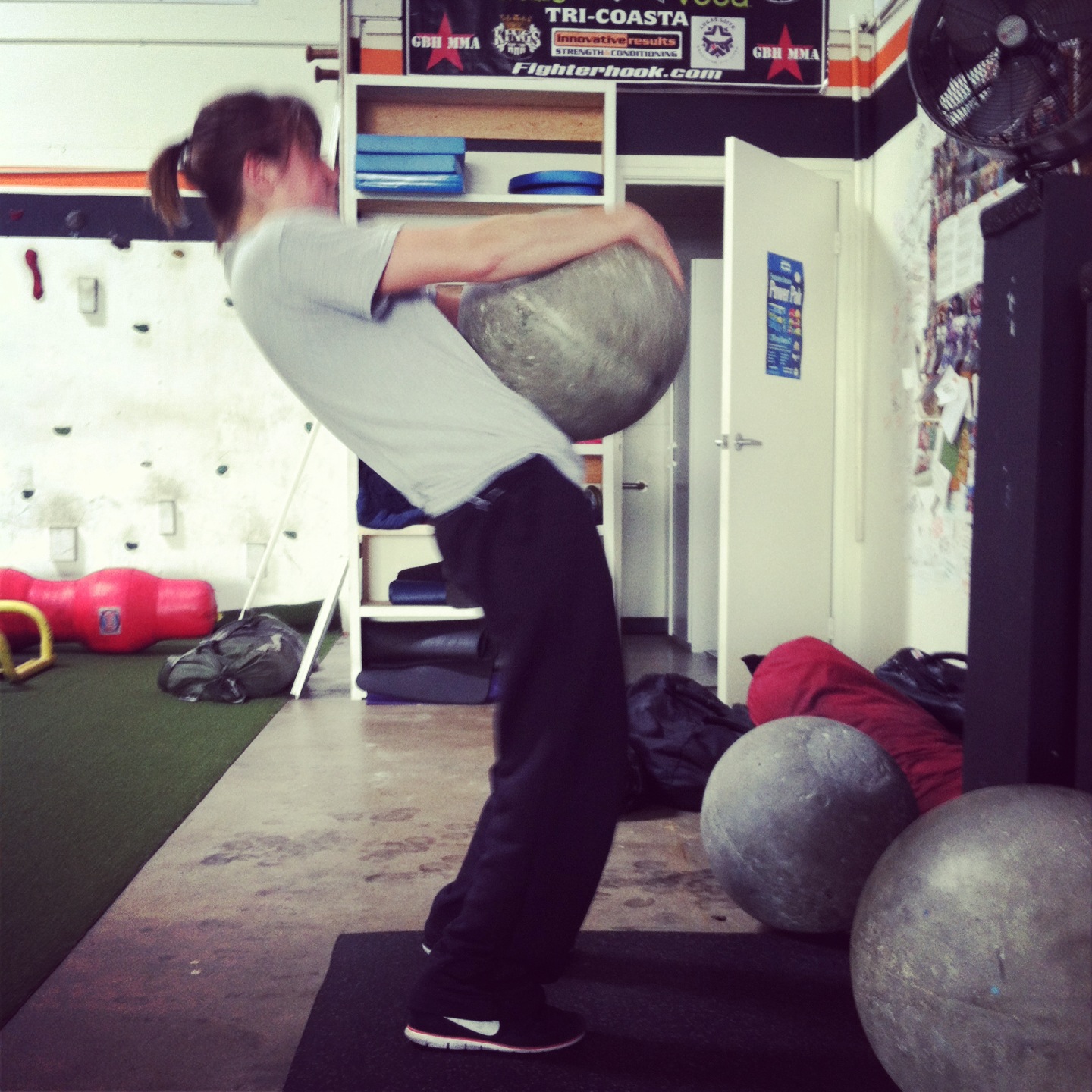
I was told to start with that one. It looked small enough and I figured I wouldn’t have any trouble. I could easily deadlift 125lbs!
Shoot…I even thought I might be able to attempt the next one up!
Uhm…lifting a round concert 125lb ball is WAY different than lifting 100 more pounds on a barbell.
The first time I attempted to lift it, I couldn’t even move it off the ground.
I couldn’t budge 125lbs!?! WHAT!?!
It was awkward and hard to grip. There was nothing to hold on to! You just had to squeeze the ball with every inch of your hand and arm. You even needed to use your back to grip the dang thing otherwise you were going to drop it.
And on top of that, it wasn’t just one smooth lift up like the barbell lift. It was a lift to your thighs before you needed to re-grip so that you could really use your glutes to power the ball up.
It was honestly exactly the move you realistically have to do when you move super heavy awkward things in everyday life.
I can name a few times when I’ve moved that I can remember attempting that exact same move to lift a heavy box (and actually failed to get it off the ground even though I was lifting super heavy with dumbbells and barbells)….SO FRUSTRATING!
There is nothing more frustrating than not being able to move something!
So it really got me to thinking about all of the time I spent doing the traditional lifts – doing traditional exercise moves.
While I love them, they may just be more functionally beneficial when done with AWKWARD weights.
You don’t need to give up deadlifts, push ups or any of the other meat head moves (that I most definitely love).
But maybe you can just make them better by adding in some awkward elements.
Like pull ups for example…
I can do pull ups off a bar…but pull ups holding on to some awkward rock climbing grip things? OUCHIE!
Or overhead presses…Instead of using a barbell, what about a slosh pipe? WAY more core engagement when you lift that pipe only half filled with water overhead (actually it kind of reminds me of a squirming child, which there is a great chance that sometime in your lifetime you will be lifting up overhead!).
You don’t have to go crazy making the moves overly awkward. Actually you SHOULDN’T try to add in too many strange elements. Awkward is good..Super awkward is crazy.
But anyway, after being humbled by the stone, I would DEFINITELY recommend that if you are training to be strong in life that you add in some more functional variables like awkward weights or grips! You don’t necessarily need to find a gym with an atlas stone, but sandbags and other uneven or awkward weights can be good! (And if you don’t already…get ready to add in some grip training…but that is a post for another day!)
Building a House – Progression
When planning out your workouts, when planning out how to reach your goal, what factors do you consider?
Do you build on what you’ve done the days and weeks before?
Or do you randomly draw exercises out of a hat based on what is sore…or what you want to work that day…or maybe even what just seems like it would be killer?
Most people take no time to create a progression. They just string together exercises and workouts that are tough or have certain moves with no thought as to how they are going to measure their success or how the workouts will actually build toward their goal.
And then they wonder why 3 months later they still haven’t gotten results.
HELLO!
If you truly want to reach a goal, you’ve got to PLAN out a way to get there. I call this plan a “progression.”
It is a progression because over a set amount of time, it will work to step-by-step get you closer to your goal.
It is like building a house.
You don’t randomly throw bricks together and hope it comes out right. You have a plan.
And then you don’t start for with the roof or even the second floor.
You build from the ground up!
Your workout progression should work the same way.
You first build a base, you lay the foundation.
Work on form. Focus on correcting imbalances by lengthening and loosening some muscles and activating others. Learn the basics.
Then once you’ve learned the basics, you start to advance moves or add weight.
Make yourself EARN harder moves…EARN heavier weights.
Build up your strength slowly so that you allow your body to adapt so that you don’t get injured and have set backs.
And while you are planning out what moves and what weights will get you to your goals, consider repetition and set schemes. Think about rest intervals.
Consider how many days you are going to lift and how long the workouts will be. Also how often are you going to include cardio? What type of cardio?
WOW! Lots to consider right?
YEP! But if you put some thought into each of the pieces ahead of time, you are going to be much more likely to hit your goal AND when you hit your goal, you will actually KNOW what it takes to get you back there if you ever need to retrace your steps.
Even if you don’t hit your goal, you can then tweak things, taking out things that didn’t work and adding in new things that may work.
Otherwise you will just end up floundering around time and time again with no way of knowing what works and probably never actually hitting your goal.
I know it seems random, but it really does seem like building a house….not that I know that much about building a house.
You have to create the blueprints so you know where everything is going to go. You’ve got to get the right tools. You’ve got to know where to start. You’ve got to lay out the plans to get it finished. You’ve got to understand your timeline.
You’ve got to lay a foundation and then build upon it sometimes using fancy things and sometimes using the basics.
The point though of all of this is that you’ve got to have a plan and you’ve got to start from the bottom up.
Ok so after all this rambling, I’ll try to break it down a bit more. Say you want to lose weight and get toned (hey it’s about to be bikini season and this seems to be about every other woman’s goal that comes into the gym).
A basic outline of a progression may be strength training 3 times a week with cardio 2.
With the strength training being three times a week, I would recommend some sort of full body-ish workout each of the three days. I would break down each day into maybe something like this…
Monday Press and Squat, Wednesday Pull and Hinge and Friday Rotational.
I would then select appropriate exercises based on the outlined movement patterns above. I would give them basic exercises to start. They would then have to EARN the harder more fun moves. Master the basic squat motion and then we will talk about fun squat variations. You don’t just get to do the fun variations…You’ve got to earn them.
Just like you EARN heavier weights.
I would start the person out with either light weights or even body weight movements for about 15-20 reps (of course depending on their level of fitness). Over the weeks I would progress them to heavier weights and lower reps. I would probably never really get below 8 reps. If I did go below 8 reps it would only be for a week.
Also, the weights would change slowly, allowing the body to adapt slowly.
Yes..Usually drastic changes lead to drastic results. But they also lead to lots of injuries that could have been prevented by just being a tad bit more patient!
While I’m a fan of the maximal strength rep range, it isn’t necessary for a goal like the one listed above unless the person does really fall in love with lifting. It may also be something to bring up in a later progression.
AND even though I’m not a fan of higher rep ranges (they are good…just mentally I hate counting to 20 haha), it is important to cycle back through that 15-20 rep range to give your body a break from the lower ranges.
Plus your body adapts to whatever it is doing so mixing it up can help you break through any plateau you may have hit!
Each progression would last about 4 weeks before I would give an active recovery-ish week and change up the workouts.
If you don’t change things up, you may hit a plateau, BUT this doesn’t mean changing things up every day or even every week.
Some consistency is key. It helps you track progress and it helps your body build up moves before you change things up again and make it adapt to new moves and weights.
And you don’t only need to build slowly with weight training. Cardio is the same way. You need to build an aerobic base first. Start with some long slow cardio. Build your base. Then as you up your aerobic endurance, add in some sprints. Start your sprints with a 1 to 3 or 5 work to rest ratio. Then decrease your rest as you get more fit. You can also play with making the sprint longer, BUT consider what you are trying to achieve.
What energy zone are you trying to work?
Consider the variables! What are you trying to accomplish and will the workouts you are doing TRULY get you there?
Anyway, so next time you lay out your goal, plan out how you are going to get there.
Things don’t just magically happen. If you want something done, lay out a plan to do it! Don’t just flounder around using random tools!


 Man Bicep