Category Archives: Workout
My way or the highway?!?
So I definitely have solid views on nutrition, but I actually don’t vocalize them as much as you would think considering I rant and rave all the time about them here.
If someone asks me my opinion, I will tell them what I personally think.
Like yesterday, the volleyball girls asked me about post-exercise nutrition.
My answer? Eat a lean protein source and a simple carb. Those will be quickly absorbed by your body and used as fuel.
When asked what counted as a lean protein source or simple carb, I answered…
Turkey, chicken, whey protein, rice, potatoes, fruit.
Notice I didn’t say no gluten. Notice I didn’t say no protein bars. (Heck notice I didn’t even say, “Well honestly, I don’t even worry about pre and post workout nutrition…That is something that really only a top few elite competitors/athletes/bodybuilders need to worry about…That the most important thing truly is to eat a whole, natural food diet throughout the day and make sure you are eating when you are hungry!)
I simply listed things I believed are good – things that I would eat.
When asked specifically about bread or gluten or processed foods, I usually say, “Well I don’t believe in eating those things, but there are other people who do x, y and z and it works for them.”
I will almost always present the other side. (Except of course for here where I get to rant about the other side! YESSSS!)
Because it isn’t up to me what you choose. I can provide you with information about my reasons for my decisions, but I can’t tell you what is right.
Because it is a gamble. There are literally thousands of studies and people on both sides of the fat/gluten/carb/vegetarian fence.
Which side you decide to pick is ultimately up to you.
I’ve picked a side and am constantly doing research to make sure that I know WHY I make the decisions that I do.
Anyway, the reason I thought about all of this is because I’m writing up a “10 Healthy Lifestyle Tips” for this Heart Healthy Expo Jeff and I are going to tomorrow.
I was reading through a lot of the different heart-healthy tip things online and I couldn’t bring myself to provide people with recipes or tips that included canola oil and other such crap as healthy.
So below are the 10 Heart Healthy Lifestyle Tips I came up with. I managed to make the tips stay pretty darn mainstream WITHOUT going against my beliefs. I didn’t say not to eat whole grains…I just most definitely didn’t say to do it!!!
- Eat whole, natural foods and cut back on processed, pre-packaged food items. Processed foods are loaded with sugars and bad fats that cause inflammation.
- Use healthy fats such as olive oils, coconut oils and naturally-raised animal fats INSTEAD OF canola and soybean oils, which cause inflammation because they are loaded with omega-6s.
- Cut back on sugar and consume more complex carbohydrates especially fruits and vegetables, which are rich in vitamins and minerals that protect our health.
- Cook more meals. No matter how healthy the restaurant meal supposedly is, it never measures up to a home-cooked meal. Even with our busy schedules and long workdays, we can fit in time to cook. It just takes some planning. Find meals, like casseroles and crockpot recipes, which allow you to make huge portions all at once so that you have leftovers for all those busy days when you don’t have time to cook!
- Plan in some “me time.” Too much stress can negatively impact our health. It is important to take some time each day. This can mean going for a walk with friends, reading a book or anything that allows you to relax for even just 5 minutes at the end of your day.
- Get more sleep! Those who average five or fewer hours of sleep per night have a far higher incidence of “silent” heart disease. In a study done, 27% of those who slept five hours or less per night developed calcifications that can signal heart disease after five years, compared to just 6% of those who slept an average of seven hours or more.
- Do 30 minutes of low intensity aerobic activity (walking, hiking, swimming, chasing after your kids on the playground) 2-3 times per week. Low intensity aerobic activity helps to strengthen our heart and burn fat.
- “Sprint” once a week. To sprint means to do short, intense activity once a week where you get your heart rate up and then let it recover before you go again. The intensity of your sprint will be dependent on your fitness level. A sprint should be between 8-20 seconds of intense work followed by a long period of rest (2 to 5 times the amount work).
- Lift weights! Too often we ignore weight training when it comes to heart health, but strength training is important! Resistance training has been shown to decrease heart rate and blood pressure while improving cholesterol levels and glucose metabolism. All of which result in a healthier heart! Add in weight training 2-3 times per week.
- Skip the two a days! More time in the gym doesn’t always equal better health. Overtraining can actually have negative effects on your health. Your workouts don’t need to be more than an hour especially if they are super intense. So don’t worry about how long you workout for – focus on your intensity!
NOTE: I am not ashamed of my beliefs, but I do believe that sometimes if you are too vocal upon first conversation with someone who you can actually get them to shut down and complete tune out all of the good stuff you are saying. Sometimes if you ease people into the unknown they are more accepting of the things you have to say!
The missing pieces
So often we talk about losing weight/being healthy/getting stronger/being in shape in terms of the diet and exercise program that we need to follow to achieve our health and fitness goals.
Depending on your specific goal, you may even be told that diet is 80% of the battle.
But is it really that simple?
Are diet and exercise really the main players in the healthy equation?
Yes…and…No.
Yes, if you follow a well-developed diet and exercise program, you most likely will hit a lot of your health and fitness goals.
BUT, these goals may be more easily realized AND easier to maintain IF you get some of the other pieces of the puzzle in order.
The amount of stress you have and the amount of sleep you get both affect your hormone levels, appetite and level of fatigue.
Too little sleep and too much stress can cause your body to not only try to hold on to fat, but also to feel hungry and overeat.
Holding on to fat!?! Overeating and feeling hungry when you really aren’t!?!
HMMMM…Maybe sleep and stress need to be a part of our program…..
And not only can too little sleep and too much stress cause you to hold onto fat and overeat, but both can also make you feel fatigued which can lead to crappy and/or skipped workouts!
Sound familiar? Skipped a few workouts recently or have you seen your numbers slowly declining even though you KNOW you aren’t overtraining?
Maybe you aren’t getting enough sleep OR maybe your body is just too stressed!
And if all of this wasn’t bad enough…let’s face it….they both also really affect your self-control.
Tired? Stressed? Where do most people turn for comfort?
FOOD!
And usually BAD food.

That doesn’t sound very good for your health and fitness goals…
So maybe diet and exercise aren’t enough on their own. Maybe you do need to consider your sleep and stress levels.
I’m not saying to change jobs to lessen your stress level. BUT it doesn’t mean that you shouldn’t start to plan in some “me time” to help you unwind every once in a while so that you don’t turn to food.
I’m not saying to start sleeping in and going in late to work, but every once in a while maybe try to take a nap or sleep in instead of forcing in that extra hour of work that realistically you COULD do at some other time. If you really do create a time management schedule, you may just find you DO have more time that you could use for sleep than you originally thought!
Anyway, sleep and stress ARE two other things you should consider when trying to create a healthy lifestyle. Diet and exercise AREN’T the only pieces to the puzzle.
Sports Specific Training
So for the last few weeks I’ve been training the Vanguard Women’s Volleyball Team.
Before I developed a program for them, I did my research. I looked up common injuries. I studied how volleyball players move. I attended their games to watch their SPECIFIC movement patterns. And I looked at many traditional volleyball training programs.
What I found was a lot of jump training. Olympic lifts. Box jumps. Sprinting. All the usual suspects were being used.
And don’t get me wrong…I love Olympic lifts. I love box jumps. I even love sprinting (actually it is really the only form of cardio I do enjoy).
But the more research I did, the more things just didn’t add up.
If many volleyball players suffer from shoulder injuries, why do snatches and jerks which would only serve to put more strain on their shoulders? And on top of the fact that many suffer from shoulder injuries, being college students, most of them are hunched over computers and books for a good portion of the day. This constant daily forward flexion and rounding of their shoulders increases their risk for injury when moving heavy loads overhead because they don’t have the range of motion to really get their shoulders up overhead without compensating.
And then on top of that even, Olympic lifts are really freaking complicated to get right. First off, they take a great amount of flexibility to really do correctly. Second, they take great stability. Third, they are complex motions with lots of moving parts which can easily be messed up! And fourth, to get people to move the loads that will actually benefit them takes a long time to build up to…Time that frankly I just didn’t want to waste at this point.
Ok so Olympic lifts were out…at least to start with. So…what about box jumps?
Eh…I would use them but they wouldn’t be the basis of my program. Box jumps could be great, but aren’t the BEST explosive power move. I would use them to work on landing mechanics but they wouldn’t be part of the daily routine.
Plus I wanted something that would get them stronger without being too redundant. They do a lot of jumping already.
Anyway, as I started analyzing programs, I started to realize that we needed to work on upper body strength and upper body flexibility more than I saw in many other programs. Elbow and wrist injuries were also common yet none of the programs really included any grip and forearm/hand strengthening.
Also, while watching the girls play, I was amazed at how much diving, rolling and mulitplanar movements there were. Rarely were they lunging forward or backward. Rarely were the squatting straight down. So…I figured we really need to work on stability in ALL planes of motion.
I had my work cut out for me. I wanted to build up their strength, but I had to do it slowly since their tendons needed time to catch up to their muscles AND they were also doing outside conditioning and practicing with their coach. I needed to work on the basics.
So I included the traditional squat and a traditional hip hinge, which I knew they would have already mastered or be able to master quickly so we could increase load. These would help them gain strength so that they could be explosive and powerful on the court. Strength always precedes power!
I then included speed, agility and quickness drills to improve their coordination and reaction time. If they wanted to react quickly on the court, they needed to work on their mind-body connection!
AND finally I addressed their areas of injury and their need to move in all planes of motion. I didn’t load them down with weight for these exercises. Actually all of them were simply body weight variations. I did lunges in different planes of motion. I used the sliders when necessary to make things more difficult. I did handstand holds and other isometric holds to work on scapular retraction to help their shoulder stability and strength. I did a ton of pulling motions, such as rows and pull up holds to work on their upper back and help improve their posture to improve their range of motion.
I even made sure to include plenty of grip work, which was definitely harder than most of them expected!
Of course there was also a lot of core work to help them stabilize when diving and rolling and a conditioning piece at the end to help them outlast and out-perform their opponents (none of which by the way was sprinting but will most definitely help them…and even improve their sprinting!).
So to sum up this long rambling post, the point is that you can’t just look up a workout program and figure it will work. I understand why so many athletic trainers use Olympic lifts because they are great and do really have many power and strength benefits for sports. But you can’t just look and train for one aspect of the sport. You need to consider injuries. Movement patterns. What athletes are doing when they aren’t playing or training. And even all of the new and INNOVATIVE training methods that are now out there. You want to help a player move better on the court, but that doesn’t mean that you should do the exact movements they do on the playing field! That also doesn’t mean you can’t use those movements.
The point is there is a lot to consider.
And that doesn’t just go for college volleyball players. It holds true for everyone!
When you design a program for yourself, you have to consider many of these same variables. What are you looking to improve? What repetitive movements or odd positions do you find yourself in during the day that may create bad postural alignment and compensations that lead to injuries? How do you want to be able to move during the day? Are you looking to get better at running or chasing after a kid because chasing after a kid is a lot more than simply having energy and running straight ahead. It means quick cuts and potentially lots of random twisting and turning!
Anyway, just think about some of these things the next time you write up a workout. Consider your specific “sport’s” variables!
P.S. Probably even the most important part of all of this is the mental aspect I’ve included in their training. Right from the warm up everyone is together and motivated, which is huge if you really want a team to be strong and work well together!
Coordination – The drills most people skip
Ever feel like there is a huge disconnect between your limbs and your brain when you are doing an activity?
Then you probably need to start doing more speed, agility and quickness drills like the ladder – which are honestly drills for the mind as much as they are for the body.
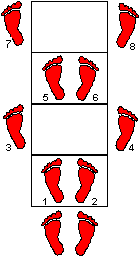
Coordination is all about how fast your mind and body can communicate.
Balance drills and most speed, agility and quickness drills work on neuromuscular control, which means they work on your mind’s ability to communicate quickly and efficiently with the body to produce a specific movement.
Besides being a great workout, these drills will help you master form in other workout moves and help you realize your true strength. These more efficient movement patterns will lead to fewer injuries AND you will probably see strength increases in your lifts because you are recruiting the right muscles in the right order quickly!
Ok so what drills should you add to your workout to improve your mind-body connection?
Balance drills are a great place to start.
Have you ever tried balancing on one foot? Maybe one foot up on your toe (it’s actually very difficult and you may want to start on both toes)? Maybe one foot on a foam pad?
Balance work will help you start improving that mind-body connection and it will strengthen your feet and ankles.
You can then move onto some plyometric training.
Most people define plyometric training as jump training, but that isn’t correct. Plyometric training is training that improves your ability to move quickly between an eccentric and concentric contraction – it improves your body’s ability to decelerate and then accelerate then decelerate quickly without much pause.
Jumping can be a great way to train this. Think about the squat jump. Start by loading or squatting down a bit. Then jump up and squat back down to jump up again. A beginner should pause after each jump before jumping again. Someone more advanced will try not to pause between jumps because their body can quickly decelerate and accelerate. The goal of this training is to go as fast as possible while maintaining control.
A HUGE part though of jump training is the landing. You should land softly….like a ninja. This requires that you bend your knees and don’t land flat-footed. It may mean squatting down enough that you swing your arms as if you are grabbing gravel off the ground. The landing is key…it is when most people get hurt. So if you are new to jump training, you may want to even start by jump UP to a very very low box. As you master this, go a bit higher or even work on the jumping OFF of the box part.
Using the ladder or cones can be another great way to improve your neuromuscular control. Shuffle quickly around cones. You can do this in a straight line or in a circle. You can sprint then shuffle then back pedal then sprint. You can mix it up. The key is quick movements and quick changes in direction.
The ladder is one of my favorite tools because it is super easy to see improvement in. You can do running forward with one foot in each box or make it harder by doing both feet in each box. You can do ins and outs or the Ali shuffle. Or one of my favorites the “icky shuffle.” The goal is to do any of these movements perfectly as quickly as possible. Start as slow as you need just do it PERFECTLY. Add speed as you learn the move and perfect it. Remember it isn’t about just going quickly. It is about doing it PERFECTLY.
Anyway, here is a little SAQ portion to do before you do your strength training.
3-5 rounds: Rest between each round. Move quickly through all three exercises.
5 Squat Jumps (or up to a box or barely off the ground depending on level)
Icky Shuffle down ladder
4 Soccer Throws each side (So overhead throw against a wall stepping forward with the same foot for 4 before switching)
All these should be done as QUICKLY as possible with good form. Try to increase your speed each time you do everything with great form.
Remember this doesn’t have to kill you. It can actually just be the end of your workout after you’ve rolled out and gotten the muscles a bit warm.
Try it. Watch how much your coordination will improve after a few weeks of just a few drills before your workout!
Barf
The easiest thing ever is to kill someone with a workout and make them have to barf.
Yep it’s easy.
Make them do hard exercises as fast as they can. BINGO!
AHHHHHH!
But seriously what does that accomplish!?! So you FEEL like you got a great workout…But what does it really improve!?!
Is it really making you lose weight? Or are you just getting worn out?
Is it really making you perform better? Or do you just feel rundown?
I mean stringing a buttload of tough exercises together and making someone do them super quick may be difficult but the workout is totally bogus and TOTALLY LACKS DIRECTION!
But trainers continue to do it and clients continue to want it. I’ve even had friends who will go do cardio after a weight training workout just because they felt like they hadn’t sweated enough and weren’t totally exhausted.
While I understand WHY people like killer workouts that doesn’t mean they are always right.
Or good for you.
Honestly, I prefer to work below the barf line. Heck I even like not necessarily being sore the next day.
Honestly. I just want a well thought out workout which doesn’t necessarily mean a killer workout each and every time!
A killer workout each and every time leads to overtraining, which leads to injury which means forced time off.
I don’t have time for that!
I don’t feel like being sidelined with an injury!
So I plan and progress my workouts. I do stabilization days, which include lots of isometric holds. I do strength days, which can mean slow, heavy lifts that don’t even make me break a sweat.
And yes…occasionally this progression does mean workouts that absolutely destroy me.
BUT THEY ARE WELL THOUGHT OUT…Not just freaking hard exercises done as quickly as possible without rest.
Actually most of the “killer workouts” I do aren’t at all like most people do to create killer workouts.
But I was very very very close to barfing. Only of course because I worked as hard as I could.
So what are the killer workouts that I accept?
300 ft in one minute on the VersaClimber.
Or like today…
VersaClimber 30 seconds on 1 min 30 seconds off for 5 rounds
REST
Tsunamis 25 on about 2 minutes off for 5 rounds
REST
5 rounds with over 2 minutes rest in between each round:
Sled pushes 100 ft
20 Sidewinders
5 Squat Thrusts
Doesn’t seem like much right? It isn’t the hardest exercises EVER with no rest. But guess what!?! It made me feel more destroyed than almost any other workout I’ve done.
And I didn’t have to do it super quickly to feel destroyed.
It was a well thought out program with movements to help me progress toward competing well at the Kettlebell Competition.
And I probably won’t be doing another workout like it for a little while.
Because…For one, I don’t need to. There is no point. It wouldn’t get me closer to my goals. And two, it would only make me risk injury!
And when I say that workouts like this put you at risk for injury, I mean that workouts like this put a ton of strain on the body and usually only serve to perpetuate bad movement patterns.
If you want the most out of your workouts, even the killer ones, you need to do some non-killer workouts to improve your movements so you actually get the most out of everything that you do.
Stop wasting your time on killer workouts and really start working toward your goal.
So mix things up and try this stabilization workout!
Workout:
5 rounds of 1 minute holds on each exercise. Try not to rest between exercises, but take a short rest between rounds.
Toes (literally just balance up on your toes as high as you can. Don’t rock to the outside toes either, really use the big toe!)
Squat hold (squat at lowest to 90 degrees or to right above where compensation occurs. Keep the chest up!)
Bat Wings (AKA scapular hold. Pinch your shoulder blades back and lean against a wall only your elbows touching.)
Push up Hold (So set up at the top of a push up and try to hold from your hands and toes. Keep everything in one straight line without sagging!)
Glute Bridge Hold (Lay on your back and push up, driving through your heels and upper back. Once a minute becomes easy, do a single leg bridge)
Pull up hold (Do a chin up and hold at the top with legs straight for as long as possible. If you need to, straighten your arms and hang at the bottom until the minute is up)
Not a long workout. A great stability/recovery day so you can get everything working properly! TRY IT!
P.S. Going back to my whole New Year’s Resolution theme of the last couple of days….Not doing killer workouts, especially at the beginning is super important. For one, your body isn’t ready to handle workouts like that and you risk injury. And two, you risk making yourself so sore that you can’t workout for days, which won’t help you get into the habit of working out consistently, which in turn will only make it harder for you to get on track to reach your goal!
Another New Year’s Resolution?

I’ve started to hate New Year’s Resolutions time.
It usually means a ton of people come into the gym and sign up BUT NEVER SHOW UP AGAIN. While of course that helps our business, it annoys the crap out of me!
I HATE WHEN PEOPLE SET GOALS AND HAVE NO INTENTION OF ACTUALLY ACCOMPLISHING THEM.
I mean why even set a New Year’s resolution if you don’t honestly have any intention of actually doing it!?!
So this year…DON’T BE ONE OF THOSE PEOPLE!
Set out that resolution and make it specific. Make it measurable. Make it something truly attainable and realistic. And make it time-based. (Ever heard of SMART goals!?!).
The resolution “I’m going to get in shape this year” doesn’t cut it!
What does in shape MEAN? Does it mean losing 5, 10 or 20 pounds? Does it mean running faster? Lifting more?
DEFINE vague goals and make them specific!
And part of that definition should include a way to measure them. If you want to run faster, what time are you shooting for? How much faster? Or how much more do you want to lift?
Make your goal something that you can easily track so you can gain momentum with your progress or make changes if you aren’t moving forward.
Then think about how long you are willing to work toward this goal. Will you dedicate 3 months? Six months? A whole year?
You need to figure out how big your goal is and how long you have to attain it. Then you have to decide…”Is that a realistic goal for the time that I have?”
If you want to lose 20 pounds and are only willing to dedicate one month, don’t even bother wasting your time setting that resolution. THAT ISN’T REALISTIC!
On the other hand, if you are willing to dedicate for or five months to your 20 pound weight loss goal, you are WAY more likely to achieve it because your expectations are REALISTIC!
Ok…so if you’ve followed the guidelines above, you should now have a SMART resolution that is specific, measurable, attainable, realistic and time-based.
So now what?
COME UP WITH A PLAN!
While it is great to outline exactly what you are going to do everyday until the day you complete your goal, that isn’t realistic.
Life happens and tends to get in the way.
But that doesn’t mean you can’t be prepared for all the random crap that will happen.
So how do you prepare for the unexpected?
Think about all of the habits you have now. What habits are keeping you from reaching your goal? What habits are helping you reach your goal?
Make some lists. Make a TO DO list and a STOP DOING list. Pay attention to not only the negatives but also the positives! Maybe you love to cook…That is a positive! Maybe you work long hours…that may be a negative since you might think you don’t have time to workout.
Then make a list of things that tend to sidetrack you. What has made you fall off the wagon in the past? Are you an emotional eater? Do you get stressed and eat? Do you skip workouts if you’ve had a long day? Do you not plan out your workouts ahead of time so feel like you waste a lot of time at the gym? Do you get bored easily but not change things up?
Do you do too much too fast?!?!
Once you have these lists, hang them someplace where you can see them everyday. Every day try to do the good things and avoid all of the pitfalls.
But also know that one “mistake” doesn’t mean you should just give up. Don’t let one slip up derail your whole program!
Remember that life will get in the way. You don’t need to be perfect because perfection is unattainable.
Shoot for progress – try to make each and every day better than the last.
Try to create new healthy habits and just remember that you may have bumps along the way, but that those bumps don’t matter as long as you get right back on track the next day.
Stop setting resolutions that you never keep. Don’t be one of those people who sign up for the gym and never come!
Don’t waste your time. Set a goal and reach it this year!!!
Breathing Squats
With my return to a powerlifting program for the next couple of weeks before moving back to kettlebell work, I’ve started doing breathing squats.
So far they’ve been light as I get back into really handling heavy weight, but I can just tell they are going to be murder soon. Talk about a great way to add strength and power to your legs!
So what are breathing squats?
After warming up, you set a box that allows you to go to parallel or just a bit below parallel.
You then pick a weight that you know you can do for about 10 reps consecutively. BUT instead of doing 10 reps, you are going to do 20 reps with that weight before you put it down.
And trust me, even using a slightly light weight, these have gotten me out of breath and my legs fatigued.
So next time you are looking for a killer leg workout, I want you to do one thing – breathing squats.
Heavy weight. 20 reps. DONE!
P.S. If you haven’t yet, enter the Under Armour Giveaway!
Back to Basics
We’ve been discussing core values at our gym, Innovative Results, in Costa Mesa and one of the core values that has really stood out for me these last few weeks is “Back to Basics.”
There are so many FADS out there, telling you they have the “quick and easy” solution.
Of course when I see “quick and easy” associated with a diet and/or exercise program, I laugh and ignore it (unless of course I want something to rant about…).
Because there really is no quick and easy solution. Hard work is involved!
BUT if you stick to the basics, I will guarantee you will actually get the results you seek.
But what does sticking to the basics really mean?
Does it mean only traditional moves like the deadlift, squat and bench press? Or does it mean battling ropes, foam rolling and corrective exercise? Does it mean only doing 3 simple exercises for the rest of your life or is variety key?
Or is everything I listed above correct?
For me sticking to the basics means these four key things:
- Compound exercises that use muscles in an integrated fashion and work the major muscle groups.
- Moves that are functional aka training that helps us move better in day-to-day life.
- Preventing injuries by correcting imbalances and developing STRENGTH.
- Creating a PROGRESSION with well-considered variables.
So for me sticking to the basics doesn’t mean SIMPLE, it means well thought out and EFFICIENT.
It means not doing the freaking leg extension machine at the gym unless you have a really really really good reason to do it (aka don’t do single muscle group movements).
It means picking out a few KEY COMPOUND EXERCISES for the month that work YOUR BIG MUSCLE GROUPS.
It means STICKING to a ROUTINE and not just throwing in random exercises that you’ve seen in a magazine.
It means correcting problem areas THAT YOU HAVE and not just doing corrective exercises and SMR (foam rolling) on areas that you’ve been told COULD BE problem areas.
Going “Back to Basics” doesn’t have to mean being boring or only doing the same few things day after day.
Honestly, it means creating something measurable. When you just put together random exercises with random weights, repetitions and sets, you aren’t setting yourself up to measure your progress.
If you stick to the basics, you will create a program that will not only allow you to measure you progress but will also probably help you reach your goal faster!
So take a second right now to think about your current exercise program. Can you measure your progress? Are you doing compound movements and working your major muscle groups? Do you stick to a progression for at least a month? Are you correcting YOUR imbalances?
If you answered no to some of the questions above, maybe it’s time you got BACK TO THE BASICS!
P.S. Getting back to the basics most definitely also applies to diet. Just think, “WHOLE NATURAL FOODS!” This will definitely be a focus of mine after four days traveling and eating all of the goodies that St. Louis and Bloomington have to offer! 🙂
Not everything’s a circuit
So I’ve always loved circuit training. You can get your heart rate up and work your entire body quickly and efficiently.
But circuit training isn’t necessarily the best way or the only way to get great results.
I think most often circuit training is our go to for workouts because it is easy to great a program using the model and usually the workouts are KILLER.
But a “killer workout” doesn’t necessarily mean that it is helping you reach your specific goals.
Just because you don’t feel like death after a workout doesn’t mean that it wasn’t amazing and even more beneficial than one that completely destroyed you.
Anyway, I’ve definitely been playing around with program design recently. I always think that if you are open to learning, you will continually find better, more efficient ways of reaching your goals.
You just can’t be stuck on having to do a workout that “destroys you” every time.
One great design I’ve been using more often is supersets either with strength and stabilization or strength and power OR, as I mentioned in a post a month or so back, even just sticking with one exercise for a period of time before moving on to the next.
So on that note, I just wanted to share my wonderful workout from today, which is actually courtesy of Aaron the owner at Innovative Results! Honestly the only part I wanted to “die” on was the Versa Climber…but we have a love-hate relationship anyway….
Workout:
Warm up (foam roll!, band walks, lunges, locomotion)
Kettlebell Jerks (30 seconds right arm, 30 seconds left arm, alternating 5 minutes)
Rest
Battling Ropes (30 seconds intense waves all the way down, 30 seconds easy sidewinders, alternating for 5 minutes)
Rest
Kettlebell Snatches (30 seconds right arm, 30 seconds left arm, alternating 5 minutes)
Rest
Stage Coach Ropes (double arm waves) (30 seconds intense waves all the way down, 30 seconds “punching” rotational work, alternating for 5 minutes)
Rest
Kettlebell Long Cycle aka clean and jerk (30 seconds right arm, 30 seconds left arm, alternating 5 minutes)
Rest
Battling Ropes (5 minutes)
Rest
Versa Climber (30 second sprint, 30 second rest for 5 minutes)
DONE!
Walk around until you don’t feel like you are going to fall over and not get back up and then foam roll!
A great workout that is challenging, gets your heart pumping, works on full body strength and explosive power and even works on patient endurance!
It does it all…And it isn’t just a workout that “murders you.”
P.S. If you haven’t ever done snatches or long cycle (aka clean and jerk) with a KB before, please check out the videos on the site I linked to above. Kettlebell lifts are way safer than Olympic lifts but that doesn’t mean you shouldn’t have some technical guidance before attempting them!


 Man Bicep