Eating Well…Eating Out
I hear it time and time again…”I can’t eat well because I eat out all of the time.”
HA!
That is simply another excuse people use to allow themselves to continue to eat food they know is bad for them!
You can in fact eat very healthily even while eating out.
While it isn’t ideal, it is most definitely doable! There are always healthy options…they just aren’t always the options you WANT to eat. But if you make an effort and really look at the menu instead of just ordering the first thing that looks good because you are hungry, you may find that there are even more healthy options out there than you realized!
Restaurants are starting to listen to make menu options for the health conscious individuals.
I was super excited when Ryan showed me Panera’s new healthy menu options!

I don’t ever eat Panera anymore. I had it recently when I made a car trip to Indiana with my Mom to visit my sister and we got Panera bagels and mochas for old-time sake. But before then I literally hadn’t visited Panera in years.
For one, I didn’t feel their food was as good as it used to be and two, it had become too sodium laden and un-primal eater friendly.
But now there are actually Primal and healthy options there! And while they aren’t actually on the menu, they are available.
Why Panera chose to make a “hidden menu” for these healthy options is beyond me. Hey…at least they are providing some great breakfast and lunch options though!
Anyway, check it out! A little research can turn up some really great options. Eating out doesn’t have to mean sacrificing your healthy lifestyle (unless of course it is a cheat day!).
What are your favorite and healthiest restaurant meals?
P.S. While I do believe you can eat well at restaurants, I don’t think they really substitute for home cooked meals. But it is good to know that if you are in need of a meal that there are places out there you can easily go to!
Sports Specific Training
So for the last few weeks I’ve been training the Vanguard Women’s Volleyball Team.
Before I developed a program for them, I did my research. I looked up common injuries. I studied how volleyball players move. I attended their games to watch their SPECIFIC movement patterns. And I looked at many traditional volleyball training programs.
What I found was a lot of jump training. Olympic lifts. Box jumps. Sprinting. All the usual suspects were being used.
And don’t get me wrong…I love Olympic lifts. I love box jumps. I even love sprinting (actually it is really the only form of cardio I do enjoy).
But the more research I did, the more things just didn’t add up.
If many volleyball players suffer from shoulder injuries, why do snatches and jerks which would only serve to put more strain on their shoulders? And on top of the fact that many suffer from shoulder injuries, being college students, most of them are hunched over computers and books for a good portion of the day. This constant daily forward flexion and rounding of their shoulders increases their risk for injury when moving heavy loads overhead because they don’t have the range of motion to really get their shoulders up overhead without compensating.
And then on top of that even, Olympic lifts are really freaking complicated to get right. First off, they take a great amount of flexibility to really do correctly. Second, they take great stability. Third, they are complex motions with lots of moving parts which can easily be messed up! And fourth, to get people to move the loads that will actually benefit them takes a long time to build up to…Time that frankly I just didn’t want to waste at this point.
Ok so Olympic lifts were out…at least to start with. So…what about box jumps?
Eh…I would use them but they wouldn’t be the basis of my program. Box jumps could be great, but aren’t the BEST explosive power move. I would use them to work on landing mechanics but they wouldn’t be part of the daily routine.
Plus I wanted something that would get them stronger without being too redundant. They do a lot of jumping already.
Anyway, as I started analyzing programs, I started to realize that we needed to work on upper body strength and upper body flexibility more than I saw in many other programs. Elbow and wrist injuries were also common yet none of the programs really included any grip and forearm/hand strengthening.
Also, while watching the girls play, I was amazed at how much diving, rolling and mulitplanar movements there were. Rarely were they lunging forward or backward. Rarely were the squatting straight down. So…I figured we really need to work on stability in ALL planes of motion.
I had my work cut out for me. I wanted to build up their strength, but I had to do it slowly since their tendons needed time to catch up to their muscles AND they were also doing outside conditioning and practicing with their coach. I needed to work on the basics.
So I included the traditional squat and a traditional hip hinge, which I knew they would have already mastered or be able to master quickly so we could increase load. These would help them gain strength so that they could be explosive and powerful on the court. Strength always precedes power!
I then included speed, agility and quickness drills to improve their coordination and reaction time. If they wanted to react quickly on the court, they needed to work on their mind-body connection!
AND finally I addressed their areas of injury and their need to move in all planes of motion. I didn’t load them down with weight for these exercises. Actually all of them were simply body weight variations. I did lunges in different planes of motion. I used the sliders when necessary to make things more difficult. I did handstand holds and other isometric holds to work on scapular retraction to help their shoulder stability and strength. I did a ton of pulling motions, such as rows and pull up holds to work on their upper back and help improve their posture to improve their range of motion.
I even made sure to include plenty of grip work, which was definitely harder than most of them expected!
Of course there was also a lot of core work to help them stabilize when diving and rolling and a conditioning piece at the end to help them outlast and out-perform their opponents (none of which by the way was sprinting but will most definitely help them…and even improve their sprinting!).
So to sum up this long rambling post, the point is that you can’t just look up a workout program and figure it will work. I understand why so many athletic trainers use Olympic lifts because they are great and do really have many power and strength benefits for sports. But you can’t just look and train for one aspect of the sport. You need to consider injuries. Movement patterns. What athletes are doing when they aren’t playing or training. And even all of the new and INNOVATIVE training methods that are now out there. You want to help a player move better on the court, but that doesn’t mean that you should do the exact movements they do on the playing field! That also doesn’t mean you can’t use those movements.
The point is there is a lot to consider.
And that doesn’t just go for college volleyball players. It holds true for everyone!
When you design a program for yourself, you have to consider many of these same variables. What are you looking to improve? What repetitive movements or odd positions do you find yourself in during the day that may create bad postural alignment and compensations that lead to injuries? How do you want to be able to move during the day? Are you looking to get better at running or chasing after a kid because chasing after a kid is a lot more than simply having energy and running straight ahead. It means quick cuts and potentially lots of random twisting and turning!
Anyway, just think about some of these things the next time you write up a workout. Consider your specific “sport’s” variables!
P.S. Probably even the most important part of all of this is the mental aspect I’ve included in their training. Right from the warm up everyone is together and motivated, which is huge if you really want a team to be strong and work well together!
Calming the Nerves
So this Saturday is my first kettlebell competition. I’ve been excited about the challenge and I like training for something.
I also thought I wouldn’t be too nervous.
But I am.
And honestly, I’m surprised. I never really had anxiety while playing tennis in college. I mean maybe a few pre-match jitters if I really wanted to beat the team or new they were really good. But I never really suffered from “nerves.”
I had some for the powerlifting competition, but I don’t remember them being this bad. Although maybe that had something to do with the fact that I had to drastically cut weight the week before and had never done that so was more focused on not eating and sweating out as much as I could than on the actually competition. (I was also very focused on making sure I had the proper equipment to compete so I guess I really didn’t have time even to truly think about being nervous.)
Anyway, I think I was mostly just taken off guard by the anxiety.
I have a solid goal for myself for the competition – I want to hit 88 reps in the 10 minutes. It isn’t an outrageous goal, I’ve hit it in practice a couple of times.
But for some reason knowing that I CAN do it and HAVE done it, doesn’t relieve my anxiety.
And on top of that, I don’t even have to lose much weight to make weight!
So really, there is nothing to be nervous about!!!
Right?
I mean logically I know there is no point to wasting any energy being nervous. I know I’ve trained as hard as I can and eaten well and done everything I can to be ready.
But still…
Nerves aren’t logical!
And facing a new and slightly unknown challenge is always scary.
But just like the powerlifting competition, I always feel so much stronger when I’ve managed to push myself to do something outside of my comfort zone – when I’ve managed to push through the nerves.
I mean…Isn’t that how we really grow?
P.S. Here is a great article that one of the owners posted to our team page today. It really motivated me and made me calm down a bit!
Dr. Oz – GRRRRRR
So on Wednesday of last week, I did a lunch and learn talk at a local business with another trainer from Innovative Results.
We talked mostly about mindset, but we did touch on some basics of dieting. We talked about eating whole, natural foods. We talked about cutting calories, but making sure that we don’t cut out too many. We talked about making small changes over time so they actually take root.
And at the end a woman raises her hand with a question…a question about supplements that she saw on Dr. Oz.
UGH! (I wanted to throw up my hands and roll my eyes. I don’t have a problem with Dr. Oz just the fact that everyone DOES exactly what he says like mindless drones.)
She wanted to know what we thought about some green coffee bean thing and raspberry ketones. She said, “Dr. Oz says that these two things will help you lose weight.”
The only thing I could say back was, “KISS…Keep it simple stupid.”

hahaha! YES!
She looked at me in confusion.
I just simply explained that I didn’t even want to get into discussing those supplements. That the MOST IMPORTANT thing if you want to lose weight is to eat whole, natural foods.
First you have to get the macronutrients in order before you start thinking about the micronutrients.
Green coffee beans or whatever the heck they are, aren’t a magic pill!!!! There may be some new study saying they can help AID with weight loss, but trust me, if you want real results, you have to do real work and eat REAL food.
Let’s face it….Dr. Oz has a TV show. He wants to talk about new trends, new fads…It is what keeps people tuning in!
I can’t blame him! I love researching and experimenting (I mean shoot I tried the potato diet just to see what would happen!)
The problem with it is…He has power. He has credentials and a TV show that reaches millions. He is a well-respected medical figure, and rightly so!, so people believe whatever he says. If he says raspberry ketones have health benefits, people run out to buy them.
Stop being drones!!! Use your brain!!!!!
Really you think some green coffee bean is going to solve all your problems!?! I mean if you look at most of the boxes with the supplements or extracts the boxes even tell you, “take along with a HEALTHY diet and exercise program.”
What do you really think makes you lose weight!?! The green stupid bean or the healthy diet and exercise program!?!
AH!
GRRRR Dr. Oz!
Stop making people think dieting is so complicated!
Keep it simple stupid!
If you have the healthy diet on lock…If your macronutrient breakdown is in order THEN maybe think about experimenting with green coffee beans and all that jazz!
Mind Tricks
So when you tell most people to do some sort of visualization they roll their eyes and think it is kind of stupid and hokey.
It seems like a stupid mind trick…And most people think it won’t work on them.
I, myself, am not the hugest fan of the close my eyes and picture myself doing something type of visualization even though I do realize it can make a difference.
Visualization CAN and has been proven to help improve performance and adherence to goals.
But most people refuse to use it because they think that visualization only means closing their eyes and picturing themselves performing well or doing the workouts or even simply eating well. It doesn’t have to be picturing yourself once you’ve lost the weight or are able to deadlift 300lbs. 🙂
Visualization can be done in SO many ways.
All you need to do is create a VISUAL of your success or even simply of your adherence to your program.
For me it is posting the numbers I want to hit at the kettlebell competition somewhere where I can see them every day.
Numbers that mark success, even if it is just the success of hitting a short-term goal, can be great motivation.
For some people a great visual is hanging up the skinny jeans they are trying to fit into again in a place where they can see them all the time.
For others it is putting stones or coins in a jar marking how many pounds they want to lose. Each time they lose a pound, they remove a stone or coin from the jar. Seeing that jar become more and more empty is a motivating visual!
I honestly love visuals. I write out diets on calendars that I hang up. That way I know exactly what I should be eating that day. And every day I stick to it perfectly, it is so satisfying to go cross it off!
It is just so motivating when you feel even the slightest bit down or off to be able to SEE something that reminds you of where you want to be and all of the hard work you’ve been putting in to get there.
When you can see the goal, can see your success, you are going to be way less likely to give up or not work as hard as you can to keep the progress going.
Visualization is simply creating a visual of something that keeps you dedicated. Something that helps you SEE SUCCESS.
It may be a mind trick, but trust me…it can really work.
I mean think about it…Wouldn’t seeing your progress and your goal every day make you want to work just a little harder?
Get your veggies!
So Ryan LOVES chili. For me…well it depends on the chili.
Anyway, chili is an easy Primal meal to make and you can make a huge pot of it and have leftovers for days, which is a real plus!
But honestly, I get bored with chili. It is just meat with tomato sauce to me after a while (since we don’t use beans and only use rice on high carb days).
So how did we make it more interesting? Add some more texture and even more vegetables?
We added CAULIFLOWER!
This might sound a bit strange, but when you either “rice” or put cauliflower in a food processor, you get what looks a lot like rice or couscous.
It adds a nice texture to the chili, hides another vegetable in the chili for those who don’t like veggies and it makes the chili even more filling without adding more calories (actually it may even make the portion you take less calorically dense!). More bang for your buck!
So here it is…Cauliflower Chili
Ingredients:
1 lb ground beef (grass-fed)
1 onion
15 oz can of Tomato sauce
1 tbsp chili powder
1 tsp Garlic salt
1 tbsp Cumin
1 tbsp Frank’s Hot sauce
Cayenne pepper to taste
1 cup Couscous-ified cauliflower (Yea…I made the word up)
Heat a skillet on medium and add onions and half the cumin.
When those are translucent, add ground beef.
When ground beef is almost cooked add tomato sauce and spices and let simmer on low.
You can let the chili simmer on low heat for awhile. If you can let it simmer for about 20 minutes it will be more flavorful.
While chili is simmering, add cauliflower to a mixer and dice/chop/couscous-ify. Once it is all like couscous, and once chili is about a minute away from serving, add couscous cauliflower.
Serve and top with either just a tiny sprinkling of grass-fed cheese or some guacamole!
I haven’t yet taken a picture of the meal, but it has become a regular in our diet! Enjoy!
Also, do you ever add random vegetables to dishes where they aren’t supposed to be and found the new recipe to be delicious!?! If so, let me know!
Slowly Circling
So over the last couple of weeks I’ve spoken A LOT about mindset.
I’ve been slowly circling the topic talking about being “All Talk” or saying “No” all too often. I’ve talked about how you make the workouts hard based on your mental toughness and how you determine whether or not a change will stick by knowing WHY you are doing it.
And while all of these talk about different aspects of mindset the biggest point to take away from all of these posts is that MINDSET IS KEY.
If you don’t have your mind under control, how do you expect to be able to stick to a diet or exercise program? How do you expect to maintain self-control if you aren’t confident and don’t believe in yourself?
Thoughts beget actions.
So negative thoughts mean diet and exercise failures while positive thoughts mean looking and feeling great!
So here are 10 tips to help you turn a positive mindset into results!
- Figure out your WHY – Why do you really want to change your diet and/or exercise more? If you know the real reason, not your “just to be healthier reason” you are way more likely to stick to your plan. If your WHY is powerful enough, you will MAKE things work!
- Use the positive momentum – There is something that got you motivated to start the diet or exercise program in the first place. What you need to do is capitalize on it. Don’t say, “Yes I’m going to do it…I’ll start tomorrow!” START NOW! Don’t wait! Do everything you can to keep the momentum going. Start eating healthy the moment you want to start a diet. Even if you ate badly earlier in the day, you can still turn things around! Use your momentum. Map out a plan. Do small things to start. Place your motivation up on the fridge and keep it going!
- Make goals big events – When are you most likely to really stay committed to your diet or exercise program? WHEN YOU ARE WORKING TOWARD A BIG EVENT! Think about it….when you are losing weight for a wedding or getting ready for a competition you are going to work your hardest to look, feel and perform great on that big day. No big event in your future? Create your own event! You can create an event by planning an outing when you achieve your goal. You can make your diet and exercise program a competition with friends with “testing dates” which would be events to prepare for. Whatever it is, the more of a “BIG EVENT” you make it, the more likely you are to stay committed!
- Surround yourself with believers – Surround yourself with friends who SUPPORT what you are doing. Surround yourself with people who will push you and encourage you not with people who complain and skip workouts. Getting the people around you in favor of what you are doing will make it so much easier! That doesn’t mean your spouse has to do your diet, it just means he/she has to support you! Support means you won’t give in to temptation. When you feel down, you will have someone to pep you up!
- No more “Nos” – Start paying attention to how many times a day you say no to yourself. Then start stopping yourself when you are about to tell yourself “no.” When you realize you are about to say “no,” stop your thought and say “yes.” Yes you can. Yes you will. Yes you have the strength/self-control/WHATEVER. You CAN do it!
- Be the tortoise – Don’t expect perfection. You don’t have to go cold turkey and zoom ahead like the hare. Slow steady changes will make the difference in the long run! If you want to create a lifestyle that you will stick to in the long run, you need to take your time. Small swaps, little changes will turn your new diet and exercise program into a habit! If you create a plan, plan in times to indulge and enjoy. Don’t seek PERFECTION!
- Visualize! – So I’m not telling you to close your eyes and visualize your body looking splendid and you jumping and running through the fields happily. Visualization can be a lot of different things. For me visualization means looking at my lifting numbers and trying to match my best or beat it. For me visualization means posting pictures of myself where I look my best and trying to make sure I stay there. For me visualization isn’t imagination – it is putting something solid in front of you that you WILL attain. It is putting a picture in front of you of a woman who is the weight you want to be. It is putting the lifting numbers of a woman you want to beat in front of you. You aren’t picking out outrageous things, but things that tangibly represent your goals! It is showing yourself your goal in solid terms!
- Post, share and make your goal be known – Post your goals on the fridge, on your computer, by your bed, wherever you can see them each and every day! Share your goals with friends and family. Create a blog. Make a Facebook page. Do whatever, but make your goals be known! You are way more likely to retain self-control and stay positive when you know that you won’t only be letting yourself down but the others who know about your goal if you quit!
- Breath and refocus – That downward spiral of negativity can ruin a day. It can ruin a week…Heck it can ruin years! So what do you do? You have a negative thought. You cheat on your diet. You skip your workout. Stop, breath and refocus! Sometimes when I get into a downward spiral I mentally tell myself to “STOP”…or “shut up” depending on my thoughts. One slip up doesn’t ruin anything. It doesn’t excuse the slip up but it doesn’t ruin anything. What RUINS your diet or exercise routine is if you let that one incident spiral out of control. Remember, if you have a negative thought or a slip up, just stop breath and refocus! The key is to implement something that stops the negativity in its tracks!
- Start acting the part – Thoughts create actions, but actions can also create thoughts. If you start acting the way you want to be, you will start thinking of yourself in that way, which in turn will mean you act the part. Sometimes the best way to become what you want to be is to play a part. Make a list of 10 things a person like the person you want to be would do and then do those 10 things…Not once, but every day!
Do you know why?
Do you honestly know why you eat the way you do? Do you know why you do certain exercises?
If I asked you right now why eating vegetables is good, could you truly give me an answer?
Or would you just be able to repeat something that someone else told you?
How do you know that what they told you is even true!?!
YOU DON’T!
Unless of course you’ve done your own research.
Ok so I’m not saying to doubt everything that you hear. And I’m not saying that you shouldn’t trust a professional’s word.
But I do firmly believe that no matter what the subject, you need to do your own research.
I mean I tell you to avoid gluten. I tell you that fat is not the enemy. I tell you to eat LOTS OF MEAT aka I’m anti-vegetarian.
And while I hope you agree with me because I firmly believe I’m right, I know that people won’t believe with me.
And while I don’t mind a good debate, I really hate when people tell me that I’m wrong without truly backing up their opinion.
Sorry to pick on you vegetarians, but I really hate when you attack me about how our farming industry is hurting our environment and that we should all be vegetarians to protect it.
Because for one, this shows me that you obviously haven’t really read a word I said. If you notice I don’t promote conventional farming practices…I’m for all naturally raised animal products a.k.a the way animals WERE living on the land originally when we used to hunt them,
And two, no one really ever explains how being a vegetarian is MORE environmentally safe than eating meat raised the natural way. Most of the time when I actually point out how BAD mono-crop farming is for the environment, they have no response.
And why don’t they have a response?
Not because someone out there hasn’t come up with one, but because most people don’t really understand WHY they are doing the things they do!

haha random but funny!
So while I’m sure there will be a few vegetarians offended by this post, my point isn’t to get a response to my above comments. My point is that you need to THINK.
I don’t care what diet or exercise program you follow, even if it is mine. You still need to UNDERSTAND why you are doing it.
Don’t eat a diet low in fat and high in “whole grains” and tell me fat is bad and whole grains are good for you if you can’t back it up.
And saying, “Well whole grains have fiber” doesn’t cut it.
Anyway, next time you decide to take a stance on something, make sure you’ve really thought about your stance and understand the reasoning behind it.
Coordination – The drills most people skip
Ever feel like there is a huge disconnect between your limbs and your brain when you are doing an activity?
Then you probably need to start doing more speed, agility and quickness drills like the ladder – which are honestly drills for the mind as much as they are for the body.
Coordination is all about how fast your mind and body can communicate.
Balance drills and most speed, agility and quickness drills work on neuromuscular control, which means they work on your mind’s ability to communicate quickly and efficiently with the body to produce a specific movement.
Besides being a great workout, these drills will help you master form in other workout moves and help you realize your true strength. These more efficient movement patterns will lead to fewer injuries AND you will probably see strength increases in your lifts because you are recruiting the right muscles in the right order quickly!
Ok so what drills should you add to your workout to improve your mind-body connection?
Balance drills are a great place to start.
Have you ever tried balancing on one foot? Maybe one foot up on your toe (it’s actually very difficult and you may want to start on both toes)? Maybe one foot on a foam pad?
Balance work will help you start improving that mind-body connection and it will strengthen your feet and ankles.
You can then move onto some plyometric training.
Most people define plyometric training as jump training, but that isn’t correct. Plyometric training is training that improves your ability to move quickly between an eccentric and concentric contraction – it improves your body’s ability to decelerate and then accelerate then decelerate quickly without much pause.
Jumping can be a great way to train this. Think about the squat jump. Start by loading or squatting down a bit. Then jump up and squat back down to jump up again. A beginner should pause after each jump before jumping again. Someone more advanced will try not to pause between jumps because their body can quickly decelerate and accelerate. The goal of this training is to go as fast as possible while maintaining control.
A HUGE part though of jump training is the landing. You should land softly….like a ninja. This requires that you bend your knees and don’t land flat-footed. It may mean squatting down enough that you swing your arms as if you are grabbing gravel off the ground. The landing is key…it is when most people get hurt. So if you are new to jump training, you may want to even start by jump UP to a very very low box. As you master this, go a bit higher or even work on the jumping OFF of the box part.
Using the ladder or cones can be another great way to improve your neuromuscular control. Shuffle quickly around cones. You can do this in a straight line or in a circle. You can sprint then shuffle then back pedal then sprint. You can mix it up. The key is quick movements and quick changes in direction.
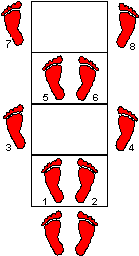
The ladder is one of my favorite tools because it is super easy to see improvement in. You can do running forward with one foot in each box or make it harder by doing both feet in each box. You can do ins and outs or the Ali shuffle. Or one of my favorites the “icky shuffle.” The goal is to do any of these movements perfectly as quickly as possible. Start as slow as you need just do it PERFECTLY. Add speed as you learn the move and perfect it. Remember it isn’t about just going quickly. It is about doing it PERFECTLY.
Anyway, here is a little SAQ portion to do before you do your strength training.
3-5 rounds: Rest between each round. Move quickly through all three exercises.
5 Squat Jumps (or up to a box or barely off the ground depending on level)
Icky Shuffle down ladder
4 Soccer Throws each side (So overhead throw against a wall stepping forward with the same foot for 4 before switching)
All these should be done as QUICKLY as possible with good form. Try to increase your speed each time you do everything with great form.
Remember this doesn’t have to kill you. It can actually just be the end of your workout after you’ve rolled out and gotten the muscles a bit warm.
Try it. Watch how much your coordination will improve after a few weeks of just a few drills before your workout!


 Man Bicep