Category Archives: program development
Build a Strong Back for Better Posture (And More Pull Ups!)
Because of sitting all day, we tend to hunch forward. Our chest and lats can become tight and often the muscles in our back, especially our lower traps, are weak.
And then on top of that, people spend way more time on their chest shoulders and triceps than they do on their back and biceps. This only adds to the imbalance and creates worse posture.
It can also hinder you from being able to do pull ups! (Which recently I’ve gotten asked a lot about!)
Here are some great stretching and foam rolling moves you should do before beginning your back workouts and using the exercises below. The exercises in the post above can also be great activation moves!
These back exercises will help correct your posture and can also help you improve your pull ups!
1. Inverted Row variations:
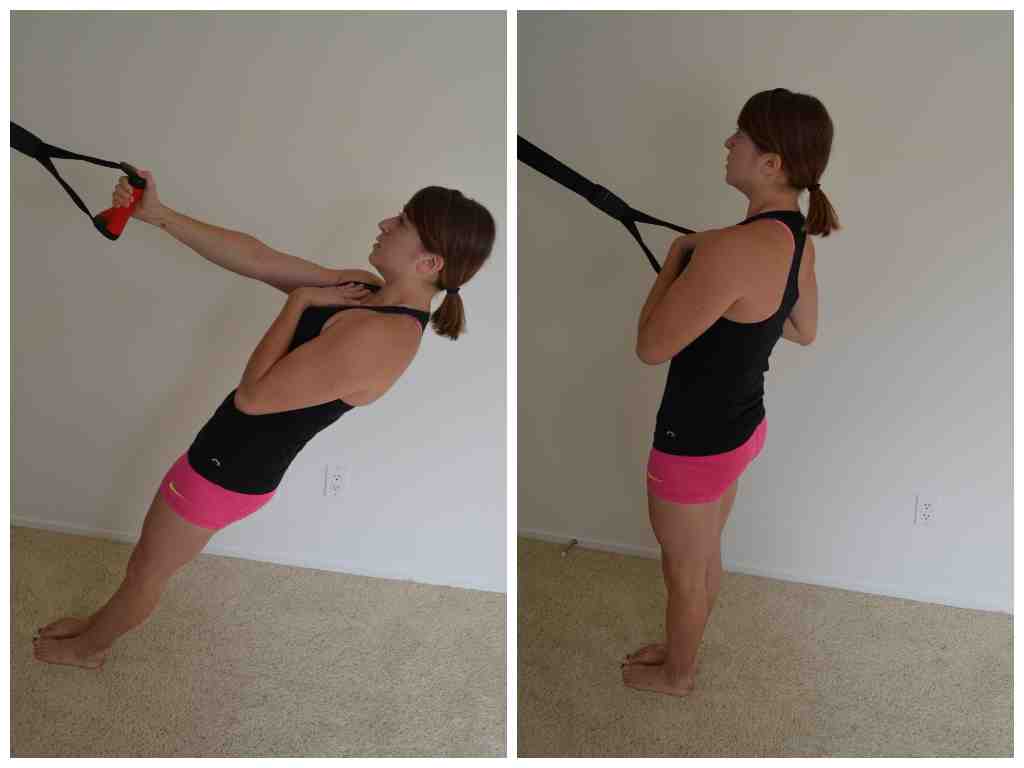
You can perform a two arm inverted row or even a rotational or anti-rotational single arm row. All three develop great back and core strength to improve your posture and build your back strength so that you can work up to a full pull up (or add to the number of pull ups you are currently able to do)!
Make sure with all three that you are keeping your core tight.
For the basic inverted row, you will hold an XT strap in each hand. Walk your feet out so you are leaning back. The closer to parallel to the ground you get, the harder the move will be. Squeeze your core and glutes and press your chest out so there is tension behind your shoulder blades. Then row up, keeping your body in a nice straight line. Row until your chest comes up to the handles and then lower yourself back down. Don’t let your hips sink as you lower back down. Also, keep your chest pressed out the entire time (do not let your low back arch though).

Do do a single arm anti-rotational row, you are going to do basically the exact same thing just with one hand. You want to keep your shoulders even just like you are holding the strap in the other hand. Do not let the shoulder of the arm not holding anything rotate toward the ground. As you row in, also make sure the shoulder of the arm rowing doesn’t shrug up by your ear.
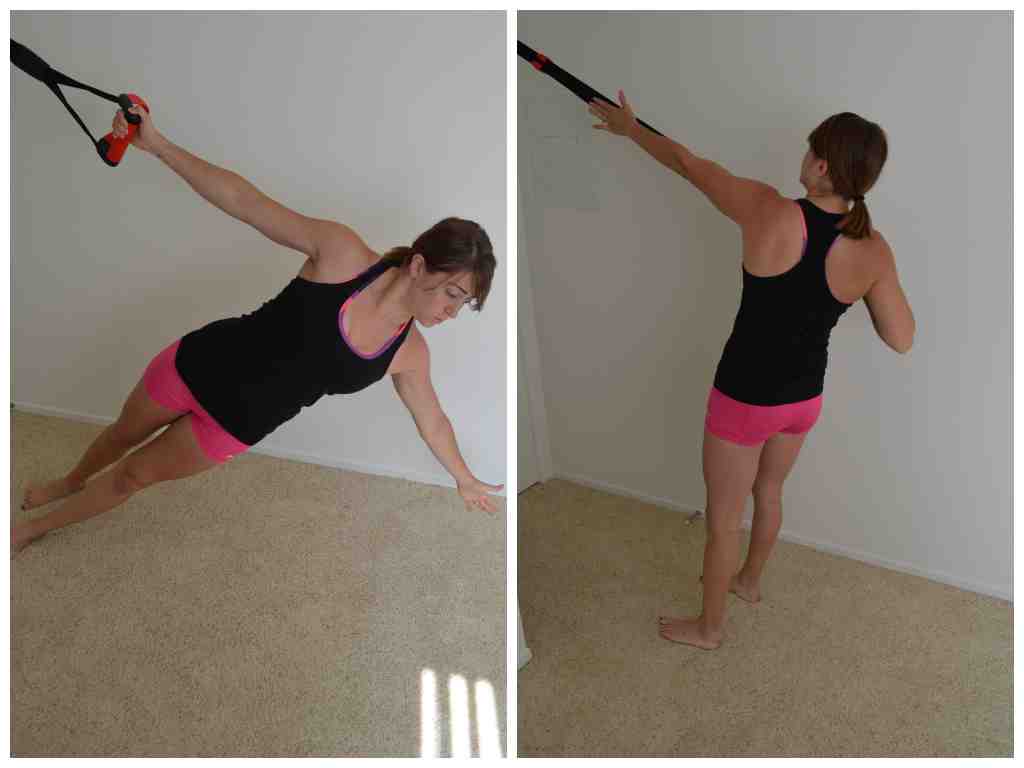
With the rotational row, you are going to open up as if almost doing a hanging side plank. Do not let your hips dip toward the ground. As you row up, keep your core tight and rotate toward the strap, reaching as high up the strap as possible. Then rotate back up and repeat.
2. Row variations:
You can do a barbell row or a single arm dumbbell row. You can do a row with or without rotation. These are also a great way to develop back strength and improve posture.
Here are two great row variations using a band.
Two-arm Row – Lean forward and loop the band over itself and stand on the point where the band crosses over itself. Make sure there is tension even when you are fully extended if possible. Lean over, creating a nice straight line from the tip of your head all the way down your tailbone. Your chest should be pressed out and shoulder blades pulled down and back. Keeping your arms in by your sides, row up on the bands. Bend your elbows and pull the bands to your chest. Control the bands as you relax back down. Keep your core tight and tension in your back. Do not let your back round as you do this move! You want to make sure you are pressing your butt back and away and creating a nice straight line with your back.
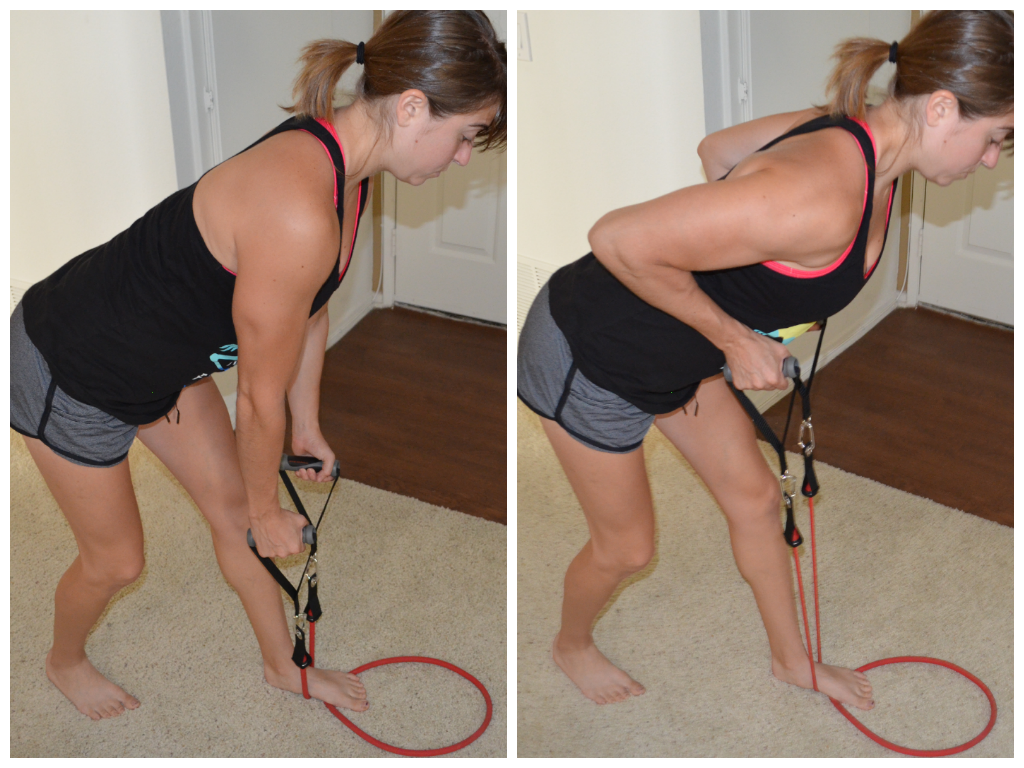
Lawn Mower Row – This is a rotational row, but could also be done without the rotation. I call it the lawn mower row because it kind of looks like someone starting a lawn mower (apparently this is the midwest girl in me as many people I say that to now just kind of stare at me blankly…). Again loop the band and stand on the place where it crosses over. Reach down and then pull the band up toward your chest. As you row up, rotate open toward the band so that you can actually row up past your chest. Then control the band back down to the start and repeat.

3. Scapular Hold variations:
As you all know, I love the scapular wall hold. But there are other variations out there that are great. Basically a scapular hold is just the top hold of a row. You can do it on XT straps by holding at the top. Or you can do it by lying face down on a bench and rowing up and holding at the top. You could even just hold at the top of the two-arm band row.
Scapular holds are great at creating that scapular retraction that we need to be able to do pull ups. They are also great at strengthening our lower traps so that we have less neck and shoulder pain AND BETTER POSTURE.
Honestly, these are one of the few exercises that I have no problem if you almost do them every day. If you are sitting for a long time at your desk, get up and do them. They should be apart of your warm ups when you do deadlifts or back days. Shoot you may even include them on chest days just to get in a little extension in your back since it is so often in flexion!
These are great for injury prevention especially if you’ve had back, neck or shoulder problems!
4. Pulldown variations:
These are great subs if you can’t do full pull ups. While I love assisted pull ups, pull up holds and deadhangs, these are also useful in developing strong lats for pull ups.
You definitely want to make sure though that you’ve rolled out your lats and chest before doing these moves.
Bands or even a cable machine can be used for these moves.
Kneeling Pulldown – Kneel on the ground. You can even sit back on your heels. Place a band in a door or looped over something higher off the ground. Hold a handle in each hand and reach your hands up overhead. If the band isn’t straight above you, you will want to slightly lean forward so that your upper body is inline with your extended arms. Then pull the band down toward you. You can do variations with your palms facing toward you (chin up), palms parallel or even palms facing away (pull up). Keep your core tight and your arms in by your body as you pull down. Do not let your elbows flare way out.

On the left is the pivot prone grip and the right is the parallel grip.
One of my favorite variations of this move is the Pivot Prone Pull shown by Nick Tumminello. It really works on lower trap strength.
Straight Arm Pulldown – While I don’t use this move that often, it can be another great way to strengthen your core and lats.
You can use a cable machine or a band for this exercise. Anchor the band or cable above your head so that there is a little tension when you hold your arms out straight at shoulder height. Keep your core tight and your arms straight as you press the band down toward the ground and then back toward your legs. Keep your chest up nice and tall and do not round forward. Feel your back and lats engage as you press down. Control the band back up to shoulder height.
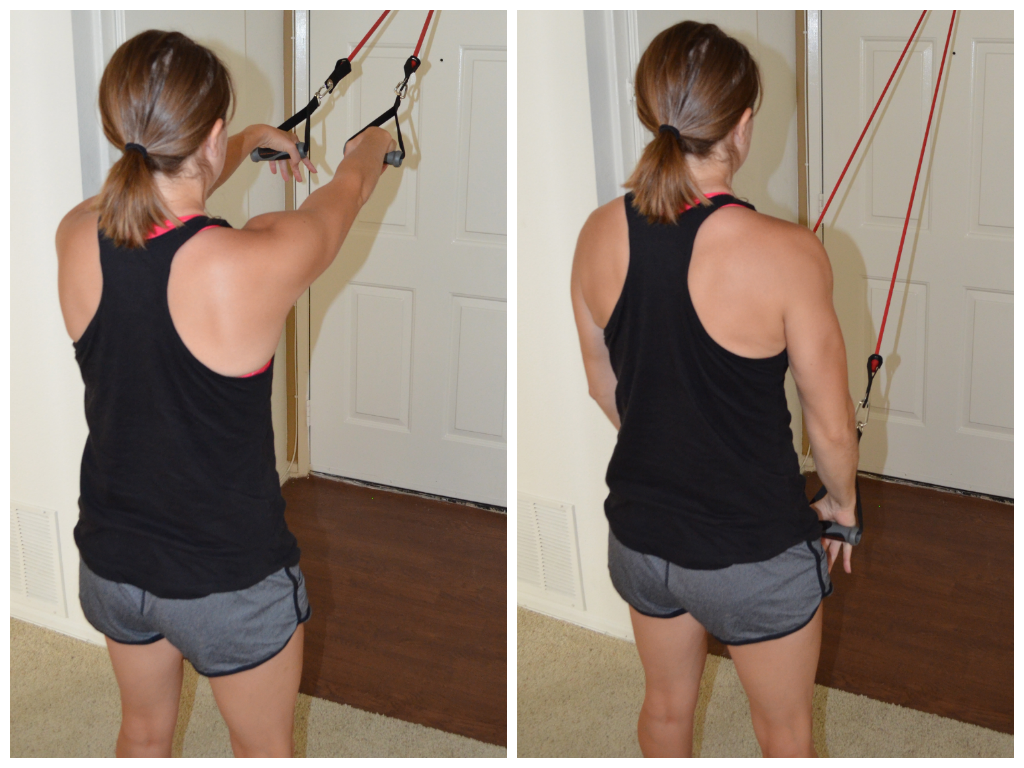
If pull ups really are your focus, this is a great move to use.
5. Pullover variations
Pullovers are also a great move to use to strengthen your lats.
You can do these with a weight or on the XT straps. This move is very core intensive. Do not let your low back arch!
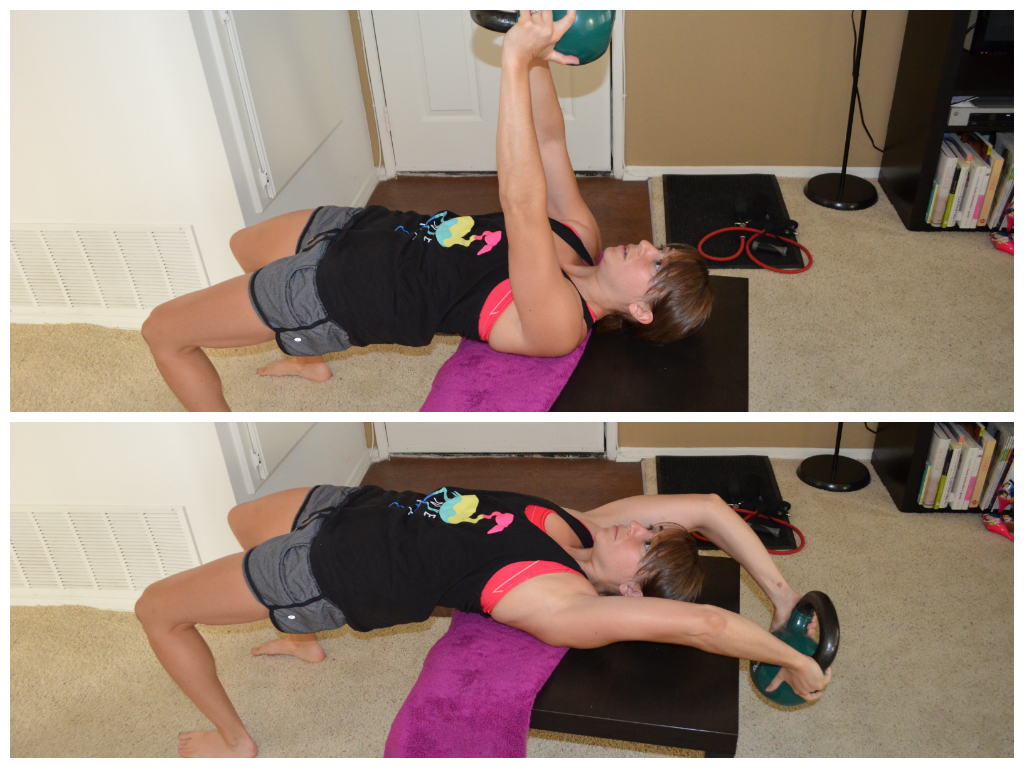
Weighted Pullover – Lie on a bench or table. Set up so only your upper back in on the bench and your feet are on the ground. Bridge up and extend the weight up over your chest with your arms out straight. Keeping the elbows slightly bent, reach the weight back and overhead, extending back as far as possible. Keep the hips high and the core tight. Then pull the weight back over so that it is above your chest and repeat.
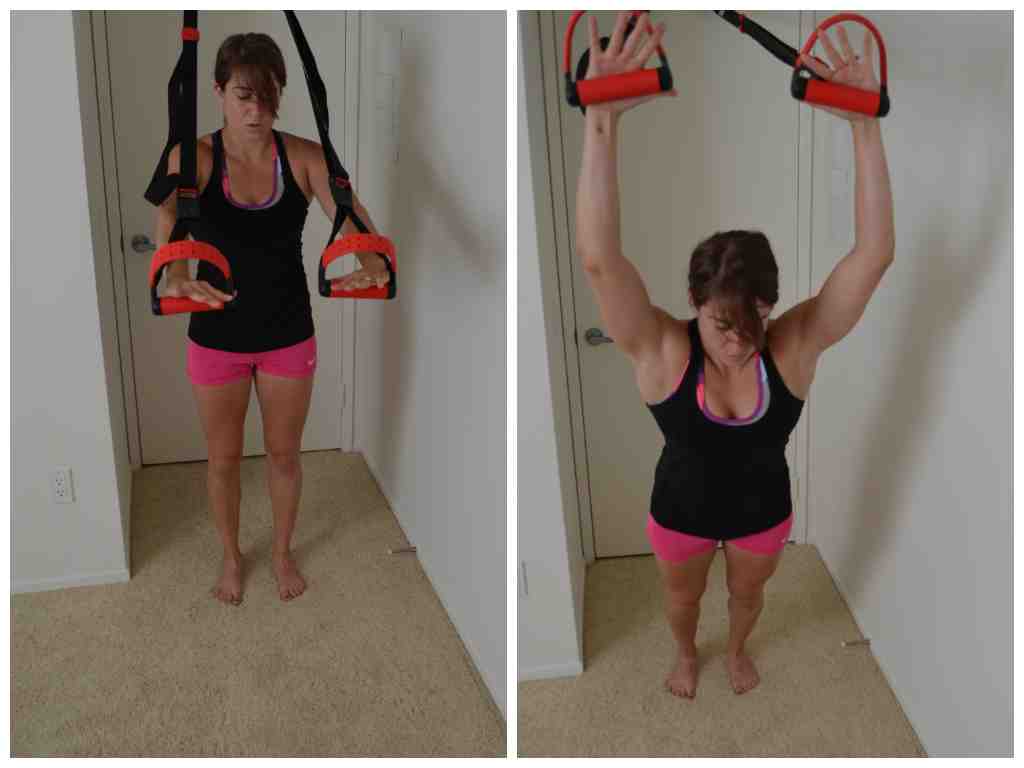
XT Pullover – Face away from the XT strap anchor point with one strap in each hand. The closer to parallel you get to the ground, the harder the move will be. Extend your arms out at about shoulder height. Slowly let your hands extend overhead, keeping your arms pretty straight. Keep your body in a nice straight line. Do not let your hips go up in the air or sag toward the ground. Then press down on the straps and bring your arms back down to about shoulder height.
All of these moves are great to improve your posture and build a stronger back so that you can do more pull ups.
HOWEVER, in your desire to do more pull ups, do not do a back workout every day. Muscles get stronger when they have time to rebuild…AKA you need rest days! If you constantly break your back down, you won’t get any stronger. So DON’T do these exercises every day!
Neck and Upper Back Pain Fixes
Let’s face it…Even if we are pretty active, we spend a great deal of time hunched over a computer. Which generally leads to bad posture and upper back and neck pain.
Because most people sit looking at a computer screen all day, muscles get out of their proper alignment. For instance because you hunch over the computer, your upper traps may become active (aka you may be tense a lot with your shoulders up by your ears). If your upper traps are overactive, most likely your lower traps will be underactive. Muscles therefore aren’t working the way they should be.

When muscles aren’t properly aligned and working the way they should be, other muscles compensate, leading to injury.
Below are some great trigger point release, stretches and strengthening moves you can do to alleviate minor aches and pains in your neck, shoulders and upper back. These moves will release and stretch any muscles that would be tight from sitting all day. They will also strengthen those muscles that are underactive.
NECK – Be careful when rolling out your neck. Use a very softer ball and stand against a wall with the ball between the wall and your neck. Do not go over your vertebrae. Dig in lightly to any tight spots. Look side to side and up and down to release any trigger points.
UPPER TRAPS AND SHOULDER BLADES – Stand with your back to a wall. Place a tennis ball right behind your trap (just to the side of your neck). Roll the ball out toward your shoulder and then back in. Then roll it down your shoulder blade and back up. Hold on any tight spots. You can even stretch your neck away from the side of the ball and then relax to help dig out the trigger point. As you work your way down your shoulder blades, you may even cross one arm (the arm on the side with the ball) across your chest to allow you to really work under the shoulder blade. Hold on any tight spots and relax and breathe.
CHEST – A big foam ball works best if you do this on the ground. Take the foam ball and place it in your chest near the shoulder joint, but not on the shoulder joint. Lie face down on the ground with the ball in your chest. Reach your hand overhead and then bring it back down by your side. You can even reach out to the side and then bring your hand back in. Hold on any tight spots. You can also do this standing with a smaller ball against a pole, door frame or corner of a wall into a hallway. Place the ball on the wall in your chest near your shoulder joint. You should put it in the side of your chest that isn’t blocked by the wall so you can stretch your arm out in front of you. Stretch your arm out in front of you at shoulder height. Then raise it over head and lower it back down to the ground. Move the arm around to help dig out any trigger points.
LATS – You can use a foam ball or a ball. I prefer the roller because I can hit my lats and also roll out my upper back and work on thoracic extension. Lie on your side with the roller under one armpit. Rock forward and backward and then move the roller down your side toward your belly button. Work down your lat to about the end of your ribs. Rock forward and backward as you move to really dig out the lats. If you use the blue ball, you can actually start in your chest and then roll the ball under your armpit and up between your shoulder blades. It is a great move if you want to hit your back, lats and chest all in one!

THORACIC EXTENSION – Take a roller and roll out your upper back. Let it roll from about your ribs to your shoulders. You can lean a bit to either side to change exactly where the roller hits. You can also use a ball to roll out your upper back. I like the roller though because after your roll out your back you can do a nice little stretch. With the roller in your upper back, drop your butt down to the ground and then lean back over the roller, trying to drop your head to the ground behind you. Change where the roller is in your upper back and then drop your butt to the ground and extend back over again. Really works on thoracic extension since we seem to be in thoracic flexion for 8 hours a day while sitting in front of the computer screen!
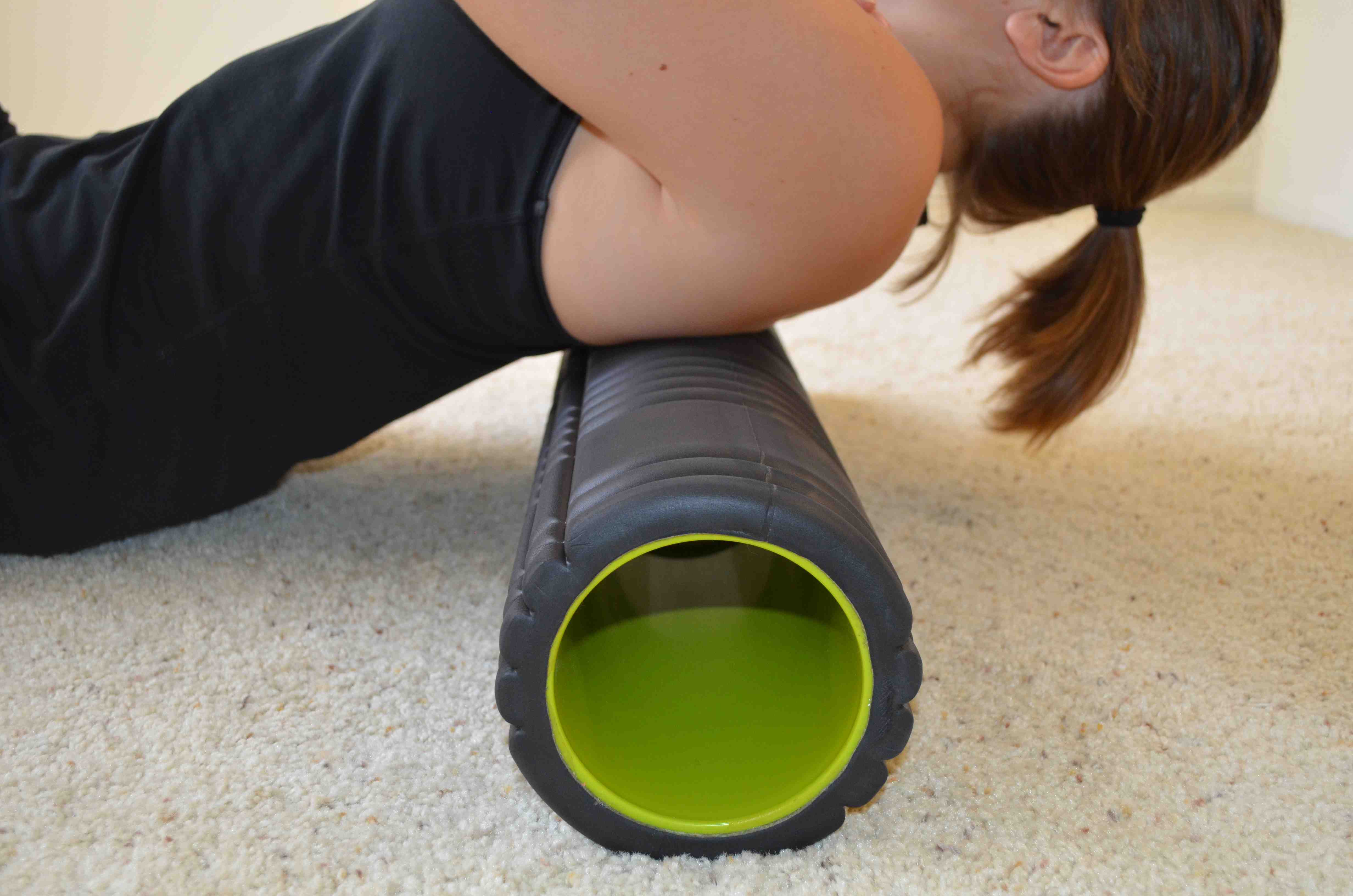
For more great foam rolling techniques, check out the Redefining Strength video library.
STRETCHES
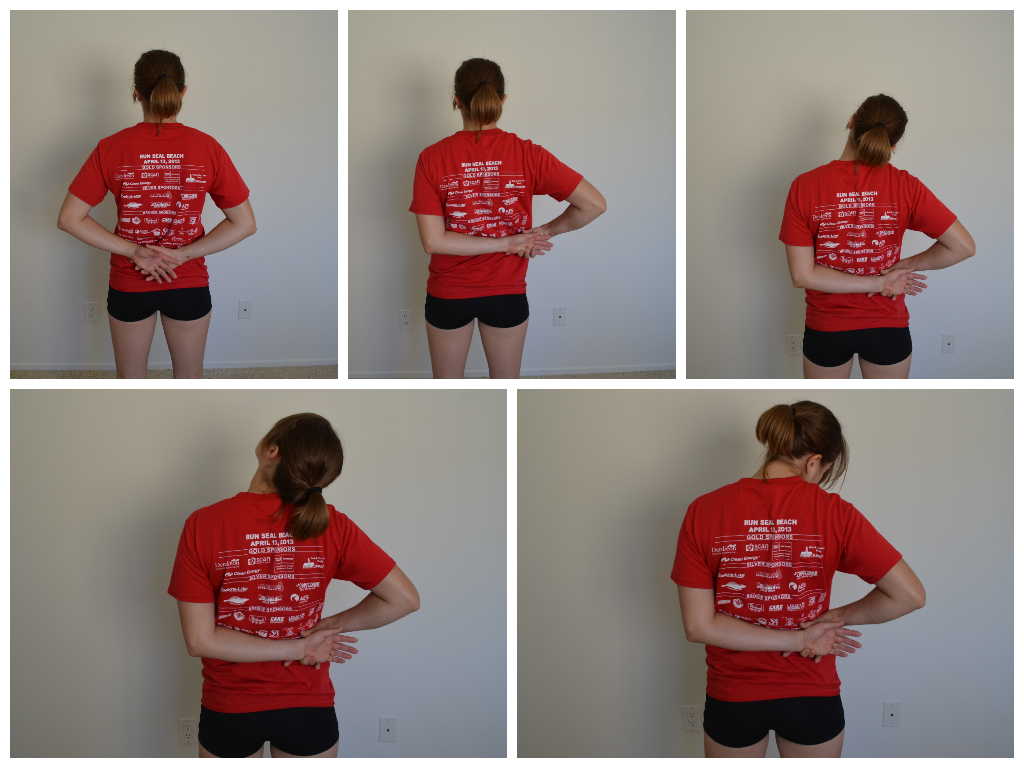
THREE WAY STRETCH – You can do this move seated or standing. Reach one hand behind your back and then grab that wrist with the other hand. Pull the arm behind your back toward the opposite side. Then lean your head to the side you are pulling to. Do not tense your shoulders and bring them up toward you ears. Relax into the stretch. Then change the direction of your gaze. Look up and hold for a second or two. Then look straight ahead. And then look down. Move your chin as you look and not just your eyes. Changing the direction of where you look, will change exactly which muscles in your necks and upper back that you stretch.
HEAD NODS — There are three types of head nods I like. The “yes” head nod where you look down toward the ground then lean your head back and look up at the ceiling as if doing a big nod yes (move slowly trying to open up your range of motion). The “no” nod where you look side to side, trying to look as far both ways as possible as if you doing a big slow no nod (do not move to quickly and make yourself dizzy). And the “rooster” nod where you pull your chin back in toward your chest as if trying to create a double chin and then you extend your chin back out (it kind of reminds of the rooster head movement). All should be done slowly and with the shoulders relax. If you feel your shoulders creeping up by your ears, stop and relax them. You may even want to slightly reach down toward the ground with your hands to keep them relaxed.
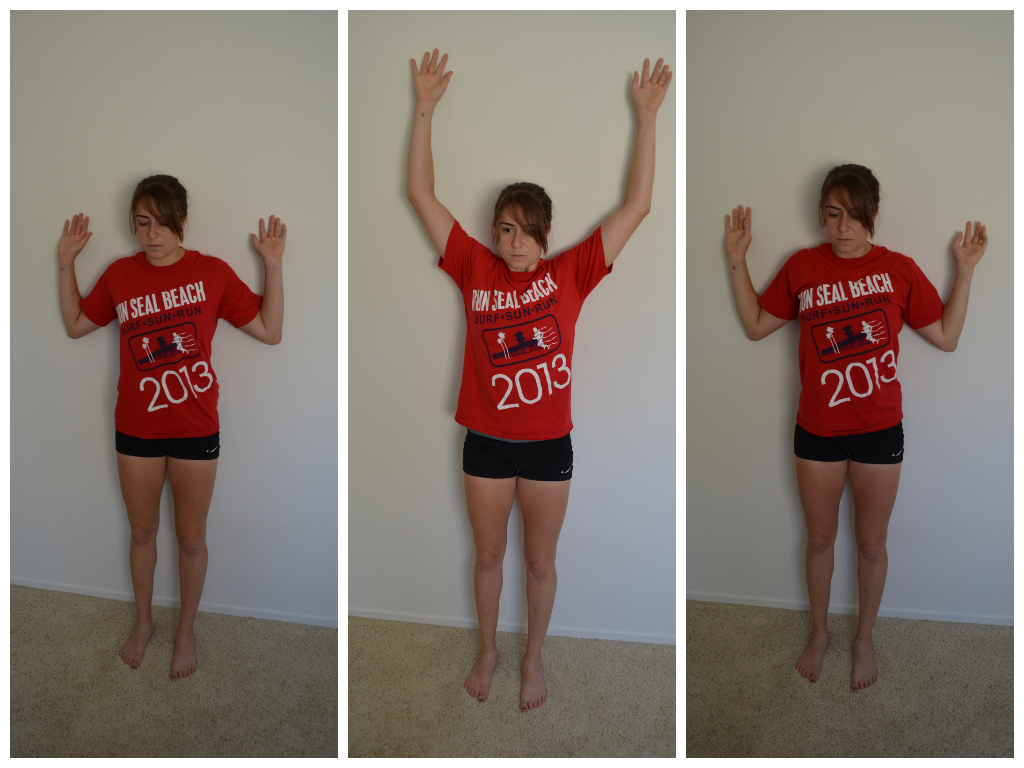
WALL SLIDES – An oldie but goodie, this one works on thoracic flexibility. Stand against a wall with your core tight and your butt and upper back firmly against the wall. Place your forearms against the wall with your elbows bent. Then try to reach your forearms and hands up the wall as far as possible without losing contact with the wall. Don’t let your head, butt or upper back move from the wall either and try to keep your core tight. Slide your hands up and down, increasing the range of motion if you can with each rep.
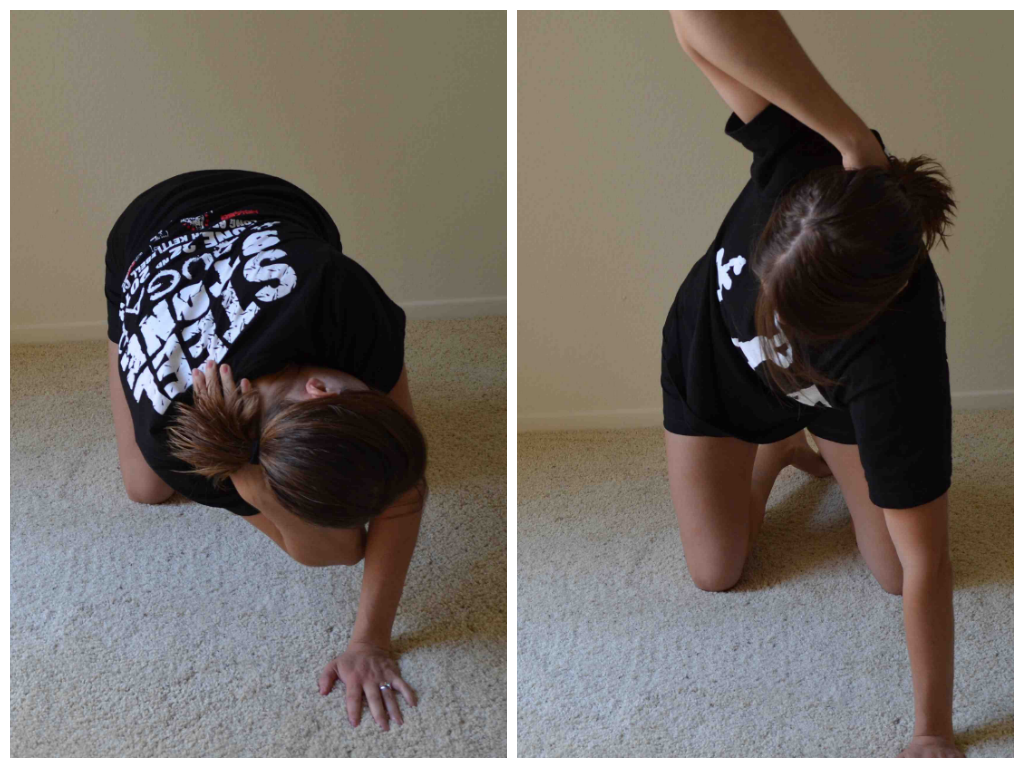
KNEELING THORACIC EXTENSION – On your hands and knees, reach one hand down your neck and spine. Fingertips should be pointing down your back toward your butt. Then rotate your core so that your elbow goes under your arm on the ground. Then rotate open driving the elbow up toward the ceiling. Try to focus on just opening up your back and not really shifting your weight in your lower body. Then rotate back closed and repeat.
CAT/CAMEL – You can do this move standing or on your hands and knees. The basic move is that you round your back as much as possible and then you extend back the other way as much as possible. So on your hands and knees. Round your back up toward the ceiling. Then drop down and arch your back driving your belly button toward the ground and even looking up toward the ceiling with your head. If you do this standing, you will round forward as if hunching over your desk. Even bring your hands and arms forward as you round. Then extend open, opening your arms and even looking up toward the ceiling. Really exaggerate the extension if you can.

UPPER BACK AND LAT – Probably my favorite stretch of all time shown to me by Mark at the gym. Kneel on the ground. Then lean forward and rotate onto one side. Drop the side of your head and shoulder down to the ground. Reach the bottom arm out in front of you. Then reach the top hand back and overhead. Really try to rotate your chest open toward the ceiling. Hold and then repeat on the other side.
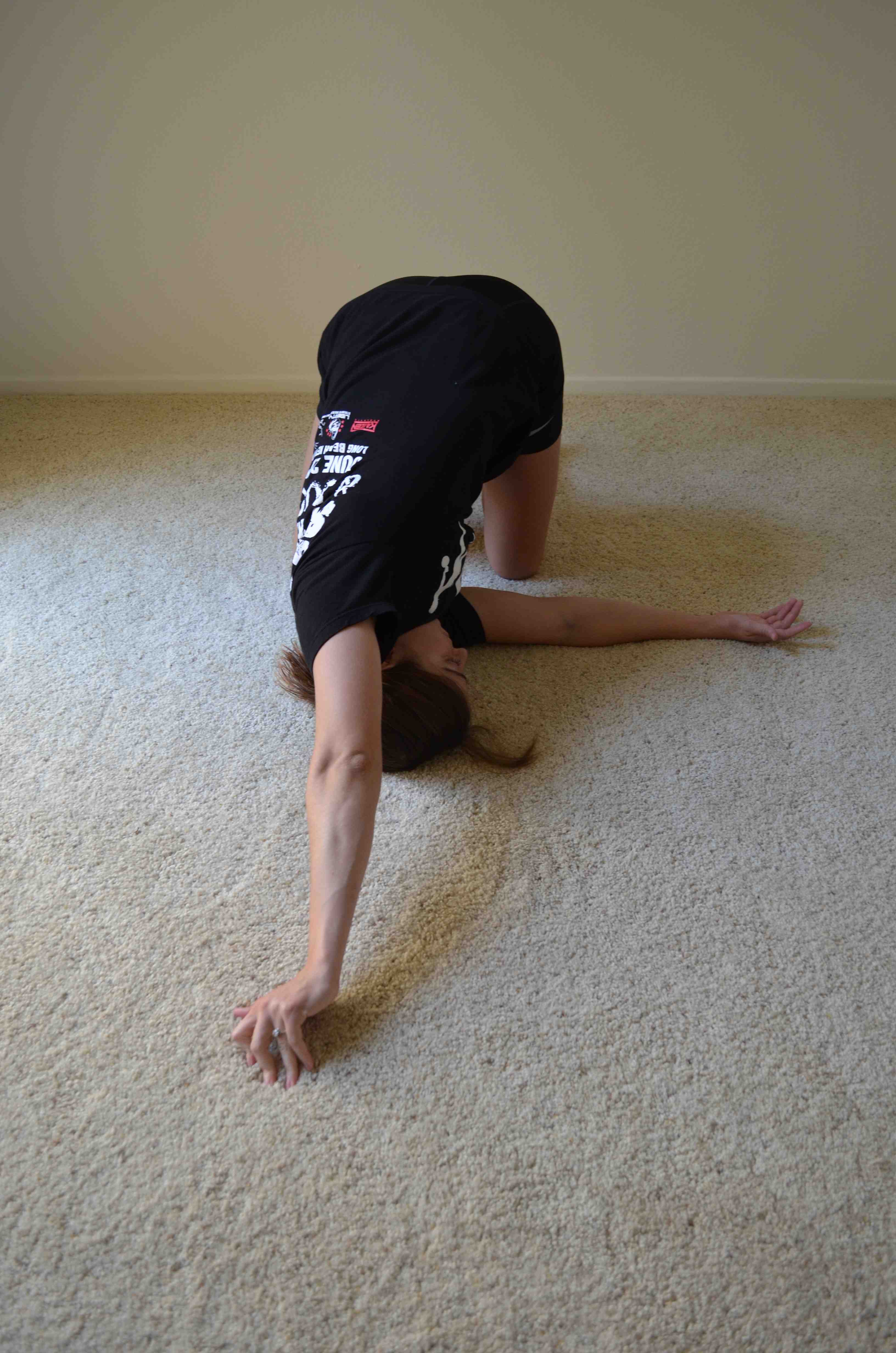
LAT STRETCH – Child’s pose can be a great way to stretch your lats and your upper back. You can also simply place the side your hand on a bookshelf or desk and then straighten your arm and bend over (if needed) and walk away. Even rotate a bit so you are looking under the arm on the desk or wall and then away from the arm. Feel a nice stretch down your arm and into the side of your back. Hold and repeat on the other side.
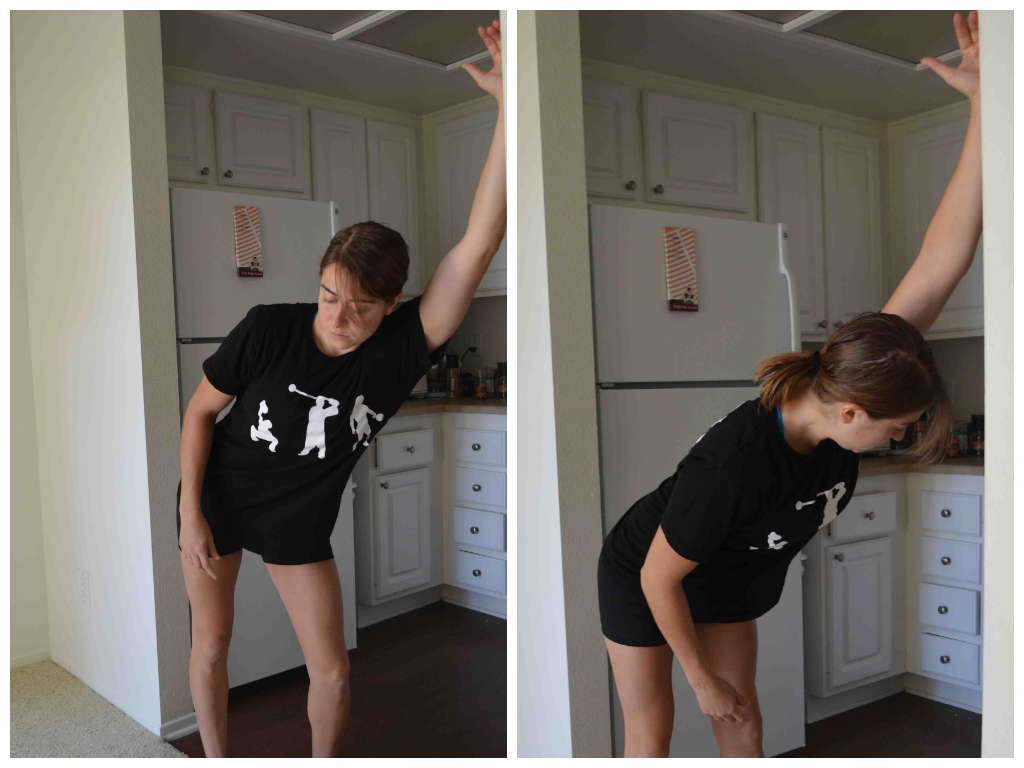
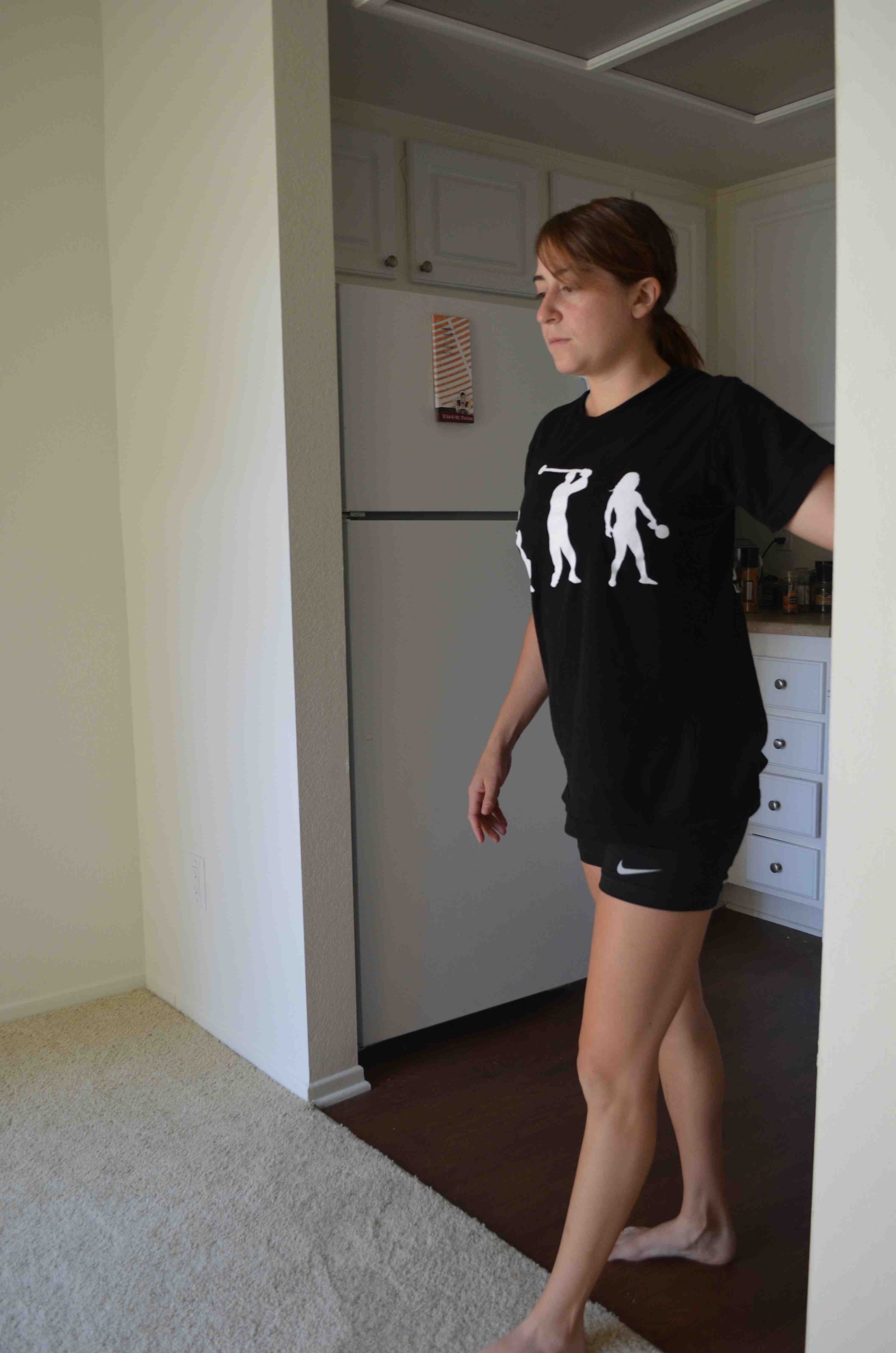
CHEST STRETCH – A doorway, pole or corner is great for this stretch. Place your hand or forearm on the side of the doorway. Step through the doorway until you feel a stretch down your chest and into your shoulder. Do not rotate toward the arm in the doorway. Try to face straight ahead. Hold and then switch.
STRENGTHENING
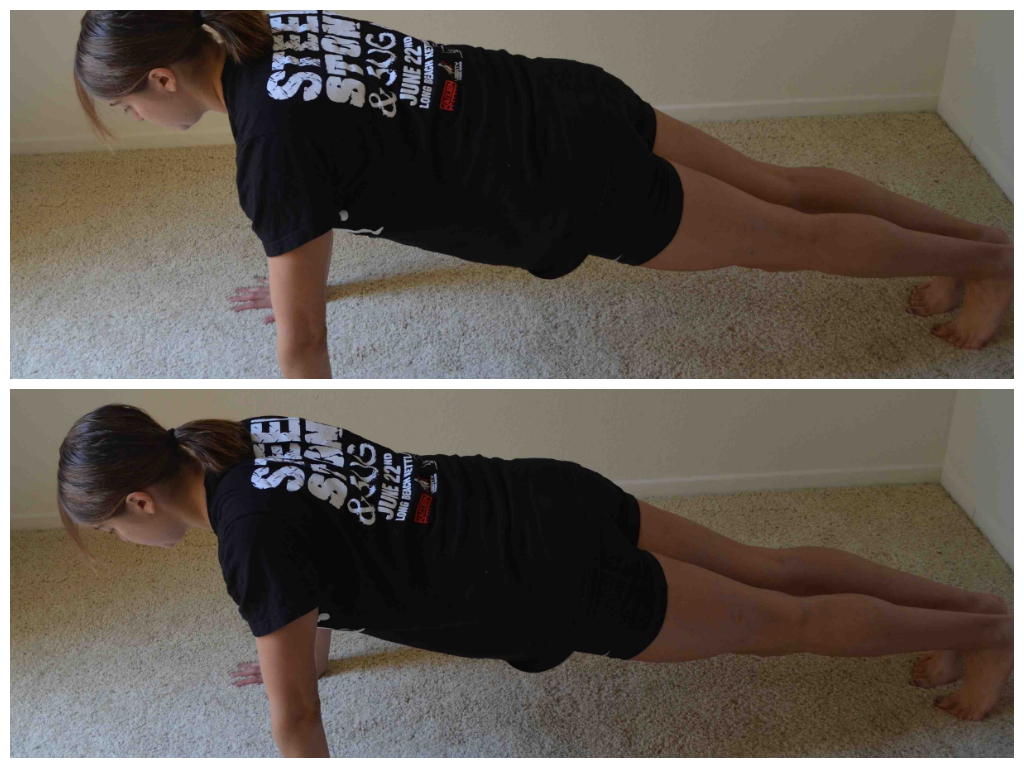
SCAPULAR PUSH UPS – These are hard for many people to do so you may want to have someone watch your form the first time. This is a very small range of motion. Set up in a push up position from your knees or toes. Create a nice straight line with your body. Then pinch your shoulder blades back and together and press your chest out. Then relax. It is really only a few inches of motion. DO NOT ALLOW YOUR CORE TO MOVE. Many people will drop their hips and move their core or bend their elbows. All you are doing is pinching your shoulder blades back and together. Do not let your shoulders shrug up by your ears.
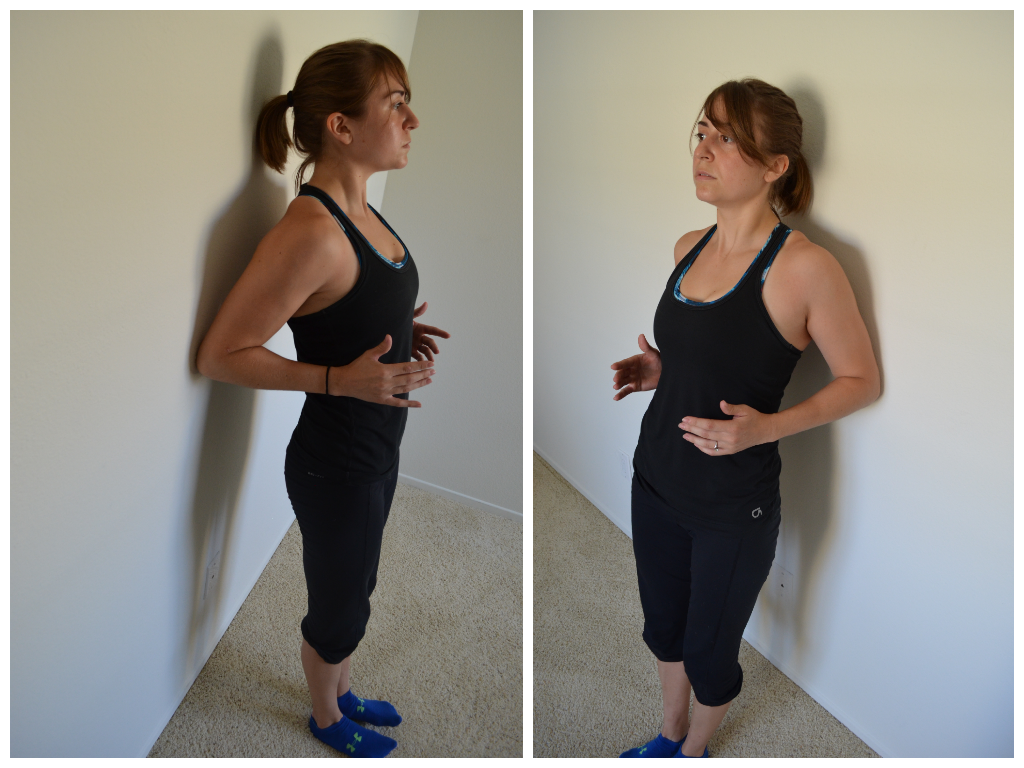
SCAPULAR WALL HOLD – An essential move if you sit at a desk all day. Stand with your back to a wall. Bend your elbows with your arms at your side. Drive your chest out and pinch your shoulder blades down and together. Do not let your shoulders shrug. Lean back into the wall. Only your elbows and maybe your head should touch the wall. Walk your feet away from the wall only if needed to increase the resistance. Press your chest out and draw your shoulder blades together as you hold. You create the tension and this move will only be difficult if you really activate the muscles.
CORNER ROW – A dynamic scapular hold. Stand in a corner in the same position as the scapular hold. Place one elbow on each side of the corner. Drive up into the scapular hold and then relax back into the corner and repeat. Do not let the shoulders shrug up as you row out. Also the farther from the wall your feet are, the harder the move will be.
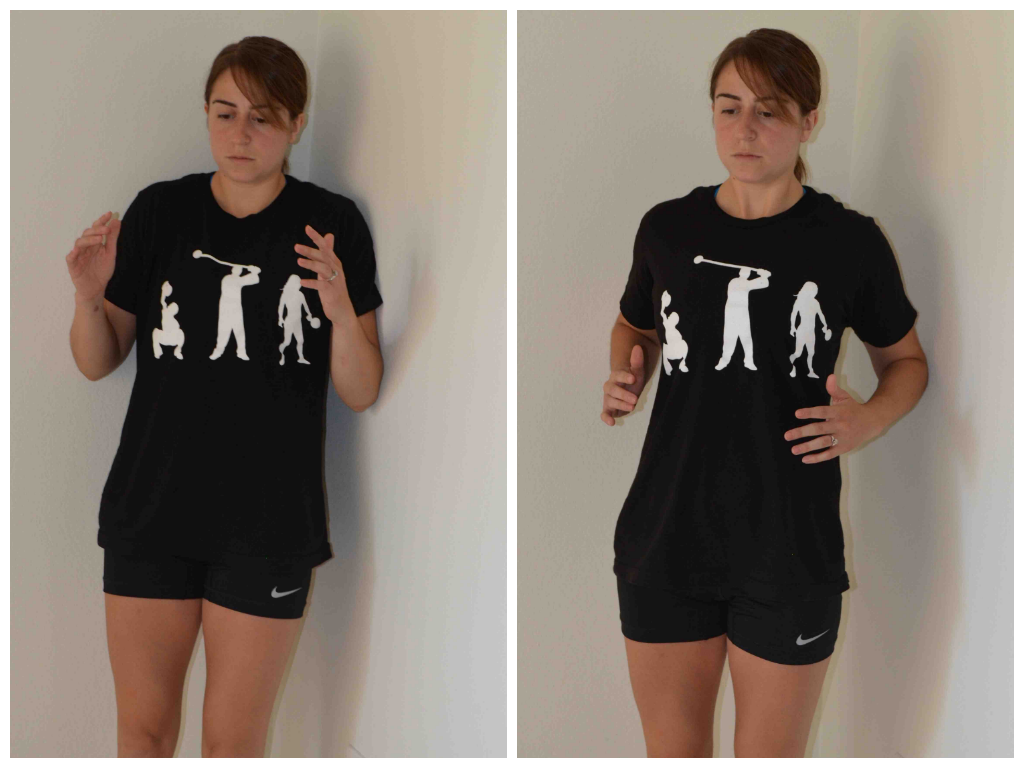
LAT TOWEL PULLDOWN – You can do this move with or without a towel. It is very much like the wall slides except you aren’t against a wall. Reach your hands up with your elbows bent. Your hands should be on either side of your chest with your palms facing forward. You can hold a towel tight between your hands. This sometimes helps to remind you to keep tension between your shoulder blades and activate your lats. Reach your hands up overhead, keeping tension on the towel. Then pull the towel back down, pulling with your lats as you pinch your shoulder blades down and together. Repeat, keeping tension between your shoulder blades and using your lats to pull.

BAND SCAPULAR FLY – For this one you need a light resistance band. Hold the resistance band with your hands about shoulder-width apart. Arms should be straight out in front of you at about shoulder height or right below. Keeping your arms straight, open your arms out to the side. Pinch your shoulder blades together as you open. Do not let your shoulders shrug up. Then once you open the band to your chest with your arms straight, bring your arms back together so your arms are about shoulder-width apart again and there is no slack in the band. Repeat.
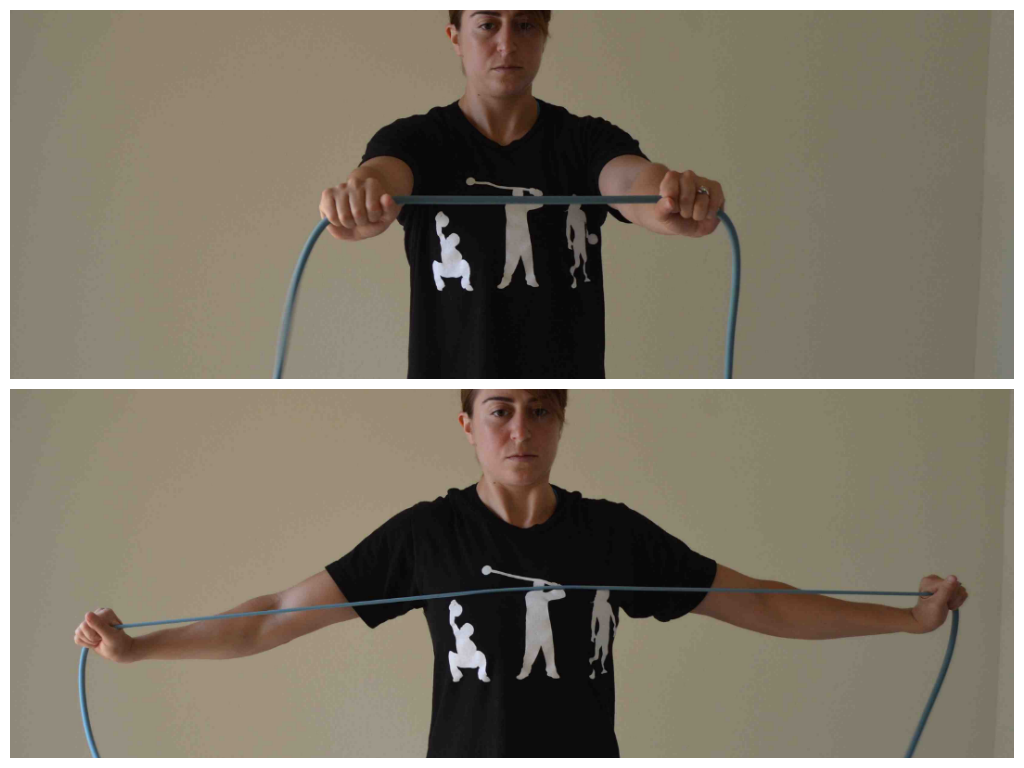
Many of these moves can even be done in your office when you need a quick break from looking at the computer screen. I tell clients all the time that at least every hour or so they should get up and do a couple quick stretches and a scapular hold for a minute or two. Great way to reverse the effects of hunching over AND a great way to become even just a little bit more active!
Here is actually a great move to extend EVERYTHING that is basically flexed all day at the computer.
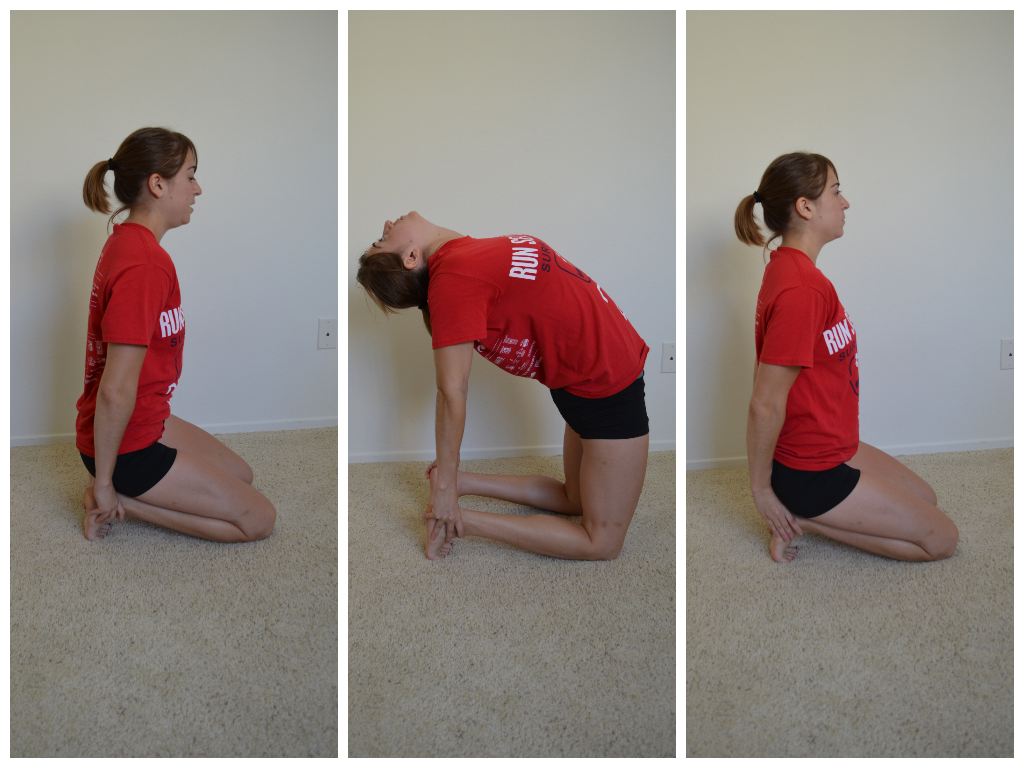
Kneeling bridge
NOTE: Anyone love…I mean hate…burpees? Look out for some cool burpee variations to come later this week!
Forced Reps – Getting that little bit extra out of your workout
All too often we give up at the first sign of fatigue or shake-age (that is my very technical term for when a muscle starts to fatigue and it gets hard to press /pull/squat/whatever the weight).
If we want results, we have to push. And that doesn’t mean working out for a lot longer or doing a ton more.
But it does mean forcing ourselves to push just a little bit harder.
It does mean forcing out those couple of reps that we really don’t want to do because they hurt.
Forced reps can be done in a variety of ways, but the point of doing them is to “force” a couple of reps that our body really doesn’t want to do so that we cause growth and change.
We aren’t going to get stronger and fitter if we just continue to do the same comfortable weight for the same comfortable amount of reps.
You need to push yourself.
Most likely your “discomfort” is more mental than it really is physical. And pushing yourself to do an extra few reps will not only push your body, but also your mind.
If you push your mind, in the future you will be able to work harder, which will lead to even more progress.
This doesn’t always mean going to failure or even past failure although going to failure isn’t a bad thing.
It just means doing a couple more than your body THINKS it can do.
So how can you force out those extra couple of reps?
Well for one, you can just do them. Sometimes by just telling yourself, “I’m going to do 8 this week because I could only do 6 last week” will be enough to make you do the extra reps.
But sometimes we really feel like we can’t eek out any more.
This is when you can use a couple of different options. Below are three techniques I like to use to make my body do just those couple of reps past discomfort.
1. Drop Sets – Drop sets are great if your goal is muscle hypertrophy. Drop sets, where you complete reps with one weight and then drop to another weight and force out more reps, really helps you recruit more muscle fibers so that you cause more muscle gains.
Let’s say you can only do 8 single arm rows with a 40lbs dumbbell. You could either choose to stop there or you could force out extra reps by quickly dropping the weight and doing more reps with that lighter weight.
With drop sets, you do reps with a certain weight and then lower the weight and do more reps and continue to do reps and lower the weight until you’ve either completed the allotted sets or you’ve hit failure.

Start heavier and get lighter. You may find that five pounds feel like 100 by the end haha
You can either do bigger drops in weight and try to increase the reps you do with each round OR you can only slightly decrease the weight, which means your reps will actually go down with each round.
With drop sets, do not rest between rounds. Try to quickly drop the weight and go right back into the exercise. The lack of rest is key to complete fatigue of the muscle.
You will probably not do more than one set of a drop set with an exercise since it will take you basically to failure. Make sure that the weight you start with is heavy for about 6-12 reps.
2. Rest-Pause – So I actually just learned the technical name for these kinds of sets after reading an article about Rest-Pause Technique by Colin over at Uber Beast Mode.
Rest-pause technique means that basically you bust out as many reps as possible, take a short little break and then go back and bust out as many more as possible until the number of reps or sets you set out to complete are done (or you’ve hit complete failure).
There are a number of ways to do the rest-pause technique.
In his article, Colin mentions one way to do it:
…[O]ne example of a rest-pause set would be to pick a weight you can do 6 times. Perform the exercise as many times as you can, (6 seems like the most likely number here don’t you think?) then set the weight down and rest for 15-20 seconds. Lift as many as you can again and repeat this process until you can no longer lift the weight. Now you can work to failure here, but let’s be smart people. You don’t want to go to actual failure on lifts where you can end up with weight on top of you unless you have a spotter. Although that is another benefit of rest-pause training. If you don’t have a spotter this is how you can get those extra reps you couldn’t safely do before as the brief rest periods will give you enough stamina to do more.
As Colin states, not needing a spotter to go near failure is definitely an upside to the rest pause technique.
Two other variations I love are:
- Do as many rounds as needed to complete a certain amount of reps. So say your goal is 30 reps on squat. Pick a weight you can do for no more than 10 reps the first time. Perform as many squats as you can with that weight and then rest. Rest no longer than 30 seconds, then pick the weight up again and perform as many more reps as you can. Continue resting and performing reps until all 30 are completed with a weight that you technically could only do for 10 reps!
- 10-7-3-1. For this rest-pause set, you will pick a weight that is challenging for 10 reps. You will perform 10 reps then rest for 10 seconds before performing 7 reps. After seven reps, you will rest for 7 seconds before performing 3 reps. After three reps, rest for 3 seconds before performing 1 rep. Then rest for a couple of minutes before performing another 1-3 sets.
3. Assisted Reps – So this one is only doable if you happen to workout with someone or there is someone there who can assist you.
But basically how assisted reps work, is that you complete as many reps as possible without assistance and then when you’re about to hit failure or can’t do any more on your own without resting, your partner jumps in and assists you with the lift.
This can be done with almost anything – squats, bench…Probably not deadlift…But the point is that someone else helps you raise a weight you couldn’t get up on your own.
One of my new “favorite” ways to use it is on push ups (Jeff at my work showed me this one…It is a combination drop set and assisted reps technique).
To do this on push ups, perform as many as you can from your toes aka go to failure from your toes and then instantly drop to your knees and keep going. When you can’t do any more from your knees, have someone then assist you with push ups from your knees until you can’t do any more without them basically having to do all the work.

Assisted push ups
OUCH!
All three of these techniques will help you get more out of your workouts without necessarily spending more time in the gym. They will also push your muscles to work harder in the time allotted so that you get great results more efficiently.
The great part about the techniques above is that they can be combined to mix things up or force yourself to work even harder.
You can do rest-pause drop sets. Or drop sets with assisted reps.
Anyway, whatever technique you chose to use, the point is to bust out those couple of extra reps that your mind and body are telling you that you can’t do.
What is your favorite way to get yourself to do those extra couple of reps?
Cardio At Home
It’s kind of interesting, but I hear all the time that people can’t really do cardio at home.
They have this idea that they either have to go outside and run or have some sort of cardio equipment (like a treadmill or bike) at home to be able to do cardio, especially aerobic endurance, longer duration cardio (jogging).
But that isn’t the case.
There are plenty of ways to get in cardio at home without any equipment. And you don’t just have to do short, intense intervals to make these exercises work. You can work on your aerobic endurance as well!
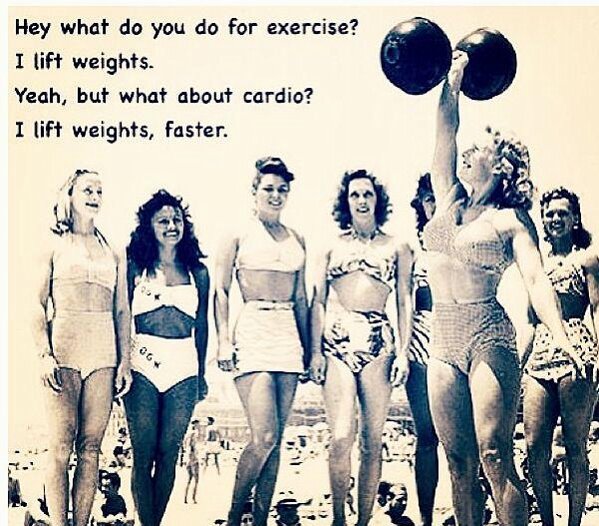
Well this is my idea of cardio! It does make the point that you don’t need a treadmill to do your cardio!
Here are 5 great Indoor Cardio Options that you can do at home:
1. Towel Taz – One of my favorite ways to do cardio at home because EVERYONE can do it and feel challenged by it. And you don’t need any equipment or really any space to do it!
This move is great to use to do intervals of 30 seconds or longer. If you do 2 minute intervals with shorter rest, you can really build your aerobic endurance.
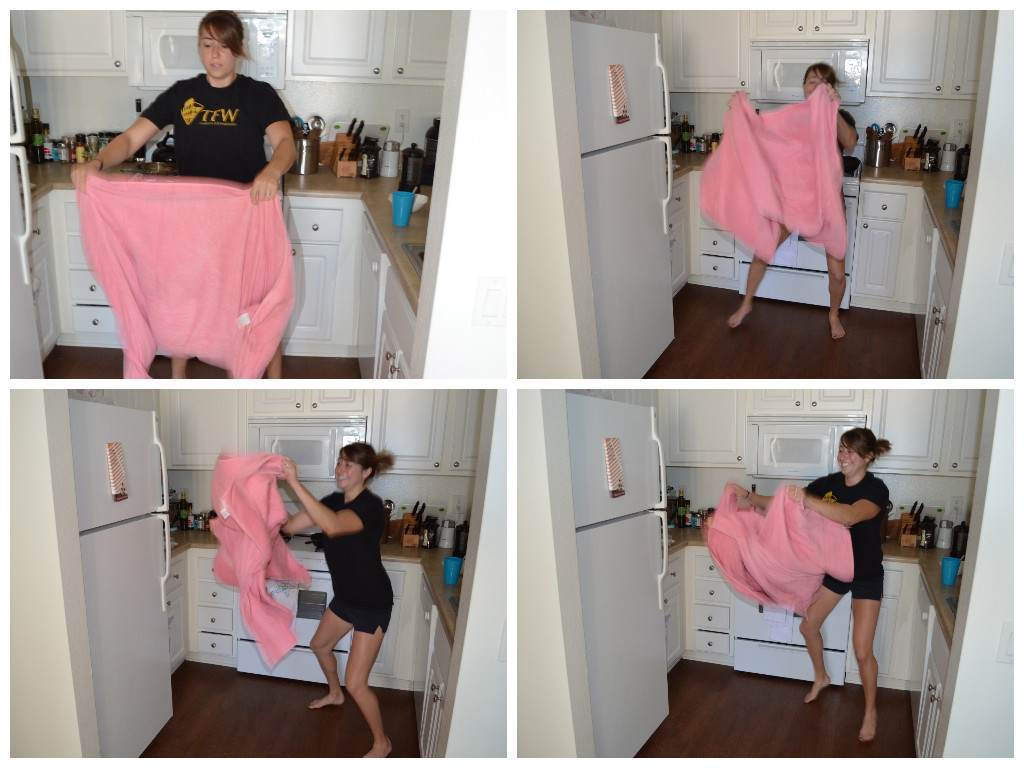
To do the towel taz, take a bath or beach towel. Hold one corner of the towel in each hand. Move side to side and all around quickly, shaking the towel up and down and forward and back. Your movements should be quick.
2. Plyometrics – Commonly known as jump training. While plyometric training is better for shorter intervals, it is still a great cardio option.
Jump squats, split squat jumps, skater hops…There are a ton of options that allow you to work your legs from every angle.
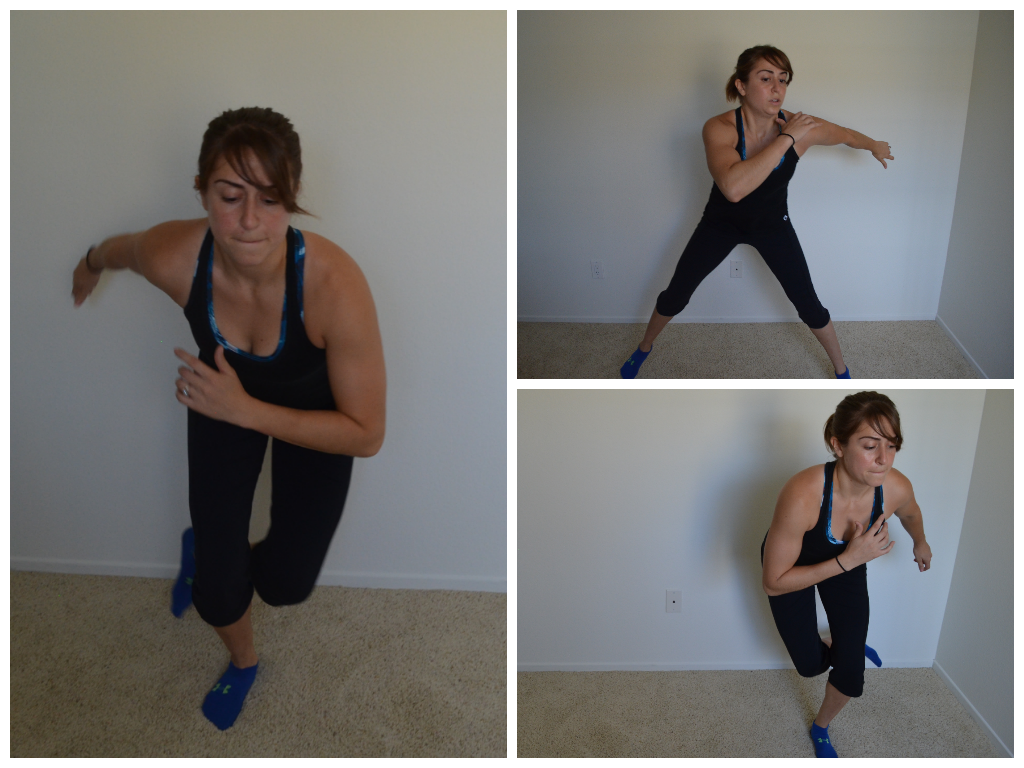
Skater Hops
But what if you are older and/or your knees won’t allow you to jump quickly and explosively off the ground? Plyometric training can be regressed.
For example: With the squat jump, you can start with a quick bodyweight squat. Then you can progress that and do a squat and come up to your toes at the top of the squat instead of exploding off the ground. Next you will just do a very very little jump off the ground, pausing after every rep. Then you will try to get higher and more explosive off the ground, still pausing or going more slowly between reps. Finally you will be as explosive and quick as possible with the jump squat.
Also, plyometric training is about training muscles to be explosive. It isn’t restricted to lower body exercises. Plyo push ups, bobcats, medicine ball throws are all examples of upper body plyos.
Actually bobcats are full body and a great way to develop a mind-body connection.
To do a bobcat, start in the crawling position on your hands and toes. The first level of this move is to just bend your elbows and drop your knees to the ground quickly and explosively. Your goal is to make sure your upper body and lower body move TOGETHER as quickly as possible. Once you start to get everything to move together, you are going to explode off the ground. Go slowly at first, focusing on everything leaving the ground and hitting the ground together. So explode up off your hands and toes and then land on your hands and toes at the same time, staying in that crawling position. As you get more comfortable, start to move as quickly as possible.
This move is super tough. It is hard to get your upper body and lower body to move together quickly!
So this is actually a video that Aaron did. This only shows a little bit of the bobcat while used in knife fighting but it will give you an idea since pictures don’t really cut it. (And actually knife fighting is another option if you have a partner. Just be careful you don’t get to into it if you are in a confined space!)
3. Crawling – Not all cardio has to be done from your feet. Crawling is a great way to get your heart rate up and it can be done as sprints or as longer, slower, endurance cardio. You can do bear crawls or gorilla crawls or even crab walks. There are a ton of different ways to crawl! Crawling is great too because it really is fully body and you don’t need much space to do it. As long as you can take a couple of steps forward and back or even just move in a circle, you are all set!

I mean shoot…you can even crawl like an alligator! Talk about tough on the core and upper body
4. Metabolic Circuit Training – If you do exercises quickly with little or no weight and little to no rest, your heart rate is going to go up.
I mentioned the other day in my Squat Variations post that you could do 5 minutes of bodyweight squats. Trust me, that definitely gets your heart rate up.
You can also do different intervals. Tabata intervals of 20 seconds on/10 seconds off can be great as long as you pick exercises that challenge you within 20 seconds.
For example, while you can use the bodyweight squat when working for 5 minutes, you may want to use a squat jump if only working for 10 seconds.
Metabolic circuits can really use any exercise.
That’s right…Any exercise can be CARDIO. Push ups when done quickly definitely get your heart rate up. Not to mention they kill your upper body!
You can easily choose exercise options that fit the space you have and your current fitness level and turn them into a great cardio circuit. Remember the key here is to move quickly not use the heaviest weight possible.
5. Cone Drills – Cone drills are a great way to improve your mind-body connection AND get your heart rate up.
And you really don’ need much room to do them…or even need cones for that matter. You can use books, pieces of paper, underwear….Really anything to just mark off the spots. Obviously, if you do have a bit more room, it is easier to set them up.
They can be great to do at a park as well!
You can do quick side shuffles to cones. You can go back and forth for time. The shuffles don’t have to be long. Two or three shuffles each way is really all you need!
You can do star drills or even four point drills. Actually there is one four point drill I love to use from my tennis days.
Set up four “cones” in a diamond. Start in the center. Sprint forward to the cone in front of you. Then go back to center. Back pedal to the cone behind you and then come back to center. Side shuffle to one side cone and then go to the other.
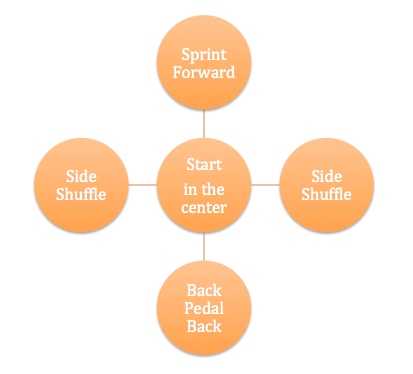
Hopefully this gives you a picture of what I’m talking about.
You can mix up exactly what direction you go. Try to not just follow the same pattern, but make your movements quick to each cone. Just remember to go back to the center after going out to each cone.
Cone drills are one of my favorite forms of cardio because they really do improve that mind-body connection which is so key for not only athletic performance but also proper functioning in EVERY DAY LIFE!
So there you have it. Five cardio options you can do at home no matter your fitness level. And the best part is – THEY REQUIRE NO EQUIPMENT!
What is your favorite way to do cardio?
Squat Variations – Mixing it up without weight
The basic bodyweight squat is a great move and often overlooked because it seems so simple and well….easy.
Most people add weight to the squat to make it more challenging.
But what if you don’t have weights at home yet have progressed past the basic bodyweight squat for reps?
Here are some variations of the squat that can help you work your legs in different ways that may just be the challenge you need even without adding weights
1. Bodyweight Squat Hold – Holding a basic bodyweight squat at the bottom (aka when your thighs are parallel to the ground and your knees are bent to 90) isn’t by any means easy even if you can squat with quite a bit of weight. Try holding for 30 seconds to 1 minute…or maybe even 2 minutes. Do not let your chest fall forward (aka do not lean forward) and make sure your weight is in your heels. Do not sink below 90 as that makes the squat easier. Beginners may need to perform a shorter hold or hold up a bit higher.
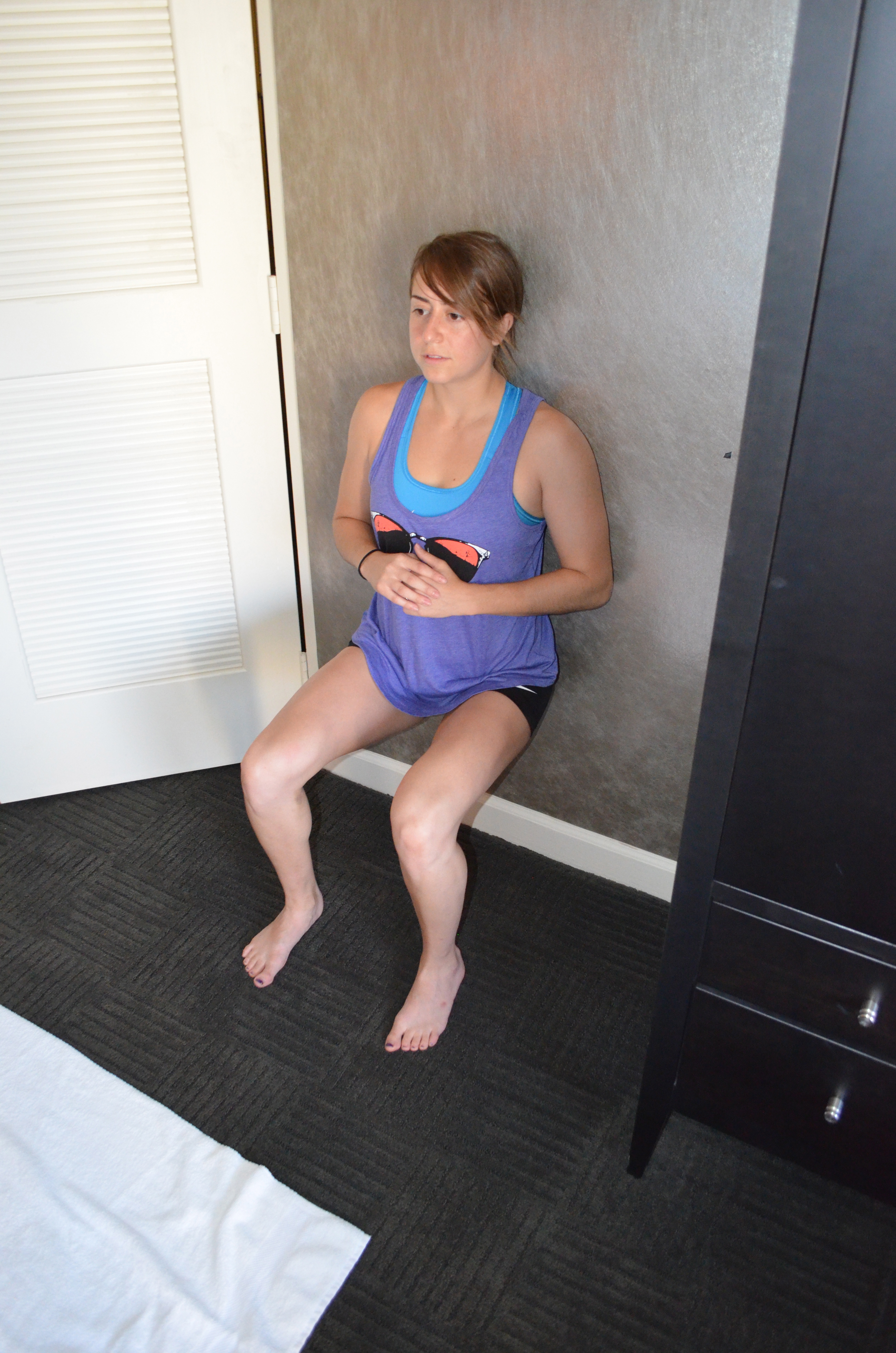
2. Wall Sit – This is a variation of the Squat Hold and equally as torturous. If you have trouble holding at 90 during the Squat Hold or if you lean forward, a wall sit will be the best option for you. Sink down to 90 and drive through your back into the wall. Sit up nice and tall. Hold for 30 seconds to 1 minute. If this doesn’t feel incredibly challenging, you can do a single leg wall sit. Raise one leg off the ground and hold it straight out in front of you (the straighter out in front of you that you hold the leg off the ground, the more you will work that quad as well). Try a 30 second to 1 minute hold on each side.
3. Squat Hold followed by reps – While bodyweight reps alone may not be challenging, bodyweight reps after a squat hold will be. Hold until your legs feel tired (30 seconds to 1 minute for most people). The longer you force yourself to hold before the reps, the harder the reps will be. Then do 10-20 reps after the hold and repeat. You can even advance this move further by doing a hold followed by reps of jump squats. (And to make this move extremely tiring, you can do a hold followed by basic reps followed by jump squats. OUCHIE!)
4. Slow Reps – Everyone always wants to go faster. No one ever wants to SLOW DOWN. And why is that? Because slow reps are AWFUL…aka REALLY HARD AND TORTUOUS! Try taking 5 seconds to lower down to the bottom of your squat before exploding back up to the top. Or try a 2-3 second lower, 5 second hold at the bottom and then a 2-3 second press back to the top. Mix it up. There are a ton of ways you can slow down the tempo. Just slow it down. Shoot you can even go quickly down, hold at the bottom for 5-10 seconds and then pop right back up!
5. Jump Squats – Just like slowing something down makes it harder, so does making something more powerful and explosive. With jump squats, it isn’t about performing a super deep rock bottom squat. You actually want just a little squat/hinge to load so that you can explode up. Squatting too deep can actually hinder your ability to be super explosive and jump high. So perform a more shallow squat and explode as high off the ground as possible. Beginners may need to rest between each rep. To make the move harder, jump up and sink right back into the squat to repeat. Really focus on a soft landing. You should never land with your legs completely locked out unless you want to hurt your knees. SOFT KNEES! Bend your knees to help you absorb the impact of landing.

6. 90 Degree Hops – A variation of the squat jump where you not only explode up, but also rotate 90 degrees to each side. With this move you can either focus on getting high off the ground OR on staying low and moving quickly. Both can really make the legs burn. I love this move because it isn’t just a simple sagittal plane squat! Just like the basic jump squat, you need to remember to focus on a soft landing.

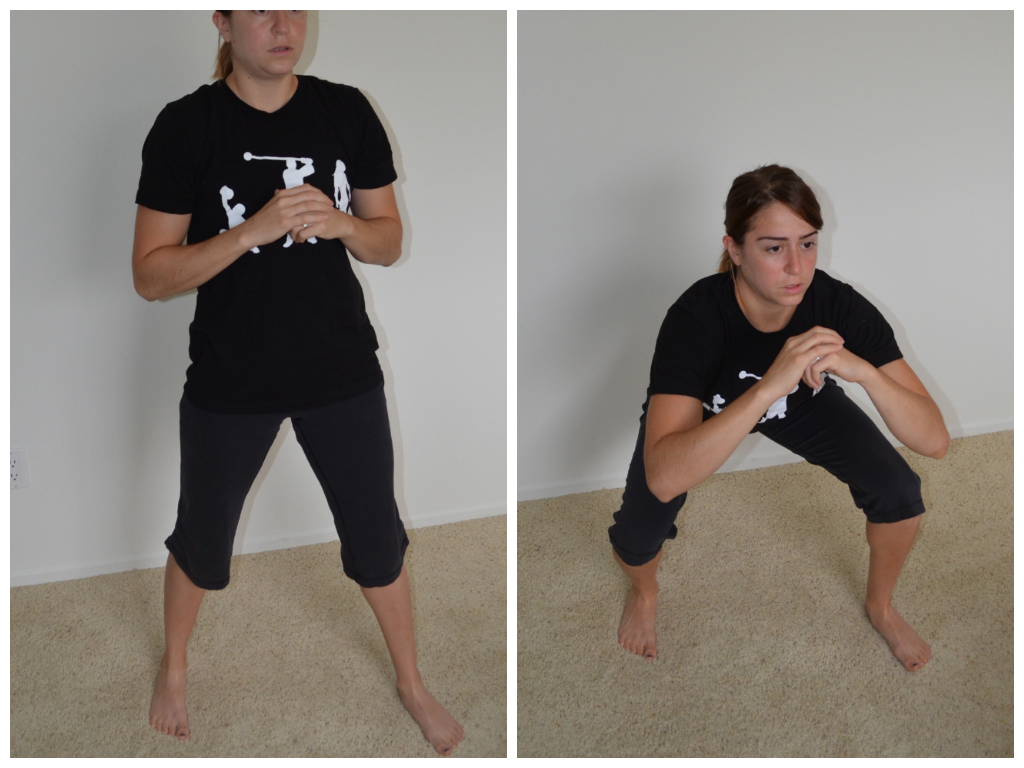
7. Staggered Stance Squats (and or Jumps) – A great way to work each leg individually without doing a single leg movement, is the staggered stance squat. Place one foot in front and the other foot about hip-width to shoulder-width apart and a bit behind the front foot (the back toe should be about even with the instep of your front foot). Squat down as low as possible, keeping your weight in your front heel. Do not worry if the back heel comes up. Do not lean forward or let your back round. Complete all reps on one leg and then switch to a staggered stance on the other side. To make this move harder, you can do one of two things – you can do a staggered stance squat jump or you can do a slow tempo staggered stance squat.
8. Single Leg Squats to Bench – This is a progression toward a pistol squat and a great way to correct any imbalances because the legs work individually. I did it with my IKEA table, but you can use a chair or bench or well…a step stool. Anything that is the proper height that you can sit down to. The lower the “box,” the harder the move. Start by sitting on the bench. Place one foot solidly on the ground with your heel right under your knee. Lift the other leg off the ground. I like to hold it out straight to make the quad work. Stand up straight. Try not to lean forward as you stand. Sit back down, controlling your decent as much as possible. As with all squat variations, you can slow down the tempo to make this move harder!

9. Single Leg Squats Using a Wall – This is more challenging than the squat to bench unless you have a super low box and have great control over your decent. Stand in a doorway with your hands on the each side. Straighten one leg out. Sit back into your heel and walk your hands down the wall as you squat as low as possible. Once you go as low as possible, walk your hands back up and drive through the heel back up to standing. Try to pull up with your hands as little as possible. Use the wall for support only as much as needed. Do not rock onto your toe. Drive off the heel as much as possible. Really keep your core engaged as you perform the move. Do not worry about your back being completely straight.

10. Pistol Squats – Basically this is a single leg squat with no support! Go as low as possible, holding the other leg out straight. Drive up through the heel to come back to standing.
Bonus:
5 minutes of bodyweight squats – A great way to get in some cardio and work the legs using the BASIC BODYWEIGHT SQUAT is to set a timer and do as many reps as possible in the time allotted. I like five minutes. It is just long enough to be awful, but not so long that you need to take long rests. Work your way up to five minutes if you are a beginner!
What is your favorite squat variation without weight?
How to make your workouts challenging
Generally when we want to make an exercise or workout more challenging, we add more weight.
And lifting heavier definitely makes a move more challenging.
Shoot I love that feeling of lifting more than I did the week before. I love adding weight!
But adding more weight to an exercise isn’t always the best way to make the move more challenging.
If you feel like you are plateauing or have plateaued, or if you feel like your workouts just aren’t challenging you anymore, here are five ways to your workouts more challenging WITHOUT just adding more weight to the moves.
1. Change up your rep tempo:
I think rep tempo is far too often overlooked. I think most of the time people just do the reps as quickly as possible or in a “controlled” tempo. They never want to slow the reps down. Why? Because slow reps are uncomfortable and HARD! A great way to make any move more challenging without adding more weight is to slow down your rep tempo. I love doing a 5 second eccentric contraction (the part of the movement when the muscles are lengthening). Like in a squat…Take five seconds to squat down to the ground. Then explode up. That slow eccentric contraction is killer!
You can also do isometric versions of the exercises or HOLDS. Instead of doing reps of a squat, or maybe even BEFORE you do squat reps, do a hold (with or without weight). The hold is killer and then makes the reps even more challenging. Here is a great Isometric workout that will challenge you even if you don’t use much weight at all!
Those are just two of the ways you can slow down reps to make them more challenging.
You can also speed the reps up if you always do them slowly. Doing reps more explosively can also be challenging.
The key is to adjust your tempo and use it to challenge yourself instead of just doing reps in the same old “controlled” fashion all the time.
2. Change up your rest:
Not every workout has to be done as quickly as possible with as little rest as possible. On the flip side, not every heavy strength workout has to include a TON of rest between sets.
Honestly, I feel like recently you have more and more people just trying to cut out the rest and go as quickly as possible through everything though.
And less rest doesn’t necessarily mean a better workout.
Change up your rest if you are always doing the same thing.
Try some circuits that are timed so that you have to do as many rounds as possible before the time is up. This will force you to take less rest.
Or try taking more rest if you are always pushing yourself to go faster. Try to recover so that you can really give the same work output each round.
Recovery/rest should be used to achieve specific goals. Don’t just take out all rest because it “feels hard” at the time. Add in rest or take it out to achieve specific goals.
Are you working on your work capacity? Then maybe shorten the rest. But if you are really trying to focus on strength or maybe even on improving your speed or power, you may want to add in more rest.
Longer rest doesn’t mean easier.
3. Do a variation of the current lift (single limb movements are great!):
There isn’t only ONE way to squat. ONE way to deadlift. ONE type of push up! Variations of these moves could help you target your weak spots.
For instance, if you do the sumo deadlift all the time, try doing a week or two of conventional. It will give your hips a break and it will probably end up strengthening your sumo deadlift!
Or try a front squat instead of a back squat. A front squat is going to force you to engage your core more (and you may actually need to lift LESS than you would with the back squat).
There are a ton of variations that may just target your current weak spots without using more weight (and maybe even using less) and make them stronger so that, in the end, you can lift more on the moves you love!
Some of my favorite exercises variations to add in are single limb movements. These exercises work to correct imbalances, develop core strength, and improve balance all while building a stronger mind-body connection.
Try a single leg deadlift or a single leg squat. You may not even need weight at the beginning to challenge your body! Here are some single leg movements to try!
4. Change up the type of resistance/equipment you are using:
Do you do step ups but they aren’t feeling that challenging anymore? Do you usually just add more weight?
How about trying a higher box! Using a higher or lower box can hit your glutes from a different angle.
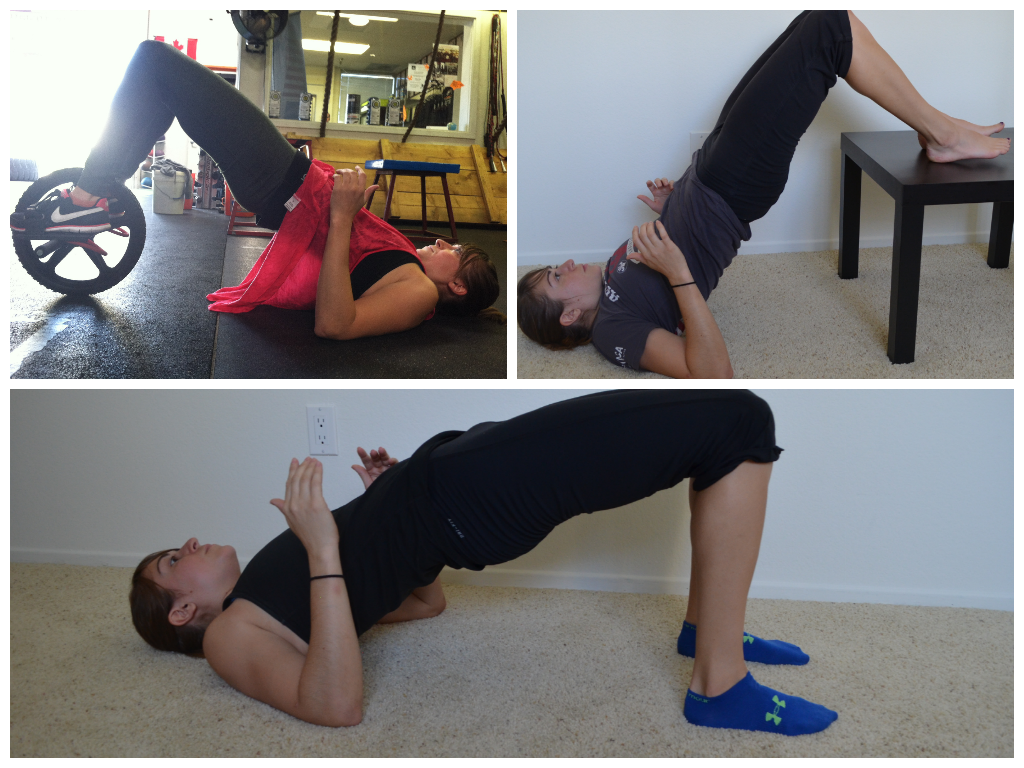
You can also mix up glute bridges by using different pieces of equipment. It is the same basic move, but it can be done with your feet up on a box or on a powerwheel instead of just simply on the ground.
And same even goes for lunges. Sliders (towels) can be a great way to reduce traction and make lunges harder without adding weight!
Any exercise can be changed up by using a different piece of equipment or a different type of resistance. And sometimes when you change-up the equipment or type of resistance, you will find you even need to go down in weight at the beginning.
A split squat can be done on the ground OR with the back foot up on a bench (balance lunge). The first time you change from a split squat on the ground, even if you use weight, to a balance lunge, you may find you either need to use less weight or drop the weight all together. Both moves can be challenging, but both definitely work the muscles in a different way while being the exact same basic move!
And not only can you add in a piece of equipment to a move but you can also change-up the type of weight that you are using. What about an overhead press with a resistance band instead of dumbbells? Or what about a deadlift with kettlebells instead of a barbell?
Doing the same exercise can feel very different just by switching up the resistance. Bands force you to work on the way up AND the way down. Whereas with dumbbells you really only work on the press overhead, you work harder in both directions with a band because there is consistent resistance throughout the move.
A deadlift with kettlebells is also very different from a deadlift with a barbell. It is way harder on the grip to hold two heavy kettlebells that equal 135lbs than it is to hold a deadlift with 135lbs. For one, neither hand gets assistance from the other. For two, the competition kettlebells have a fatter handle than the barbell, which make them harder to grip.
The point is by making simple changes in exactly how you perform the same moves can make them more challenging and even work on weak points within your lifts by hitting the muscles from a different angle!
5. Load asymmetrically:
Have you ever tried using less weight to make a move harder?
Try dropping a weight on just one side when you lift.
Asymmetrical loading can make moves incredibly hard and really build core stability. It also forces each side of the body to work independently which helps correct imbalances without necessarily being a single limb movement.
Try a unilateral deadlift, single arm bench press or unilateral farmer’s walk. It will be harder than you think. You may even need to go down in weight at the beginning since it takes a toll on your core.
It isn’t easy trying not to lean either too much away from the weight or too much into it. Your body will want to rotate, but you can’t let it.
Asymmetrical loading is one of my favorite way to add some variety to my workouts as it really does build great core strength and can be done with almost any move (it can also really help improve your balance).
Do you always just add more weight to make exercises harder? What are your favorite ways to add variety and keep your workouts challenging?
Home Workouts – Keep It Simple Stupid
The other week I was contacted by the OC Register about participating in a column they were writing throughout the year about workout moves you could do at home. They were talking to a few different trainers in the area and getting each of them to demo about 8-10 exercises. (My first move will be featured on the 25th…AHHHHHHH!)
You could use equipment. It just had to be something that could easily be stored.
I was super pumped to participate and instantly started writing out a list of things I could do. I debated about a kettlebell or sandbag.
But decided against using any equipment except for something someone would easily have lying around the house.
I’ve become extremely interested in finding and creating great and challenging home workout moves you can do with limited space and no equipment and I wanted to highlight some of those moves.
And when the reporter asked me why I picked the moves I did when there are so many crazy cool new pieces of equipment out there that could be stored easily at home….
I said, “Because you don’t NEED any of those!”
Equipment can be fun. It can keep you interested and add variety to a routine that is getting stale.
But it isn’t NECESSARY.
Equipment doesn’t mean you are going to get a more challenging workout. Heck sometimes it even means getting away from truly functional moves that will truly have the most benefit.
Equipment is a TOY. It isn’t necessary even though people have become convinced that they can only get in a great workout if they have the latest and greatest TOY.
Basically, I explained to him that I wanted to make a point that you don’t really need ANYTHING to get in a great workout at home! That there are a ton of tweaks you can make to traditional moves to make them more challenging and keep your workout interesting.
Yea I love equipment, but sometimes it just takes us away from what is important. Sometimes it distracts us from focusing on what will actually help us achieve our goals.
Sometimes equipment just complicates moves unnecessarily.
Sometimes we would get more out of a workout if we just KEPT IT SIMPLE and stuck to basic moves and movements!
Pull, push, squat and hinge. Those four basic movements are all you need.
Push Ups, pull ups (or rows), squats and lunges. These are examples of each of the four movements above.
Those four moves work your entire body. And those four moves can be made challenging without any equipment. There are also a ton of variations you can do without anything fancy so you never get bored.
Push ups can be done on an incline. Or you can do them on a decline to advance them. You can do handstand push ups. Or set up some books and do a shuffle push up over them. You can also do a push up to side plank or a fly to push up on a towel. (For more push up variations, here are some ideas. You can do all of these at home even the push up to dip.)
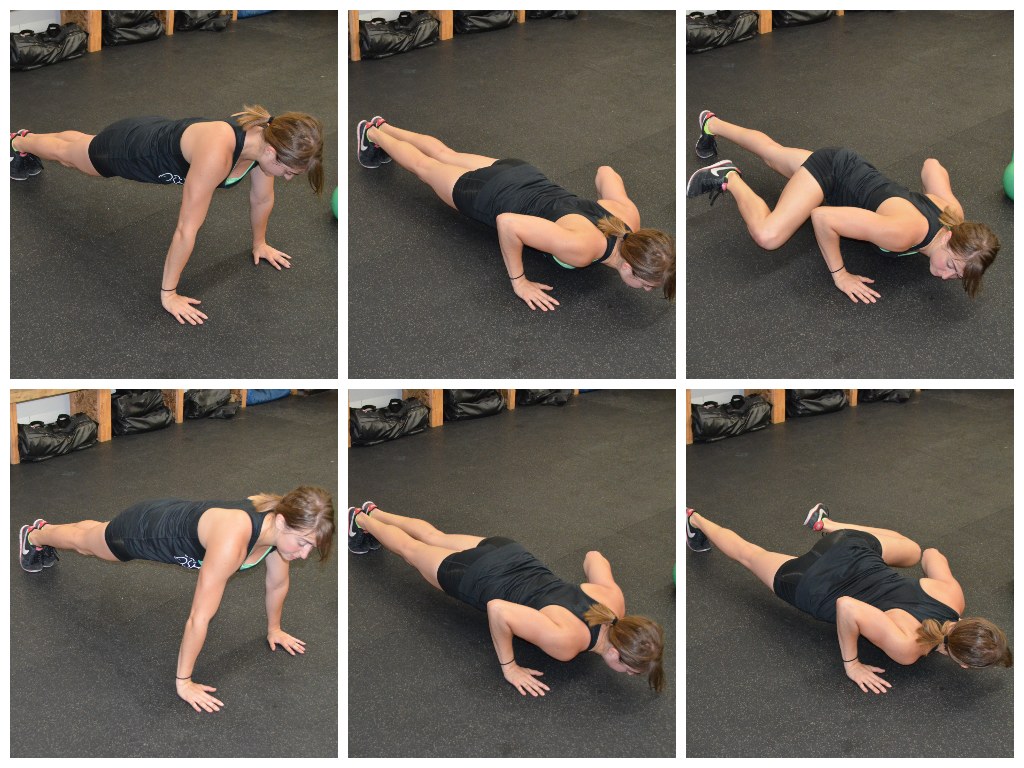
There is always the spiderman push up too….
All these moves are simple. None of them require anything you don’t have at home. And all just are slight variations on the traditional push up.
We aren’t reinventing the wheel here.
We are just tweaking it slightly to make it harder or easier. We are adjusting it to focus on slightly different parts of our body.
Same goes for the pull ups or rows, squats and lunges.
Especially the lunges.
People think of lunges and they think forward and backward lunges….maybe they even include side lunges. But what about curtsy lunges? What about lunges in EVERY DIRECTION? You can do angled lunges. Rotational lunges…You can literally lunge in every direction to hit different aspects of your leg.
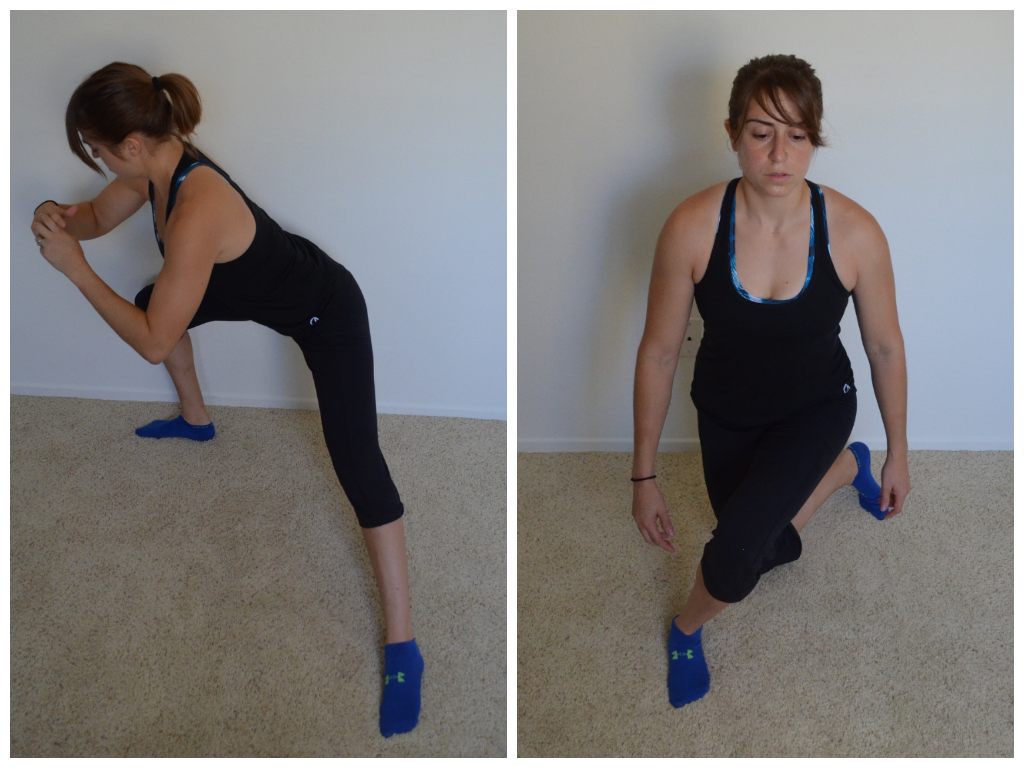
You can lunge in EVERY direction!
And on top of that you can add a towel to one foot to increase the intensity of the lunges. Or you can even do a balance lunge with your foot up on a couch/chair/table to make the basic split squat even more difficult.
You can do lunges where the weight is on the leg moving out. Or you can do a lunge where the leg working is more static. For example: On a side lunge, you can either step out into the lunge and sink into the leg that has stepped out OR you can sink into the standing leg and then just reach the other leg out straight to tap the toe out to the side.
Both work the leg in very different ways!
But you don’t need any fancy equipment to make the moves hard or even add variety! You can work your legs from every angle just by doing a LUNGE.
Keep it simple stupid.
Don’t worry about the latest and greatest equipment. Stick with the basics and you will get results!
What are your favorite variations of the push up, pull ups (or rows), squats and lunges? Do you find that you get caught up always looking for the next new piece of equipment? Do you even skip workouts at home because you don’t have “equipment?”
P.S. Who likes working out with a friend or a spouse? Interested in some great partner moves? Check back tomorrow!!!
10 Isometric Exercises – Why You Need To Include Them
At least once a week, as part of the warm up, I would do isometrics with my volleyball girls. (I also use them with my clients.)
But they are an especially important tool to use with young athletes because they work not only on physical strength but also on MENTAL TOUGHNESS.
Isometric exercises are any exercise you HOLD under tension.
And holding a move when your muscles are shaking and your brain starts to say, “QUIT!”…well there is nothing mentally more challenging. There is no movement to make it better. No place to escape the pain.
You’ve just got to sit, stand or lie there and hold it through the pain. (They sound really great right now…huh?!?)
You can use isometrics as part of a warm up, to get muscles activated and working together. You can also use them as a workout by themselves by doing only holds or by pairing the isometric exercises with strength or power repetitions.
Here is a list of a few of my favorite Isometric Exercises.
1. Toes (Single or Double) – This move works on your balance and warms up your feet, ankles, knees, hips and core. It is also a great calf and core strengthener. To do this move, stand on both feet and go up as high on your toes as you can. Hold that position for 30 seconds to 1 minute. To make this move harder, do single leg balancing on your toe.
2. Squat Hold (Wall Sit) – The squat hold can be done as a wall sit or as a free-standing squat and hold. Place your feet between hip-width and shoulder-width apart. Sink down until your thighs are parallel to the ground. To make it easier, do not sink as low. Keep your core engaged and your chest up. Do not lean forward too much. Make sure to sit back on your heels when you squat. You should not be on your toes at all. Do not sink below 90 degrees with this move as that actually makes it easier. And do not let your knees collapse inward. Hold for 30 seconds to 1 minute. If you want to make this move harder, you could hold a weight at chest height or even on your lap while doing a wall sit. Or you can even do a single leg wall sit!

3. Warrior Pose – Many yoga classes use isometric moves. Any time you hold one of the warrior poses, you are performing an isometric exercise. I call this move the “warrior pose” (although I know there are a few different warrior poses in yoga). To do this move, set up in a wide stance for a lunge. Turn your back foot so that the toe is pointing away from you. Your back foot will be perpendicular to your front foot, which will be pointing straight ahead. Do not let your front knee collapse in as you sink down in the lunge. Keeping the back leg straight, sink down as low as you can. Shoot for the front knee to be at 90 degrees. Make sure your front foot is firmly planted on the ground at that your knee stays about over your ankle. If you want to add a bit of shoulder work in, bring your arms up to shoulder height. Reach one forward and one backward toward opposite walls. If you want to make this move easier, don’t sink as low. Hold 30 seconds to 1 minute.
4. Split Squat – Set up in a wide stance with one foot forward and one foot back. Both toes are pointing straight ahead. Sink down until your back knee is almost touching the ground. Make sure you are not leaning forward. Your front knee should be over your ankle. If you want to make this move easier, don’t go as low. Hold for 30 seconds to 1 minute.
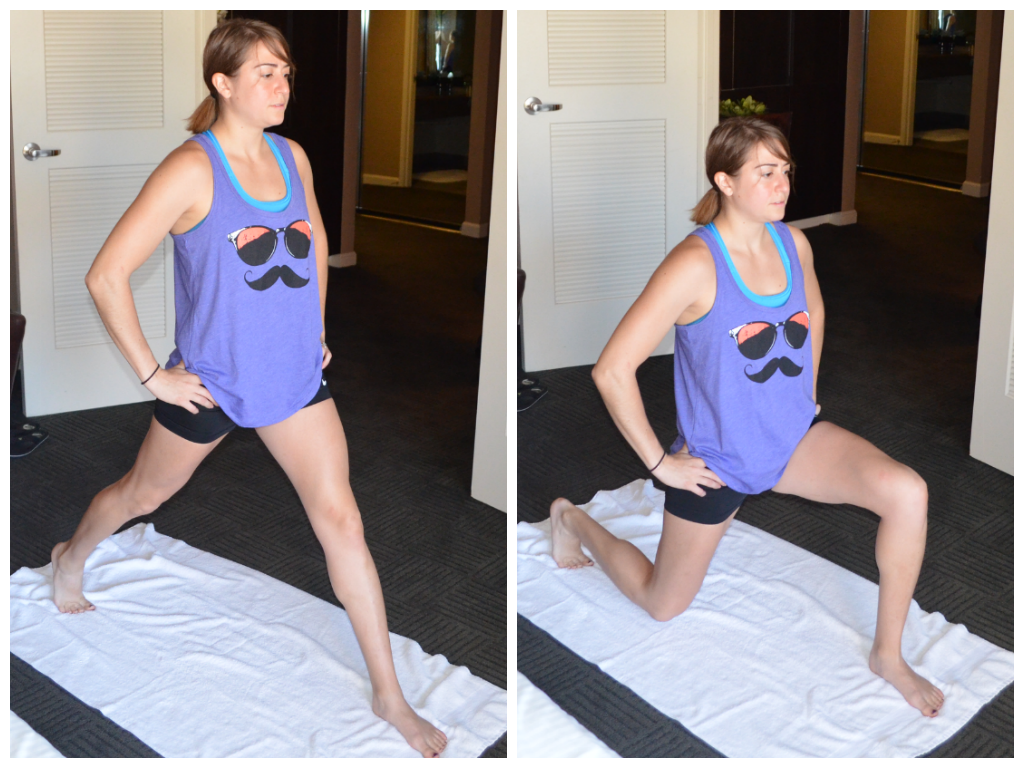
5. Scapular Wall Hold (Could also be a row up and hold) – THE BEST MOVE FOR POSTURE AND PULL UPS! Bend your elbows to 90 degrees. Lean back into a wall with only your elbows touching. Press your chest out and your shoulder blades down and back. Walk your feet away from the wall only as much as needed to feel the muscles behind your shoulder blades working. Do not let your shoulders shrug up by your ears. The bigger the incline from the wall, the harder the move will be. Make sure to keep your body in a nice straight line. Keep your core tight and squeeze your quads and glutes. You could also sub out the scapular wall hold for an inverted row to hold. You could row up on either a TRX or barbell and hold at the top of the row. Hold for 30 seconds to 1 minute.
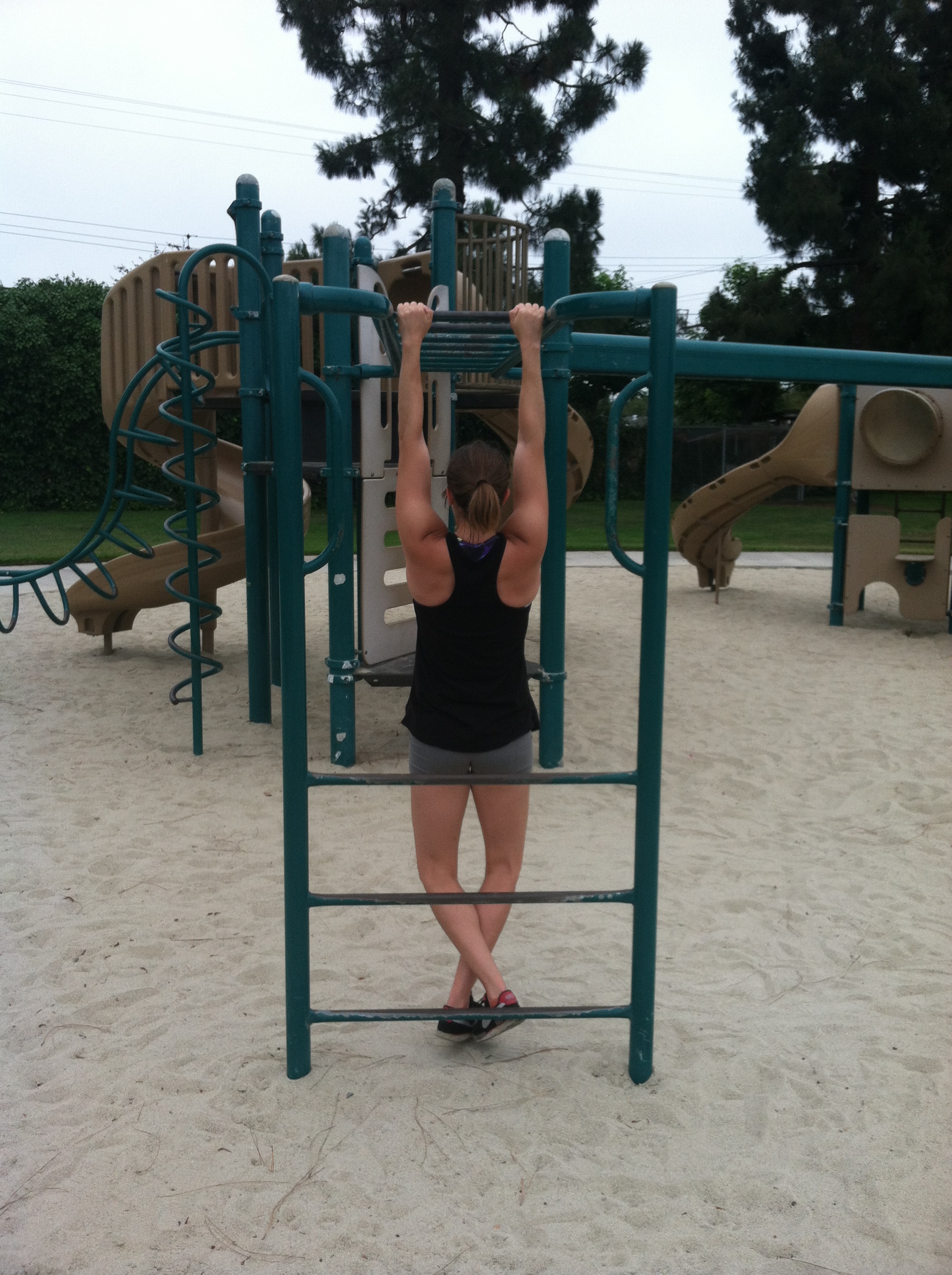
6. Dead Hang (Pull up and Hold) – You can hold at the bottom, middle or top of the pull up and each will have its benefits. My two favorite are the dead hang (holding at the bottom and just pinching your shoulder blades down and back) and the pull up to hold (holding at the top). With the dead hang, grab the pull up bar and pinch your shoulder blades down and back. You want to press your chest out and tighten your core as if you are going to pull up. To make this move easier, hold for a shorter time OR add some assistance by either keeping your feet on the ground so you are pulling less weight or by using a band around your knee. To do the pull up and hold, hold at the top of the pull up. Your shoulder blades should be down and back and your legs should be straight. Do not tuck your knees. To make this move easier, use a band or place one foot on the ground for assistance. Hold 30 seconds to 1 minute. (Below are the dead hang and the assisted hold at the top.)

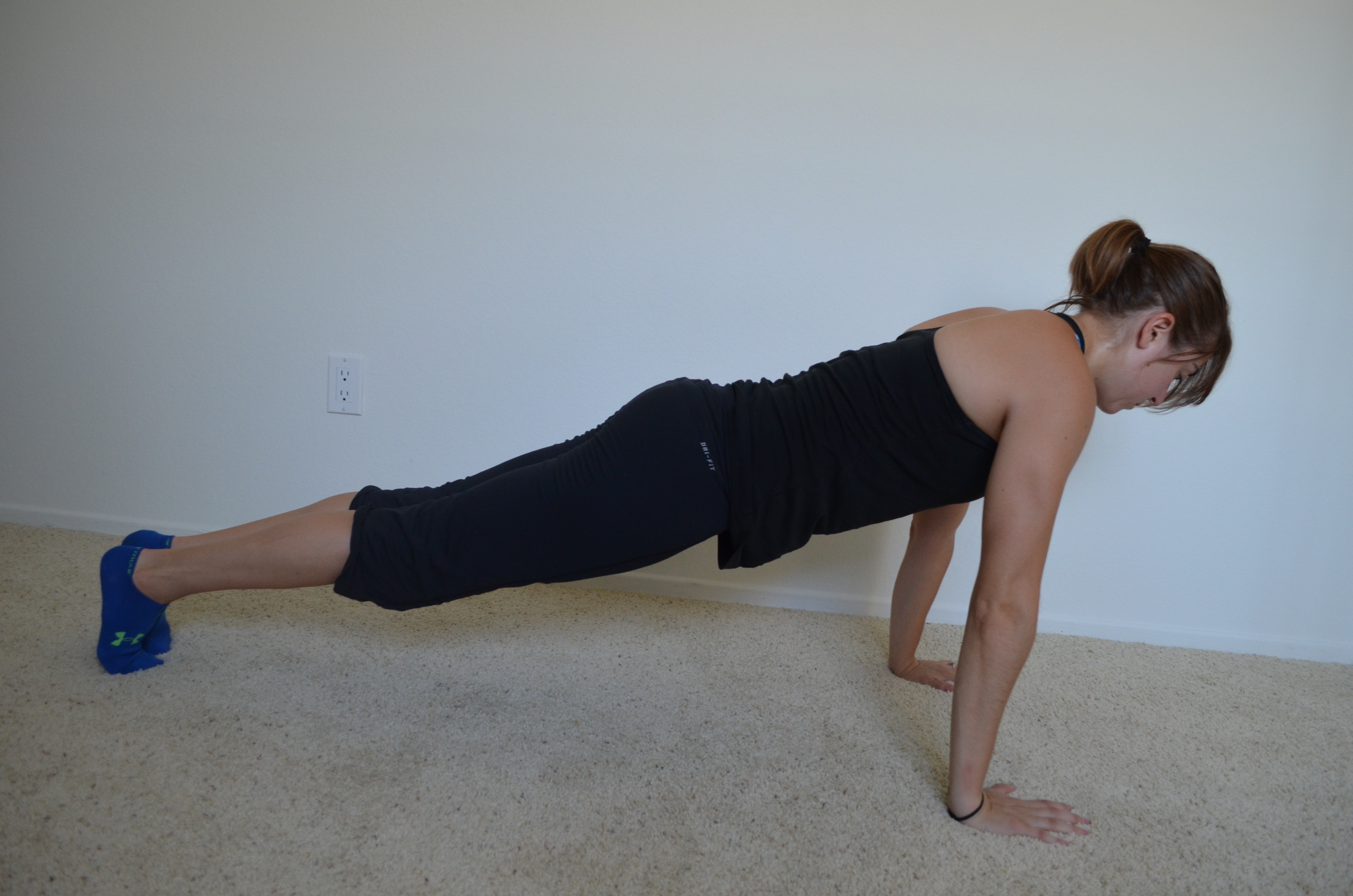
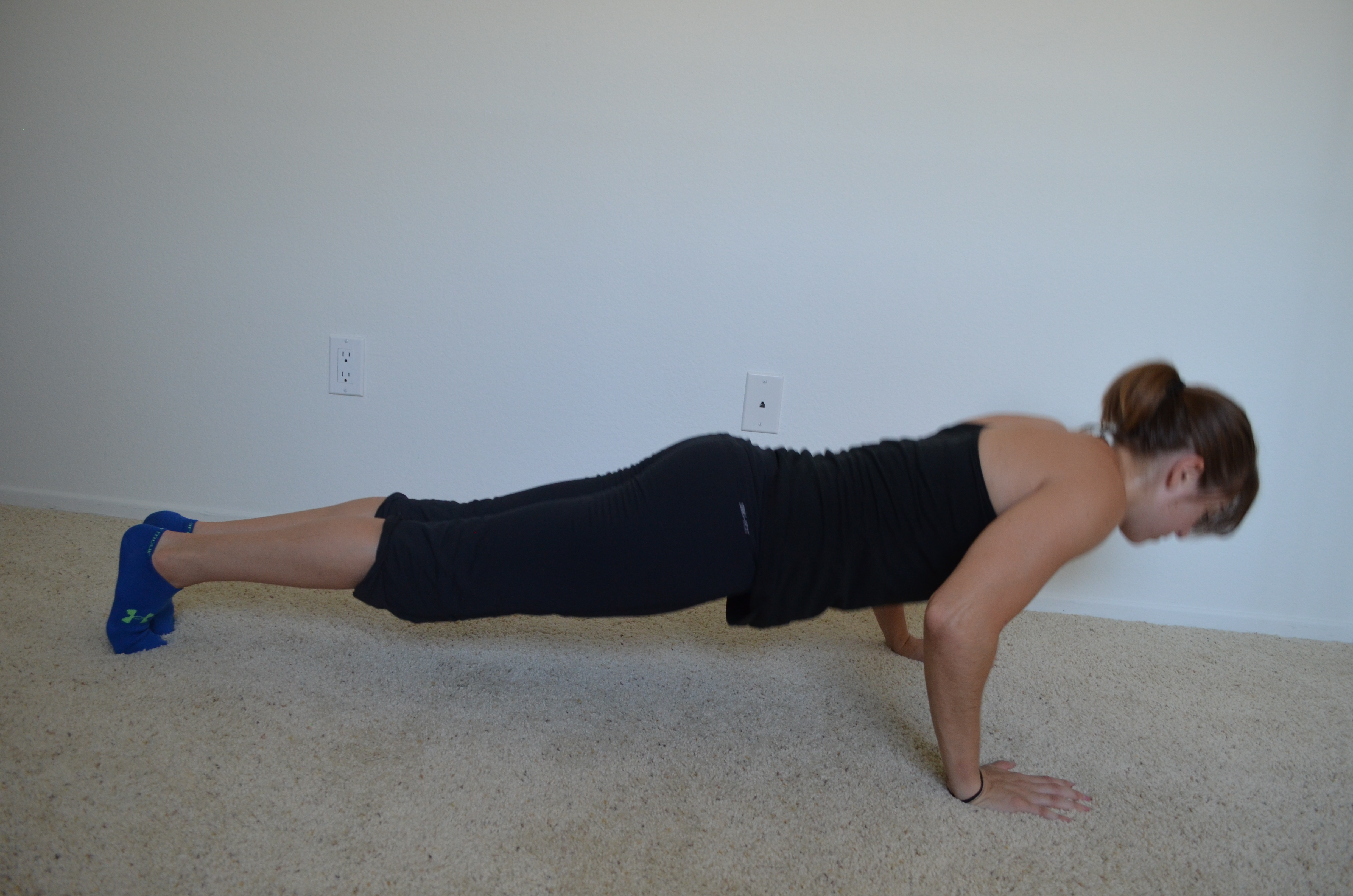
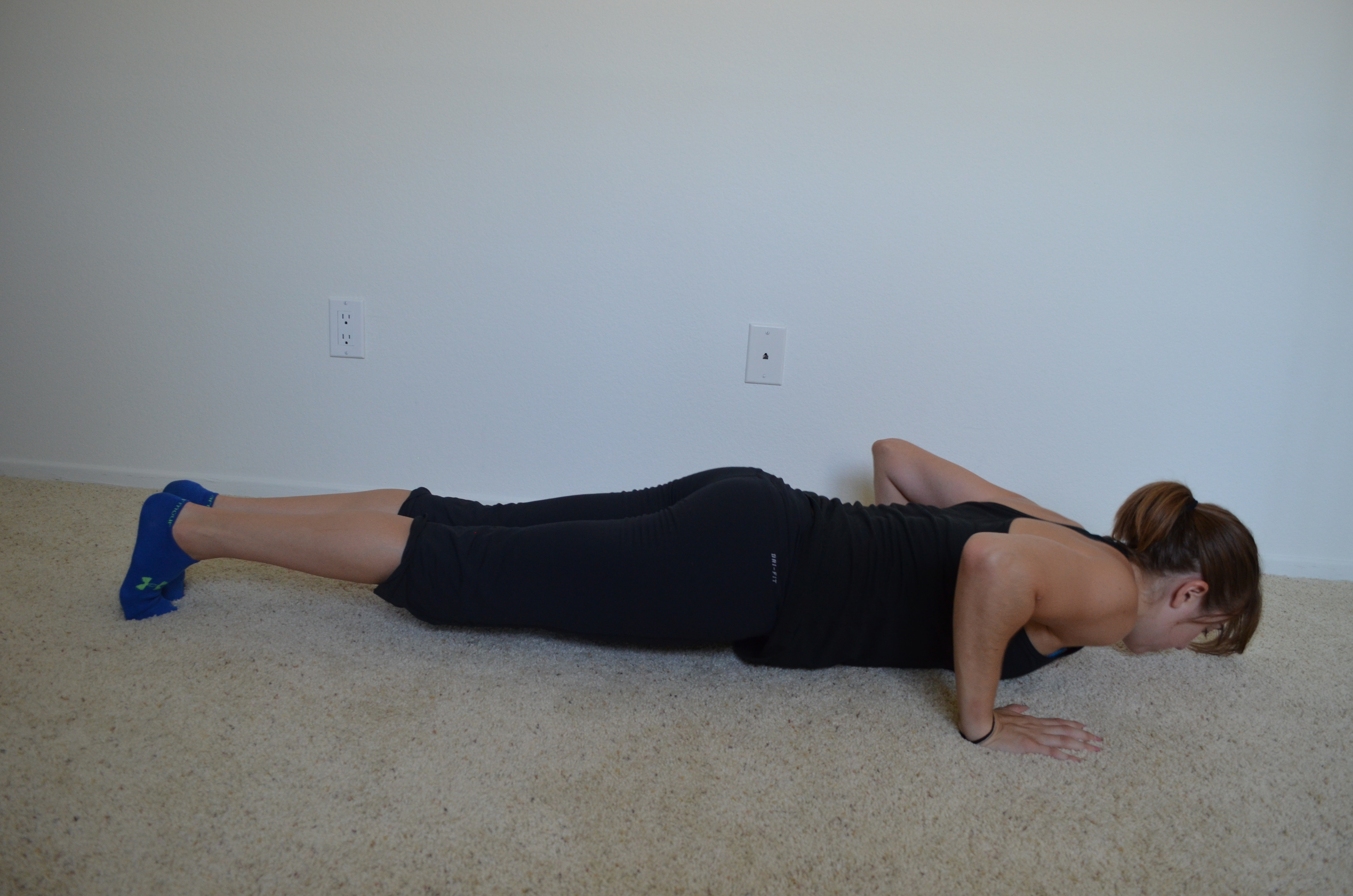
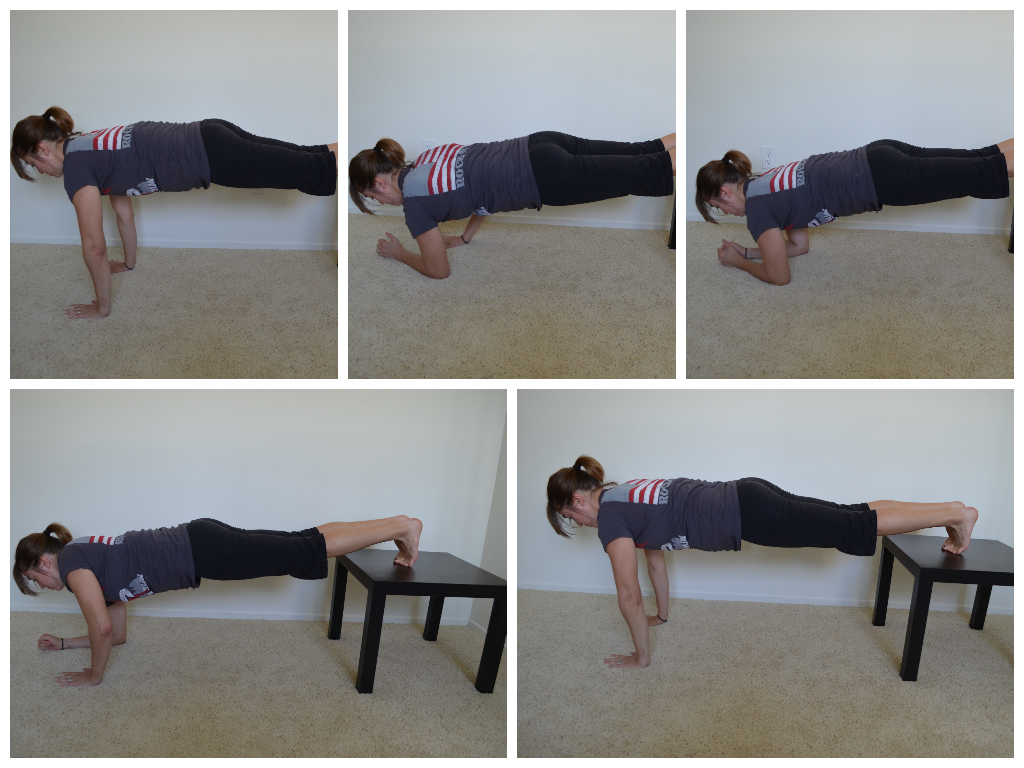
7. Push Up Hold (Hold top, bottom or middle) – I most often hold this move from the top of the push up. So set up on your hands and toes. Feet are together and hands are underneath your shoulders. Draw your belly button into your spine and squeeze your quads, glutes and adductors. Your shoulder blades should be down and back and your shoulders shouldn’t be up by your ears. Keep your head in line with your spine. Hold for 30 seconds to 1 minute. When I do isometric holds at either the middle or bottom of the push up, it is usually for only 3-5 seconds. When I do those holds, I’ll hold at the top for 5 seconds, middle 5 seconds and then bottom for 5 seconds before pushing back up to the top. I’ll usually do anywhere from 5-15 reps like that. (Below are holds at the top, middle and bottom.)
8. Side Planks – You can do these from your hands and toes or knees and forearms. Going down to your knees or forearms will make the move easier. Place your hand underneath your shoulder. Rest on the side of your feet. Stack one foot on top of the other or place one foot in front of the other. Raise up on your hand and the side of your foot. Do not let your hip sag toward the ground. Keep your chest open. Do not let it rotate toward the ground. Hold in a nice straight line, squeezing your core, quads and glutes. Hold 30 seconds to 1 minute each side.
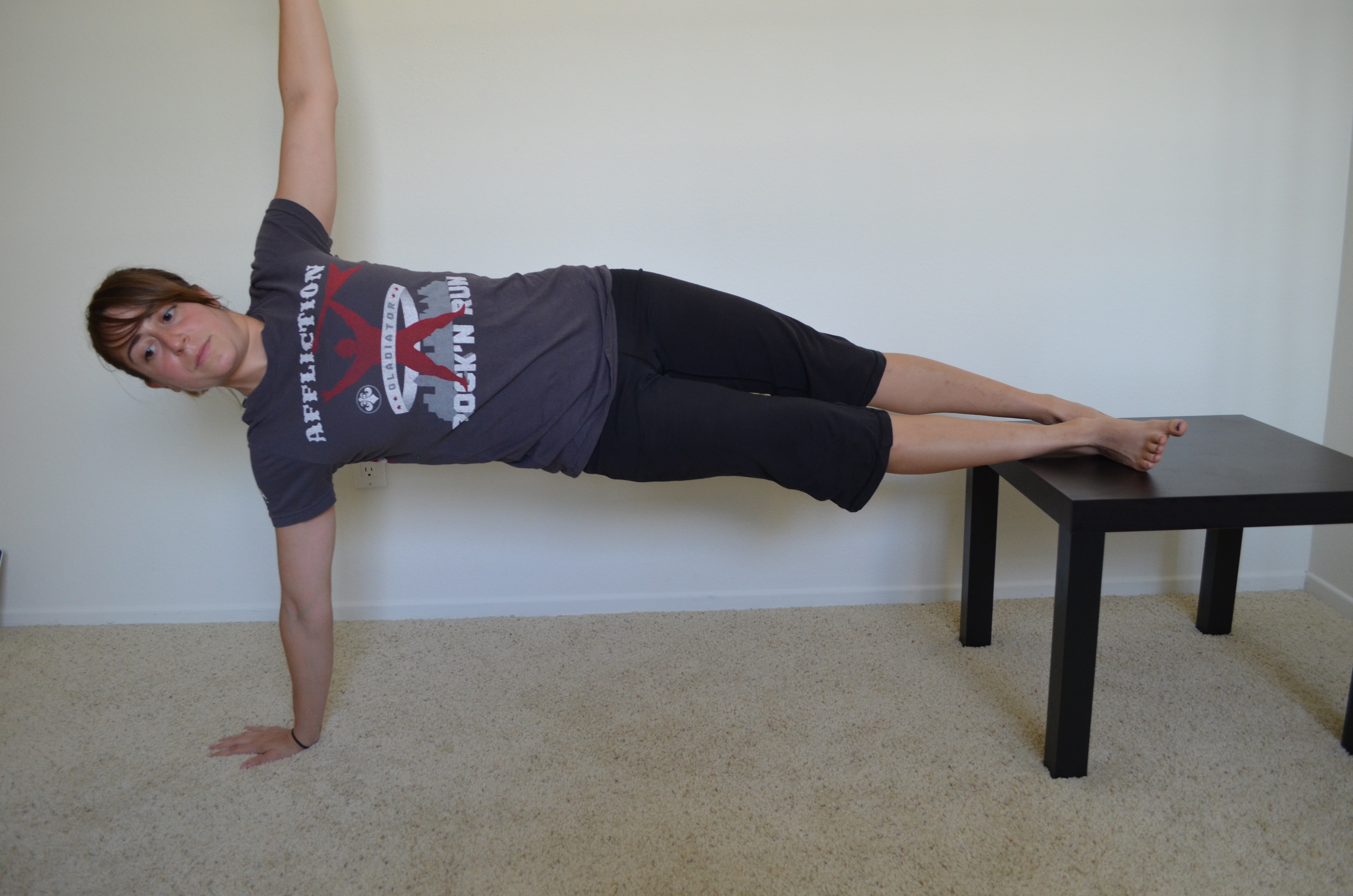
Can make the side plank harder by putting your feet up or raising the top leg.
9. Glute Bridge – Lie on your back. Bend your knees and place your feet flat on the ground. You should be able to graze your heels with your finger tips. Squeeze your glutes and raise your hips off the ground. Keep your core tight and drive up as high as you can. Your weight should be in your heels. Do not go up on your toes. To make this move harder, do a single leg hold. Hold 30 seconds to 1 minute.

You can make the bridge harder by holding on a power wheel.
10. Bull Dog – Start on your hands and knees. Knees should be under hips and hands underneath shoulders. Tuck your toes under and raise up onto your toes and hands. Hold with your knees just an inch or so off the ground. Do not let your low back arch. Keep your core tight. You will feel this a lot in your quads too. If you don’t, make sure your knees are under your hips. Hold 30 seconds to 1 minute. To make this easier, raise up a bit higher or walk your feet back a bit. You can also perform a shorter hold.
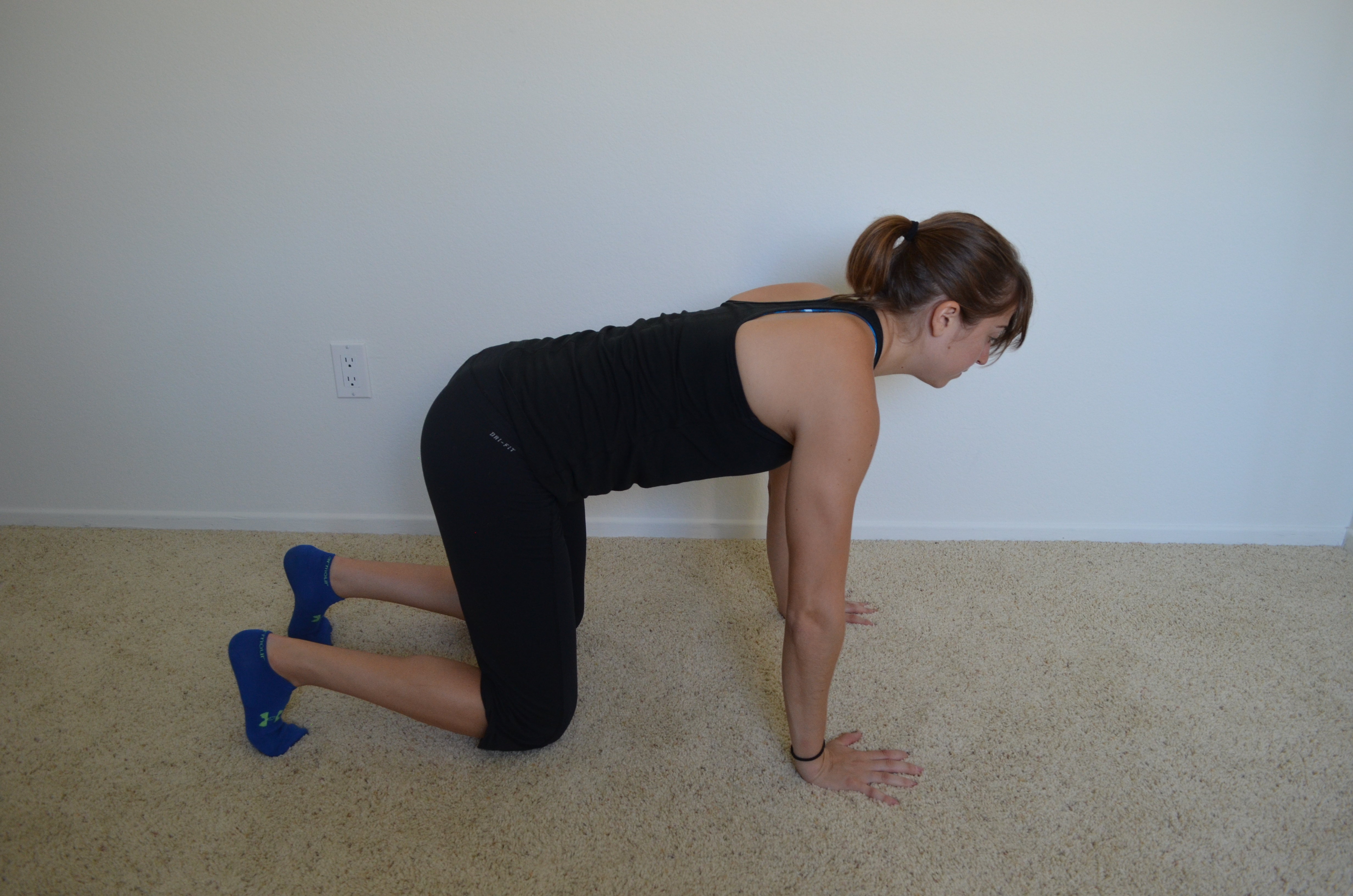
While it is hard to tell, my knees are hovering about an inch off the ground.
And in case you aren’t completely sure how to combine the moves above, below are two workouts you can start with!
Isometric Holds (can be shortened to a warm up)
3-5 rounds of 30 second to 1 minute holds:
Toes
Squat Hold
Scapular Wall Hold
Bull Dog
Side Planks
Isometric Holds and Repetitions
3-5 rounds of the following:
Toes 30 seconds to 1 minute
Jump Rope 25 reps
Split Squat Hold 30 seconds to 1 minute
Split Squat Jumps 10 each side
Scapular Wall Hold 30 seconds to 1 minute
Inverted Row 10 reps
Push Up Hold 30 seconds to 1 minute
Push Ups 10 reps
Glute Bridge Hold 30 seconds to 1 minute
Single Leg Glute Bridge 10 reps each side
Rest 1 minute between rounds.
For more isometric moves, check out these Isometric Moves To Alleviate Desk Job Aches and Pains!
And if you are a runner, here is a Runner’s Recovery Workout using isometric moves.
NOTE: Handstand holds are also a great isometric move that I didn’t include but wanted to make note of because I love them!
My Fitness Pal – Consciously consuming
I never count calories now. I haven’t for years.
I eat whole natural foods and I know my calorie intake will be where it should be.
Really the only time you need to count calories is when you have to worry about calories in vs. calories out. And that only happens when you don’t consume quality calories.
So while I’ll make basic notes about to help guide my eating, I don’t that often use a calorie counter or food tracking app.
However, there will be periods of time that spur me to be curious about my exact macronutrient breakdown, which is when I turn to a calorie counter/food tracking app.
Food logs or food tracking apps/websites are a great way to help you really be conscious about what you are eating. While I think calorie counting is awful and stressful, I think tracking what you are eating can be super helpful.
If we aren’t truly aware of what we are consuming, how are we going to know what needs to be changed if we aren’t making progress? If we are succeeding, how are we going to know what works so that we can keep doing it?
That is where a food log comes in handy.
Anyway, after our Metabolic Typing workshop at Innovative Results, I became interested to see my exact macronutrient breakdowns.
I generally don’t worry about exactly what ratios I’m eating. I focus on eating meats and veggies as the base of my diet, with carb cycling throughout the week. My carbs include rice, potatoes, fruit and the occasional corn tortilla.
I knew my carbs stayed low, under 60g, on most days and about 150-300g on carb refeeds (with my fat intake under 50g on carb days).
But I honestly had no idea what my fat and protein intakes truly were.
So I decided to try out a food tracking app.
In the past I’ve used Fitday.com.
And I like Fit Day, but honestly, it isn’t the easiest thing in the world to use. If you are willing to spend the time to put in your own foods and the nutritional breakdown, it is perfect.
I’ve also had clients use Spark People and love it. I found it easy to use and liked that it had some good information in addition to the tracker for anyone using the site.
But I decided to try out My Fitness Pal since a ton of my clients love it and I’ve liked using the phone app with them.
I’ve only used it with clients and never really sat down and fully used it myself so I was curious to really give it a try.
And it is pretty darn great and tracks a ton of stuff.
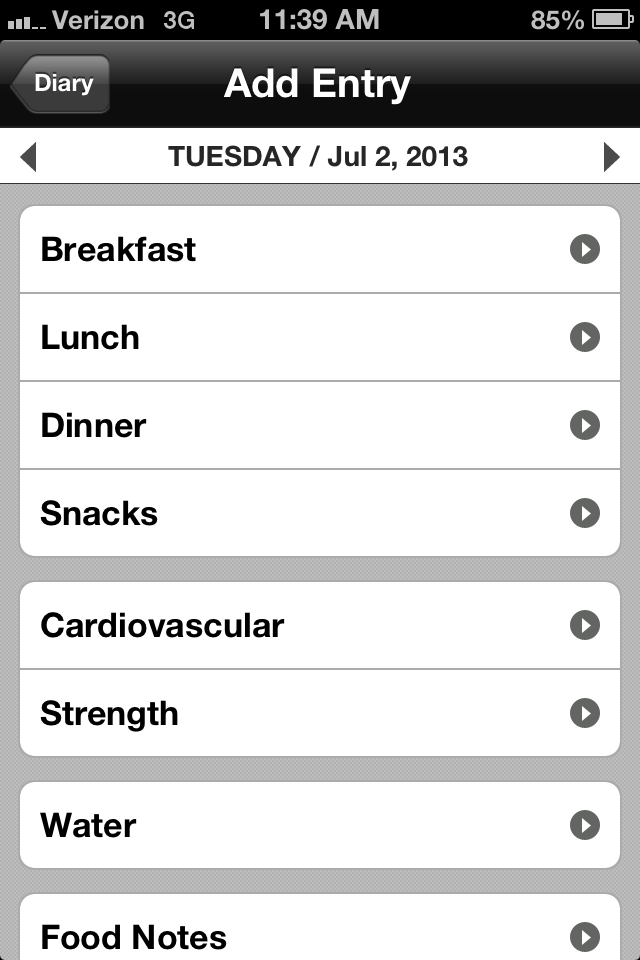
Tracks food and workouts. I do like the “notes” part as well.
I customized my own macronutrient ratios and there are a ton of foods listed in the counter already.
It is also super easy to save a meal so that you don’t have to go back through and select the list of foods in that meal every time you eat it (which for me is great since I eat a lot of the same meals over and over again).
Of course, I was amused by how many different foods there were in there….It is always interesting to see what people consider healthy…Lots of soy milk lattes and sugar-free things….YUCK!
There were also a lot more restaurant dishes and processed foods than whole natural ones. Which I guess, at least, allows people to know what they are eating when they eat out. But still, it is sad to see how much of even the diet of people trying to be “healthy” is really processed crap.
At least though, people are CONSCIOUS of what they are eating when they track it. Because so many people aren’t conscious of what they eat.
And being conscious of what you eat is extremely important. As I said above, if you know what you are consuming, you can figure out what is working and what isn’t.
Same thing goes for tracking your workouts.
Which is why it is nice that My Fitness Pal allows you to track your goals AND your workouts along with your food.
However, while I like the food tracking portion of this app, I can’t say I’m a fan of how the other two sections work.
I like that they exist…Just not how they work.
Under goals, you can choose macronutrient goals. You can even take a few measurements. You can record how many times a week you want to workout. Which is great.
But really the main focus is on weight loss. And it almost even encourages you to weigh every day…Which I don’t like.
AT ALL.
It shouldn’t allow people to record their daily weight. Because daily fluctuations don’t matter and can even discourage people.
Shoot if I weigh right before a carb day and then right after a carb day, I can fluctuate numerous pounds. It’s not really cause I gained weight though! And sometimes I might have even eaten fewer calories than on a low-carb day.
And actually the carb days are what help me become even leaner over the long run even if I do gain weight on the scale right after them.
The point is…YOUR WEIGHT FLUCTUATES. Be it water weight or whatever else. Weight fluctuates so shouldn’t be tracked daily.
And while it has measurements, it only allows you to record neck, waist and hips. Waist and hips are two great places to measure, and tell you a lot, but still…Why not just include arm and thigh as well?
You can lose/gain inches on a number places. And all can show progress. So why not include them all?
I know that there are only so many things a food/workout tracking app can do, but a couple extra measurements should be included.
Just like I think it would be great if the app included a place to record a couple lifts and/or runs and their numbers or times.
Right now, the app asks for workout goals that include how many workouts per week, how long and even how many calories you want to burn. And yes, working out the number of times you planned to, and having that be tracked, can be motivating.
But performance goals for during your workouts can be even more motivating! Having performance goals can help keep you motivated so that you accomplish other goals, like weight loss goals.
Because, let’s face it, when you have a performance goal, you are more likely to eat well AND workout hard no matter how much you want to skip the workout that day.
Anyway, I just think it would be nice for the app to allow you to include a bit more under “goals.”
Not everyone who wants to track their food intake cares about losing weight. And if weight loss IS the goal, it never hurts to have other markers of progress to help keep you motivated!
I know I just went on a bit of a rant about the goals portion of My Fitness Pal, but really the only thing I HATE about the app, is the workout portion.
I’m not sure how they could make it more accurate, but it isn’t accurate at all when it comes to calories burned. Which doesn’t matter to me, but since they add that in to what people can then eat, you would think they would want it to be more accurate. (I guess though if you really care, you could manually enter it yourself….)
But worse than that, is the fact that the app puts a HUGE emphasis on cardio.
Because when you choose the strength training moves, they don’t show you any calories being burned. Fortunately you can add weight, so if you really wanted to track your lifting progress you could always scroll back through your workouts.
However, the only way to show calories being burned during a strength training workout is to select “Circuit Training” under Cardio!
I, personally, don’t care if it doesn’t show what I burned during my workout, but since they do add that in to what you should then be consuming, you would think that strength training would have some value.
It just made me mad because I felt like it perpetuated the LIE that cardio is key to weight loss (and health in general).
Anyway, I’ve found tracking to be very interesting. And I would recommend My Fitness Pal, at least for the food tracking portion.
Do you keep a food log? Workout log? What is your favorite app? Anyone else pissed off about the exercise portion of my fitness pal? (Am I just maybe missing something that makes it better?)
P.S. Another reason I like some of these online/phone apps is that you can easily SHARE and create a community. The more you involve other people in your goals, the more likely you are to accomplish them. ACCOUNTABILITY and SUPPORT!
Home Workouts – 10 Moves You Can Do With An Ikea Table
So yesterday when Ryan and I were doing some foam rolling stuff, I used a table for a couple of the moves.
It was just our little $10 Ikea table, but it was amazingly sturdy considering I put it together…Although that may be better than if Ryan put it together…Sorry Ryan…But it’s true…
Anyway, when I used the table, Ryan said to me, “I wonder if you could do a full body workout with just that table?”
My answer, “You totally could!”
Here are 10 moves you can do with just a cheap little Ikea side table! Love you Ikea! 🙂 (The moves are in no particular order)
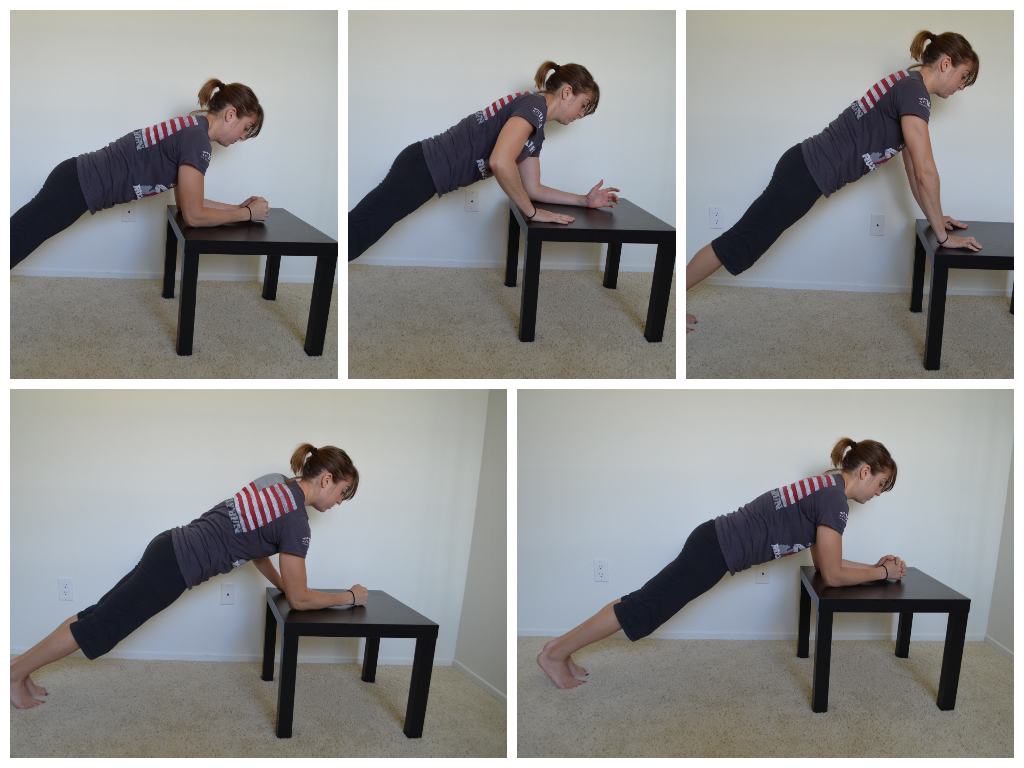
1. Decline or Incline Push ups – You can make the push up easier or more advanced using the table. To make the push up easier, put your hands on the table and then perform the push up from your knees or toes. Doing the push up from your knees will make it easier than from your toes. To advance the push up, put your toes on top of the table.
2. Balance Lunges – The balance lunge is a great leg move to do if you don’t have weights. Place your back foot up on the table and hop your front foot out so you are in a nice wide stance. Then lunge down, dropping your back knee toward the ground. Really sit back into the lunge. Make sure you aren’t going forward and that your front knee is not going past your toe. You should feel a nice stretch in the front of the leg that is back when doing this move.

3. Single Leg Squats – This table is a great way for beginners especially to start working on their pistol squats. It is also a great way to really correct imbalances since you are working legs individually. If the table is too low for you at the beginning, start with a two-leg squat to bench. Then progress to one leg. Beginners can completely sit down on the table. As you advance, try to only barely tap the table with your butt before standing up. Do not rely on sitting on the bench to stand back up.
4. Incline or Decline Climbers – These aren’t mountain climbers. With climbers you are working your shoulders and triceps. Beginners should start in a plank position with their forearms on the table. Next climb up one hand at a time until you are at the top of a push up position. Then climb back down to complete the rep. Advanced exercisers should do this move with their feet elevated on the table instead.
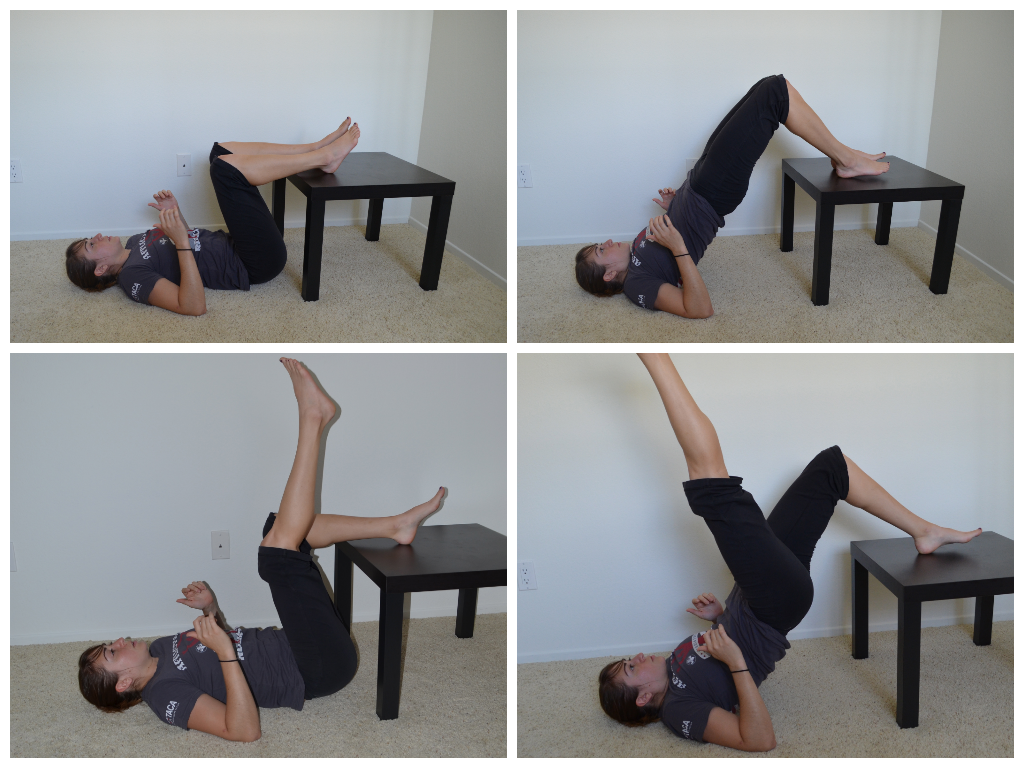
5. Glute Bridge off table – A great way to advance the glute bridge is by putting your feet up on the table. You can do either a double leg glute bridge, which is a bit easier, or a single leg bridge, which is a bit more difficult. Start by lying on the ground with your heels on the table. Your butt should be close to the table. Arms are bent to 90 with elbows driving into the ground. Squeeze the glutes and drive through the heels, lifting your hips as high as you can in the air. Keep your core tight and glutes squeezed. You should not feel this in your low back. To make the move even more beneficial, hold each rep at the top for 2-5 seconds.
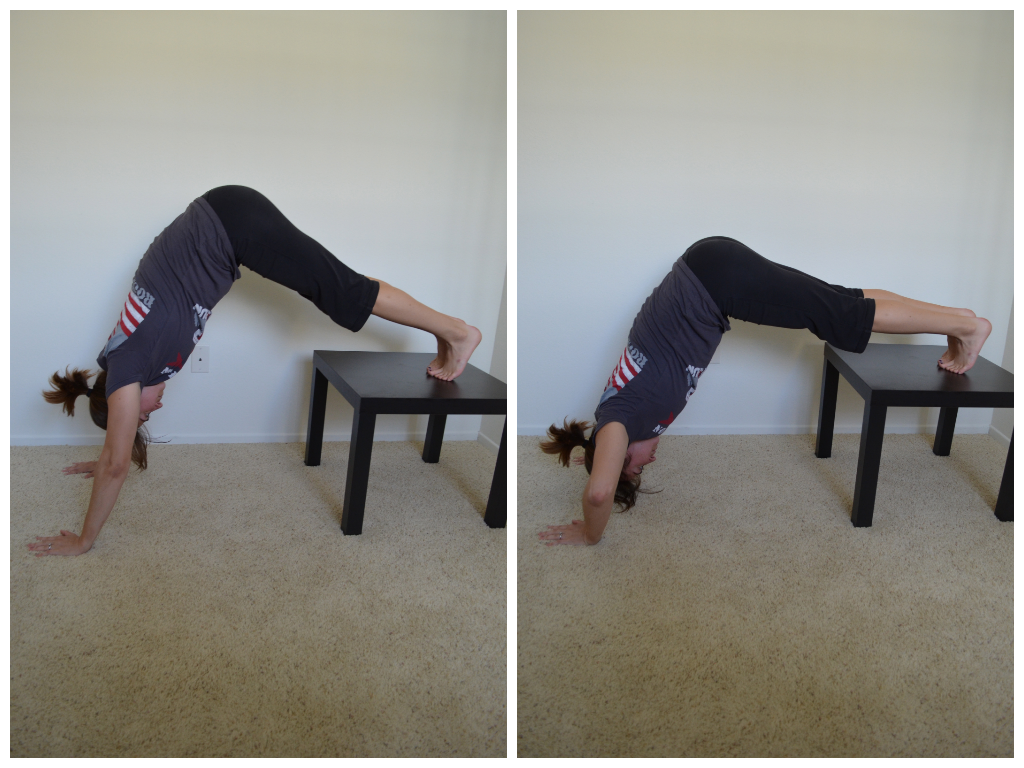
6. Handstands – Handstands are a great upper body move. Using the table you can either do a beginner handstand hold or you can make the move more advanced by adding in a push up. To do the hold, place your feet on top of the table. Walk your hands back a bit and push your butt up towards the ceiling. Push off your toes to get as vertical as possible, creating a nice straight line from your hands, up your arms and core to your tailbone. If this is easy, add the push up in while holding this position. Drop your head down to the ground and then lift back up.
7. Plank Holds – Plank holds are a great overall core move and the table can be used to make the move easier and more difficult. Beginners can hold front and side planks with their hands on the table and feet on the ground while advanced lifters can have their feet on the table and hands on the ground.
8. Lying Bat Wings – One of my favorite moves is scapular wall holds. When playing with the table, I realized you could do the same hold while lying face down on the table. Lie down with your chest on the table. Bend your arms to 90 degrees and then pinch your shoulder blades down and back. Try to bring them together you are pinching back so hard. Hold that move. Beginners can hold for 30 seconds. Advanced can hold for up to a minute. If you want to make it even more challenging, you could add weight to each hand…even if it is just in the form of a book.

9. Reverse Hypers – A great move for the glutes and hamstrings and most easily done with a piece of equipment; HOWEVER, using a table is a PERFECT way to do reverse hypers at home. Lie face down on the table. Make sure your hips are right at the edge. Squeeze your legs together and lift your legs to basically parallel to the ground. Hold for 2-5 seconds and lower. You can do reverse hypers with either bent or straight legs. Both have their benefits. You should not feel either though in your low back. Keep the core tight and really squeeze the glutes.

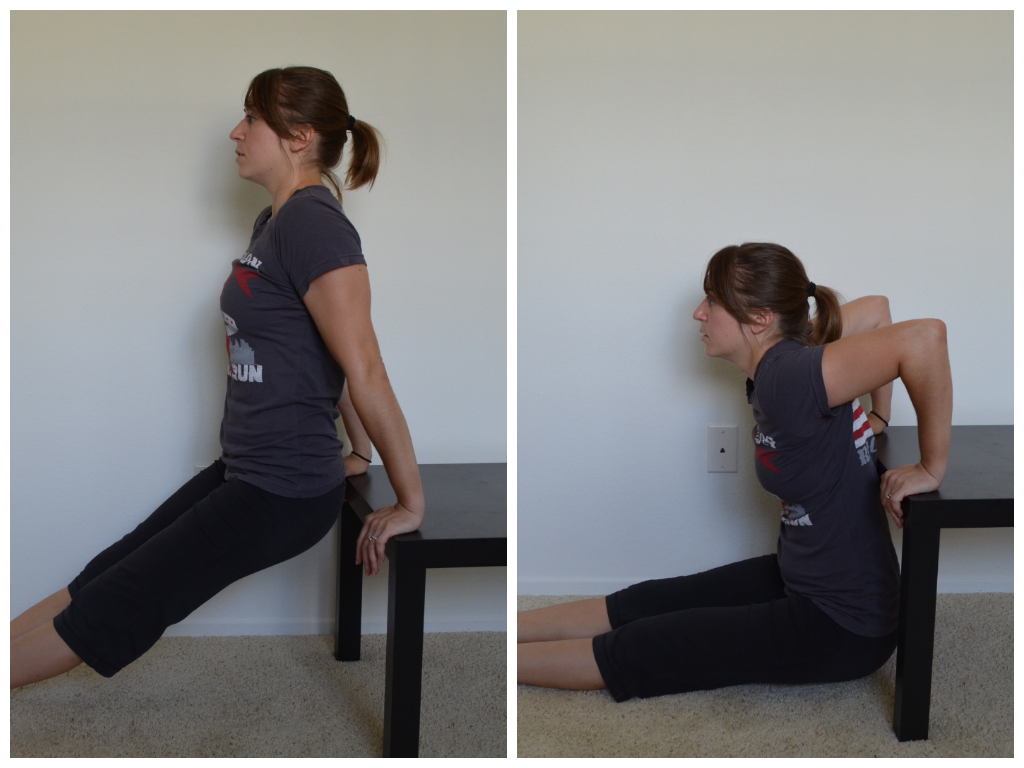
10. Dips – One of the most common home exercise moves, dips can’t be ignored. Place your hands behind you on the table with finger tips hanging over the side. Beginners can bend their legs while more advanced exercisers can keep their legs straight. Drop your butt as close to the ground as possible, bending your arms to 90 degrees and keeping your back and butt close to the table. You could even make the dips harder by doing two push ups followed by two dips for 3-5 rounds. Talk about a way to smoke your triceps….
If you like these moves and have enjoyed other Man Bicep posts, I suggest you head over to my new site Redefining Strength for a sneak peek and a few great workout freebies, including a COMPLETE FOAM ROLLING VIDEO LIBRARY!
P.S. Thank you Ryan for an amazing post idea!


 Man Bicep