Top 10 Exercises for Outdoor Workouts
So with all of this wonderful summer weather, all I can think about is working out outside. And while I love hiking and biking and sprinting and stand up paddling as my outdoor “workouts,” I also do enjoy doing more “traditional” workouts outside.
And while basically any bodyweight move can be done outside, here are my 10 favorite moves to do because they are super challenging with only body weight. Some do require a bit of “equipment”…aka playgrounds or possibly stairs…or comfy grass…but all don’t require any additional weights.
Outdoor Workout Moves:
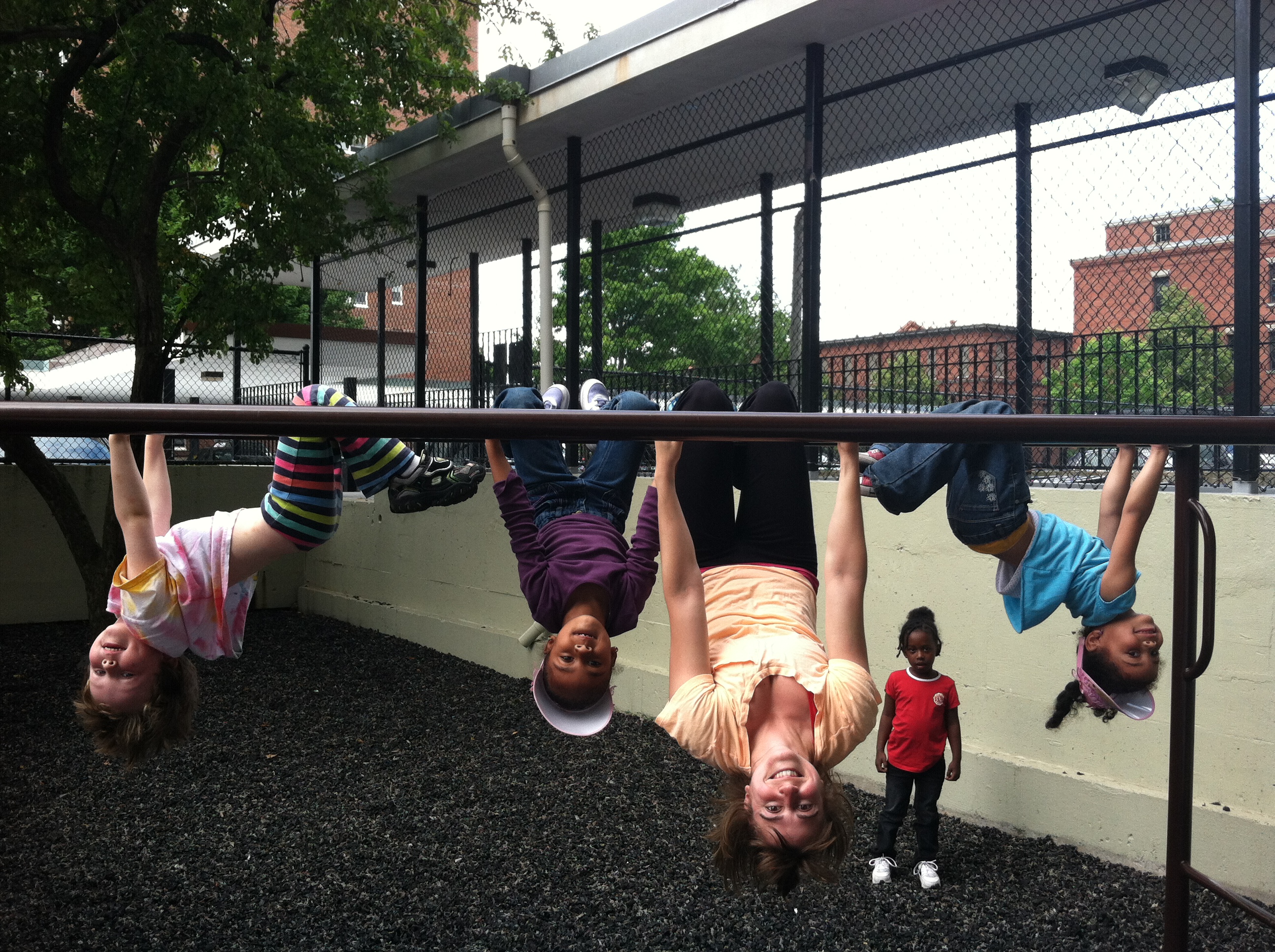
- Monkey Bars – So the monkey bars aren’t a move really, but they are a wonderful tool for any outdoor workout. I love to do pull ups off of them or even just swing across them. You can even do a pull up hold on them. (We have numerous different ways to use the Monkey Bars in the video below.)

Swinging on the monkey bars
- Knees to elbows or Skin the Cats – A great way to work your core, grip strength and upper body. You even work your quads and hips doing either knees to elbows or Skin the Cats. With these two moves, you hang from the monkey bars. With knees to elbows, you simply tuck your knees up to your elbows. You will need to pull up a bit with your arms and lean back to truly get your knees and elbows to connect. With Skin the Cats, you will actually bring your legs up and through your hands. You will then straighten your legs and reach your toes to the ground before coming back and up through your arms to return to the starting position.
- Crawling – So many people are embarrassed to crawl, but it truly is one of the freaking best moves out there for full body strength. Plus it is a great way to get in a bit of cardio. You can crawl forwards and backwards. Or side to side. Or even in circles. You can do bear crawls, table top crawls, crab crawls or even my new favorite…GORILLA crawls!
- Push ups – So outdoors you can do incline push ups off a bench (so hands on the bench) if you can’t do a full push up yet. Or you can do them from your knees. Or flat on the ground. Or you can even make them harder by elevating your feet to do a decline variation. Check out the video below with for some different push up variations!
- Stair sprints – Climbing stairs sucks in general. But if you want climbing stairs even harder, do it quickly. Sprint up the stairs or try even taking them to at a time. There is nothing worse/better than running stadiums! (And if you don’t have stairs but instead have a really big hill…Well that will do too! Hill sprints or even sprints in the sand are another way to up the intensity of your sprints. And each have different added benefits! Like extra glute work…)
- Bench jumps – So if you are a beginner, you may want to start with bodyweight squats or even jump squats. But if you done some jumping, you can make the move harder by jumping up onto a bench or piece of playground equipment. You can do forward jumps, lateral jumps or even rotational jumps up to the bench! To make them easier, step down after jumping up. To make them harder, perform them as quickly as possible!
- Bench step ups – Step ups are another great way to work the booty without any weight and without laying on the grass to perform glute bridges (I get a bit too itchy when I lay on the grass when I’m super sweaty so prefer to save my glute bridges for inside). You can use a bench or steps or anything that is a challenging height. The higher it is the more challenging it will be. Make sure though that you aren’t compensating as you step up by pressing down on your other leg with your hands or by pushing yourself up with the foot planted on the ground instead of just using the foot on top of the box. To make this move harder, you can also make it plyometric. So instead of just stepping up, powerfully step up so that you actually jump up a bit off of the box. You can either stay on one side with this move or alternate legs. You can also perform both variations of the step ups laterally!
- Swing/Bench balance lunge – So set up in a lunge position with your back foot up on a bench or a swing (the swing will be tougher). Lunge down toward the ground and return to the starting position. Make sure that as you lunge, your front knee is not going over your front toe and that your front foot stays firmly planted on the ground with the heel down. Keep your chest up tall and don’t lean forward. You actually almost want to “sit back” while performing this move. You should also feel a nice stretch in the hip and down the quad of the back leg
- Swing knee tucks – So set up in a push up position, with your feet up in the swing. You are then going to tuck your knees into your chest, controlling your legs in and out. This is a more advanced move. If you find it to challenging and feel it in your low back, start with mountain climbers on the ground. You can also progress this move by doing a pike tuck (bring your feet in toward your head keeping your legs straight) instead of bending your knees to bring them into your chest.
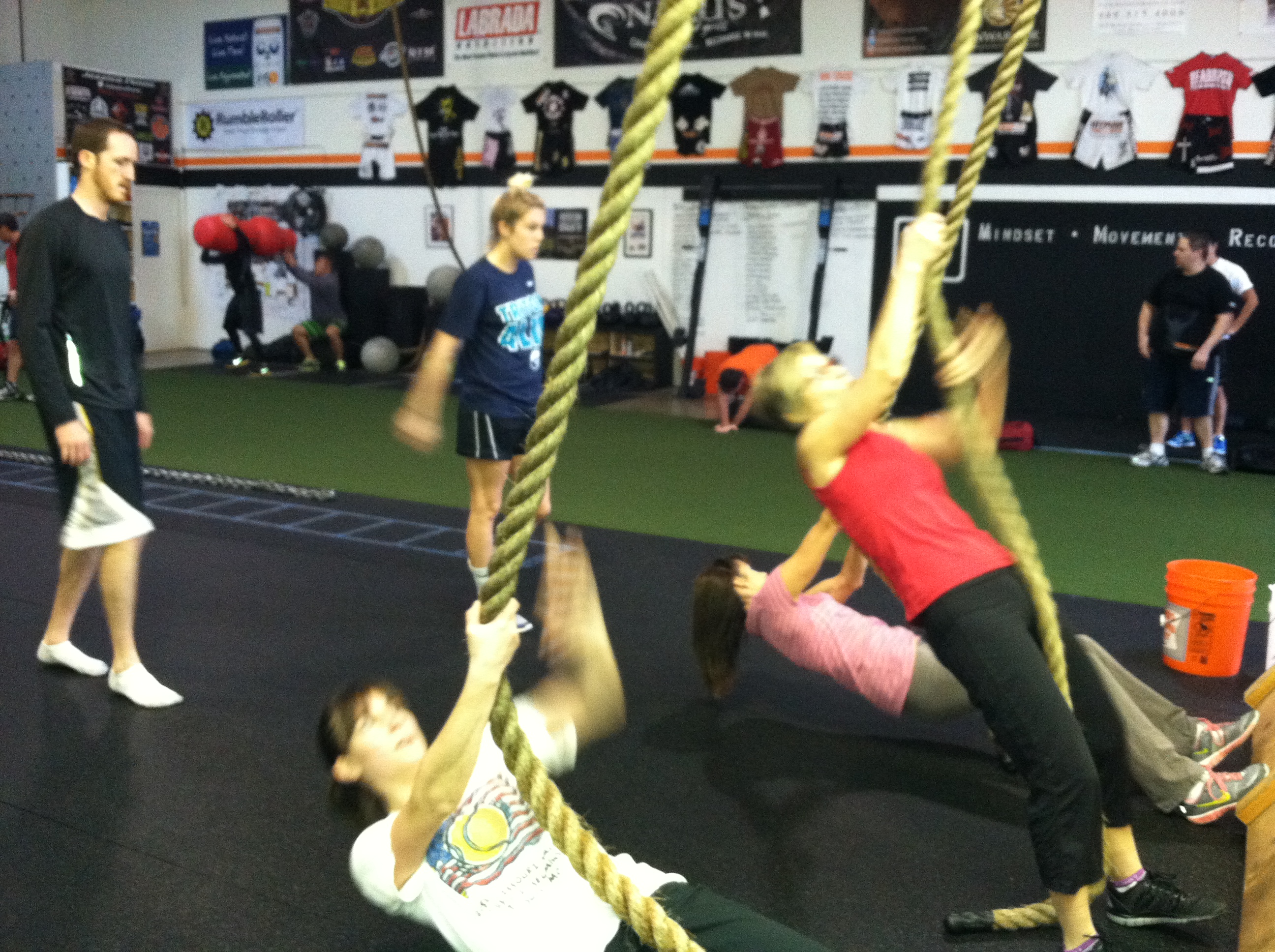
- Pole/Rope/Swing Climb – So this move can be made into either a vertical or horizontal pull. To do a horizontal pull, you can set up on the pole, rope or swing chain like you are planning to do an inverted row. You will then walk hand over hand to pull your chest up to the pole, swing or rope before lowering yourself back down. Or you can kneel at the bottom with your hands on the pole or rope or swing chain. You can then climb up to the top of the pole before sliding back down. Either way you do it, you are in for a challenge!
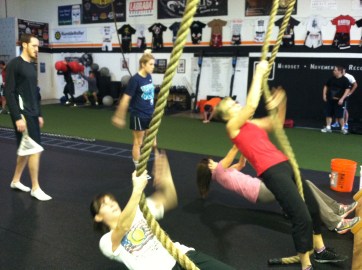
Rope inverted rows…not outside but you get the point.
Runners up: So while there are a ton of other bodyweight moves I love, like split squat jumps and sit thrus…the only other move I was tempted to put on here was jump rope…I love jumping rope. I feel like a little kid again when I do it!
Anyway, here are some other great moves that Ryan and I did a few summers ago on the playground to help get you motivated to workout outdoors this summer!
A quick guide to healthy eating
So a huge part of being healthy, looking great, feeling great and performing well is eating the RIGHT foods.
If you don’t fuel properly, your body isn’t going to run properly – it’s as simple as that.
And while I’m most definitely not a car aficionado (and I’m sure anyone who really knows anything about cars will roll their eyes at how I use the analogy) I do believe that one of the best ways to describe eating healthily is by comparing it to fueling a car.
If you use bad fuel, your car won’t run properly. You will get bad gas mileage and your car will probably break down. However, if you give your car the proper fuel, your car will run great and you most likely won’t have near as many problems with it.
Same goes for your body…Eat crap food and your body will run, but not near as well as it could. Eat healthy food and you will be able to perform a lot better (not to mention you will FEEL a lot better!).
And you may be thinking right now…I haven’t had problems so why should I change my diet.
Let me just say this..Just because you aren’t having problems doesn’t mean your body feels or functions as well as it could.
You might not even realize you aren’t running as well as you could until you fuel properly and see just how great your “mileage” could actually be. And once you do fuel properly, trust me, you won’t want to go back!
Ok so let’s say you buy it and know that you need to fuel properly.
How do you then decide what you should eat?
I live by these two simple rules:
- Eat whole, natural foods – Foods raised or grown in the way they should be. Cage-free chickens, grass-fed beef. Organic fruits and veggies. Unprocessed. Local. Seasonal.
- Eat as little processed food as possible – There is a spectrum of processed. From a veggie you can pick and eat right of the ground to a Twinkie which is so processed it will never ever go bad and doesn’t contain even one ingredient that you can even pronounce. If something lasts longer than it should, like the difference between freshly home-made bread and store bought bread that last years, you know that it is highly processed. Your goal is to eat as much as you can from the unprocessed to only slightly processed side while still occasionally indulging in deliciousness from the processed side.
On the image below that sums up this post, you will see that I break down foods with the best options in green and the worst in red. There are a lot of different levels of processing…To keep it simple, I’ve broken it down into four different levels. If you follow the two rules above, the majority of your diet will come from the green list (which is by no means all-inclusive) with some of your daily foods coming from the yellow list. You will also occasionally indulge in foods from both the orange and red lists, which are more highly processed foods that contain little to no nutritional value.
Anyway, take a look at the infographic below for a quick guide to healthy eating!

Your guide to fuel your body!
Track your progress
Yesterday I mentioned that one of the main reasons why people don’t accomplish their goals, like their goal of being able to do a pull up, is because they don’t track their progress.
And most people know they should keep track. But they don’t.
They don’t track their progress because it takes energy and time. Of course, in the end, it really takes way less time to outline and track a program than it does to flounder around for months with no clear idea of how to reach your goal, but whatever…right?
Just keep floundering and not tracking. Just keep wondering why you haven’t hit your goal even though you’ve been working hard trying all these diets and spending long hours in the gym.
Really is spending a few minutes each day keeping a food log or recording weights and reps really that awful? Is it really that big a pain in the butt?
Is it really harder/more time-consuming/more frustrating than not reaching your goal?

There are even APPS for tracking now which really gives you NO EXCUSE not to track your progress!
And I’m not saying it isn’t annoying. Because guess what? It kind of is…but it is also probably the single best thing you can do to keep yourself moving forward toward your goal.
If you don’t track your progress, you won’t know what worked and what didn’t work. There are so many different workout variables out there you need to consider when creating a program (intensity, duration of workout, rest periods, type of exercises, number of exercises, reps, sets, weights, body parts worked, movement patterns worked…). And if you don’t track which types of each thing you used, how can you possibly know what helped your or hindered your progress?
You won’t know.
You won’t know if you get better results with shorter workouts. You won’t know whether or not 5 or 15 reps works better for you. You won’t know what helped you finally do that pull up…or what kept you from even getting close!
You also won’t know if you’ve gotten closer to your goal until you’ve hit it.
And if you don’t hit it soon enough, you may give up because you don’t FEEL like you’ve gotten any closer.
I mean how many times have you started on a goal only to give up because you’ve spent time working toward your goal only to feel like you haven’t gotten any closer?
Probably more often than you’d care to admit.
BUT if you’d tracked your workouts and diet and TRACKED YOUR PROGRESS, you would have concrete evidence showing that you are closer to your goal now than when you started even if you don’t necessarily FEEL closer because you aren’t there yet.
Often we get down on ourselves and FEEL like we haven’t made progress just because we aren’t exactly where we would want to be.
But when we’ve tracked our progress, we can remind ourselves of all our hard work and show ourselves all of the victories we’ve had no matter how small. And even those small victories can be enough to keep us motivated.
No matter how we FEEL we can’t argue with concrete progress. And even when we feel down, seeing those results, seeing that progress toward our goal, will keep us moving forward.
It is way easier to give up when we don’t see any forward momentum.
Whether or not you admit it…seeing even the smallest victory can be motivating.
Heck, even the victory of TRACKING can be motivating. You want to give yourself small things each day that you can easily ACCOMPLISH and keeping a food log or recording your numbers is just such a task.
Tracking, while we complain that it is hard and time-consuming, really isn’t. It truly is a “low barrier to entry” task that you can do in a matter of minutes. It is a small, easy task that you can do each day which gets you moving in the right direction.
When we ACCOMPLISH things, even small, easy tasks, we feel successful. And when we feel successful, we feel MOTIVATED to continue working hard toward our goals.
And the final, and probably MOST IMPORTANT REASON, why you should track your diet and exercise programs is because you don’t see yourself, your habits and your daily activities clearly and you don’t hold yourself accountable for what you are actually doing.
I’m sorry…but you don’t.
I can’t tell you how many times I’ve had someone tell me they are eating well only to retract their statement when they actually keep a food log.
They aren’t aware of how often they take “just one bite.” They aren’t aware of how often they DON’T actually have fruits or vegetables with their meals. They aren’t aware of how quickly “handfuls,” “bites,” “pieces” added up.
They aren’t aware.
Tracking makes us aware and makes us hold ourselves accountable.
It makes us aware of what works and what doesn’t. It makes us aware of our progress, even the smallest of victories. It makes us aware that we are doing things each day that move us closer and closer to success.
So if you’ve been struggling to reach your goals, if you’ve given up on goals more than you’d care to remember, maybe you should start tracking your progress with food and workout logs….
Ladies…Do you want to learn how to do a pull up?
So we did testing the other day at the gym and one of the tests was a pull up test.
You probably aren’t surprised to hear the following statement, but we only had a couple of women who could do legitimate pull ups (by legitimate I mean no kipping…I have nothing against kipping, but it isn’t a TRUE pull up even if it does have its own benefits).
When I then asked all the women that didn’t do a pull up if they would like to be able to do one, most did say YES. Actually all said YES.
So then…why weren’t more women able to do one!?!
My theory is that most of the time, it isn’t that we don’t want to be able to do something, it is just that we don’t know where to begin so we don’t even start. Or we are intimidated by the move and don’t believe we can do it (again because we don’t know how to get there). Or we jump into something we think might help with no way to track our progress and then we fall off when we aren’t able to do a pull up within a few short workouts.
So below are some great tips to help you be able to do a full pull up!
Three great activation moves I like to use to warm up for a pull up workouts are:
- Scapular Wall holds – You’ve probably guessed by now that I LOVE these. They are great to improve posture and activate your upper back muscles. If you want to be able to do a proper pull up, you need to make sure that your lats activate and that you use the big muscles in your back. This move will help you do that.
- Scapular Push ups – This move does the same sort of thing that the wall holds do – It helps you get that scapular retraction that is necessary to do pull ups.
- Dead hangs – So at the beginning, I want you to just hang from the bar and get a feel for holding your body weight. Focus on tightening your core and even maybe tighten your back as if you are going to pull up. Then once you’ve done a few straight hangs, you will progress to a hang with a scapular retraction. You then want to press your chest out and pulling your shoulder blades down and together while you hang from the bar. If you can’t hold for long at the beginning, start with reps of retracting and then relaxing.
All three of these moves make you activate the muscles used to do a pull up and help you warm up your core!
Many people who can’t do pull ups will then turn to the lat pulldown machine and even simulate pull ups with bands for their “pull up” workouts. And while these moves are great to strengthen many of the muscles used by pull ups, they still aren’t the same as actually doing pull ups. They can be great supplementary moves, but if you want to be able to do pull ups…You’ve got to actually do variations of the pull up!
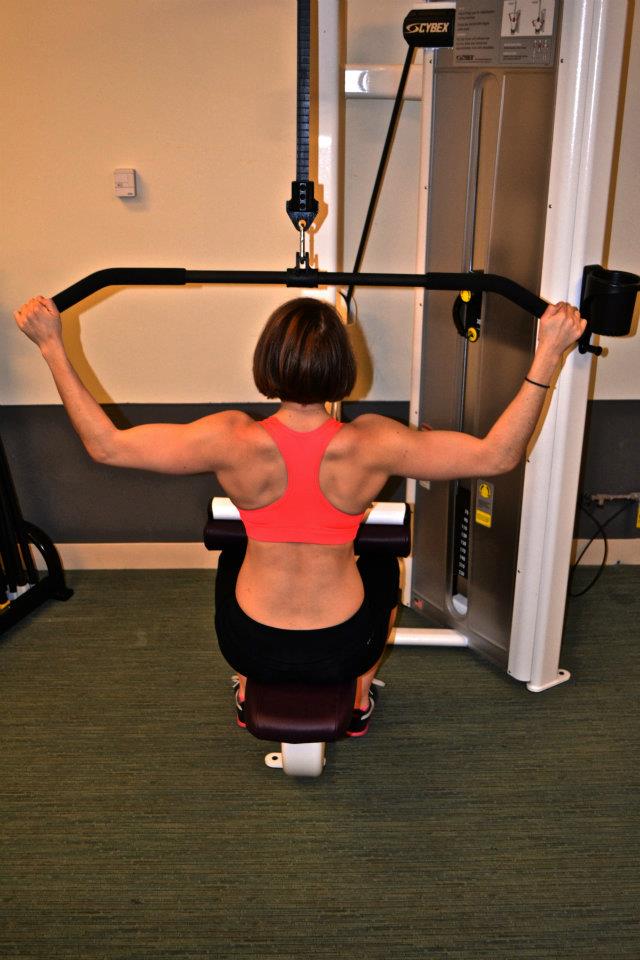
I haven’t used this machine now in over a year and some and guess what!?! By doing negatives and holds my pull ups have gotten WAY BETTER than they ever were doing lat pulldowns!
So once you’ve done the activation moves, try one of these assisted pull up variations and progress toward harder and harder variations until you can do one unassisted! If you have an assisted pull up machine, you can use that as well, but I personally like these better because they give you more control over the exact amount of assistance!
With both of the assisted variations below you can do three different things to progress or regress the move. You can do holds, negatives and full range of motion pull ups/chin ups.
- Holds – You can hold at the top, middle and/or bottom of the move. Each will work on strengthening the muscles at each piece of the motion. You can jump or push yourself into position and then hold once there for as long as possible.
- Negatives – With negatives, you work the eccentric part of the motion. To perform a negative, you will set yourself at the top of the pull up and then lower yourself down as slowly as possible.
- Full pull up – You will use assistance to perform a FULL pull up, which means chin above the bar to arms straight at the bottom.
The two different ways you can get assistance to do these three variations are:
- Foot assisted pull up – Hang from a bar or use TRX/Jungle Gym straps. Place your feet on the ground underneath you. The more firmly planted your feet are, the easier the move will be. Your goal is to use your feet as little as possible. Your feet will assist only as much as you so that you can perform a hold, negative or full pull up.
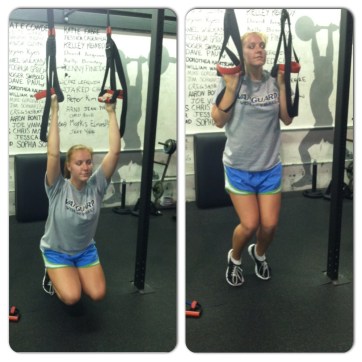
Thanks Carla for demoing!
- Band assisted pull up – Hang from a bar with a band around your knee or knees (putting the band under both knees makes the move easier). The band will add assistance as you perform the move. The skinner the band, the harder the move. The more you control the move and don’t swing, the less the band will propel you up.
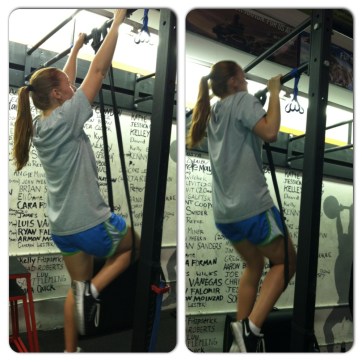
Thanks again Carla!

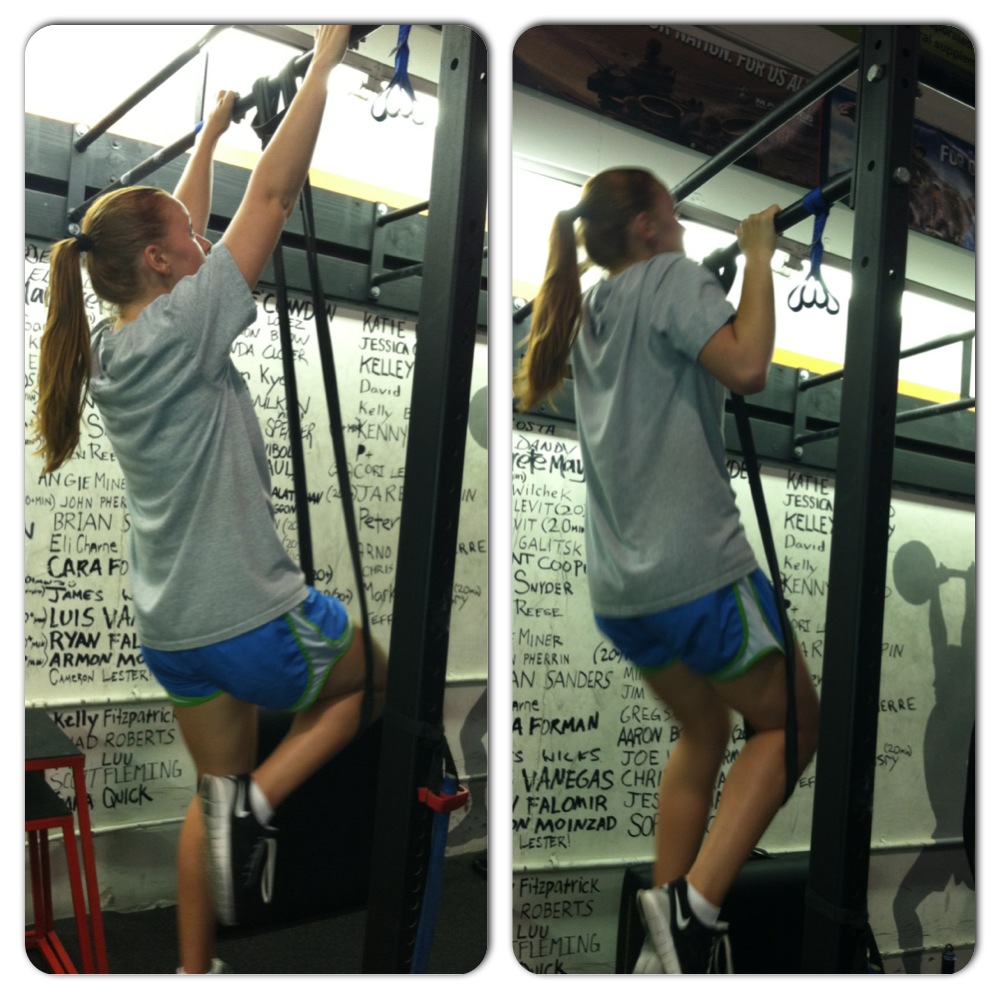
If you don’t need assistance to hold a pull up or chin up or to perform a slow negative, then you may move to the bar without assistance. Don’t use assistance if you can perform 10 3-5 count negatives (and not a fast count) or 30 second holds without assistance. Make sure you can perform the move correctly before advancing. But also make sure that you are always checking your progress to see if you can perform the moves without assistance.
Remember, your goal is to lower assistance as you master each move. Don’t just waste time on the lat pulldown machine trying to get stronger or by doing assisted pull ups on the machine. Work on each piece of the pull up and ween yourself off of the assistance!
So do you want to be able to do a pull up? What are you doing to get better at them?
Here is also a great workout to strengthen your back and biceps to help you get stronger so you can do a pull up.
NOTE: In this post I didn’t really go into grip variations. The easiest grips to do are usually the neutral or chin up (palms facing you) grips. The pull up grip and wide grip variations are generally more difficult.
Reasons why you should keep your workouts shorter
So I’ve been asked numerous times recently about how long your workout should last. In case you had the same question, my answer is…Keep it short! Maximize the time you have in the gym.
Honestly, your workouts really never need to go over an hour and here is why:
Many of us think that the more we do, the better our results will be.
But more isn’t always better.
Longer, harder workouts…extra reps…don’t always equal greater results.
People will even tell you that you aren’t doing enough if your workouts aren’t at least an hour or two.
But who is really focusing the entire time or working as hard as they can when they spend two hours in the gym?
NO ONE!
And if they are really working at 100% the entire time, they are probably overtraining and hindering their strength and size gains even further!
Sometimes too long, too hard, too much can end up hindering your progress and even cause you to go backwards – it may be the reason why you’ve been stuck looking the same way and lifting the same weight for the past few months or even years!
While hour-long or even two-hour long workouts have their place and time, most of your workouts shouldn’t last that long.
Sometimes less is actually more!
It is about being efficient in the gym, using compound lifts, shorter rest periods, heavier weights, and optimizing the time you spend there because the hormones that our bodies produce work to our advantage when we keep our workouts under 60 minutes and can actually hinder our progress when we go over.
When you start training, your body will boost testosterone levels significantly and around 30 minutes into your workout, testosterone levels in your body will peak. By about 45 minutes, your testosterone levels are returning back to normal.
So all those guys and gals spending two hours in the gym have been working without the aid of a key muscle-building hormone for about an hour and 15 minutes. They would have gotten more benefit out of 45 minutes of intense, compound, heavy lifting and optimal testosterone levels.
And on top of the fact that at about 45 minutes your testosterone levels are returning to normal, at about 60 minutes, your body will start producing more cortisol than testosterone and cortisol is a catabolic hormone, meaning it breaks down tissue instead of building it up!
When your workouts go over 60 minutes in length, you hormones are no longer helping you build muscle and burn fat. Your body is instead producing more cortisol, which breaks down muscle tissue, reduces protein synthesis, and increases body fat storage. Your body begins to fight against all of the hard work you are doing!
So instead of lifting heavy one set and wandering around the gym for five minutes “resting,” why not stay focused and get some high quality work done while your testosterone is raised?
Also, if you keep your workout shorter but more intense with compound movements, heavy weights and varied rest periods, you will optimize your hormone levels even more.
By lifting heavier with compound movements, you will maximize your testosterone response especially if you do enough volume. Working in the hypertrophy rep range of 8-12 reps for 4-5 sets at about 75% of your one rep max has been shown to result in significant increases in testosterone levels and other hormones that result in better protein synthesis.
And to get even more out of every rep, play with your tempo especially on the eccentric portion of your lifts. The eccentric portion of a lift, when the muscle lengthens, is where you can cause the most muscle damage. Studies also suggest that more protein synthesis happens after lifts with an emphasis on eccentric training. So between causing more muscle damage and more protein synthesis, focusing on the eccentric lift will cause bigger and better size and strength gains!
Also, while so many of the muscled guys and gals around the gym spend just as much time lifting as they do resting, long rest intervals may not be the best way to maximize your growth hormone response, a hormone that increases protein synthesis and muscle mass. Short rest intervals have been shown to create a strong growth hormone and testosterone response. Short rest intervals actually increase growth hormone levels higher than longer rest intervals.
However, don’t ignore the benefit of adding in some longer rest intervals especially when lifting super heavy and intensely. High intensity exercise does raise cortisol levels and longer rest intervals do allow for more complete recovery and also increase testosterone levels to counteract cortisol levels. Make sure to VARY your rest intervals.
So stop wasting your time in the gym doing two-hour, non-efficient workouts when your cortisol levels are working against you.
Not only are you not getting the most out of your time in the gym, but you are also causing yourself to not recover as well or as quickly.
Work SMARTER not LONGER!
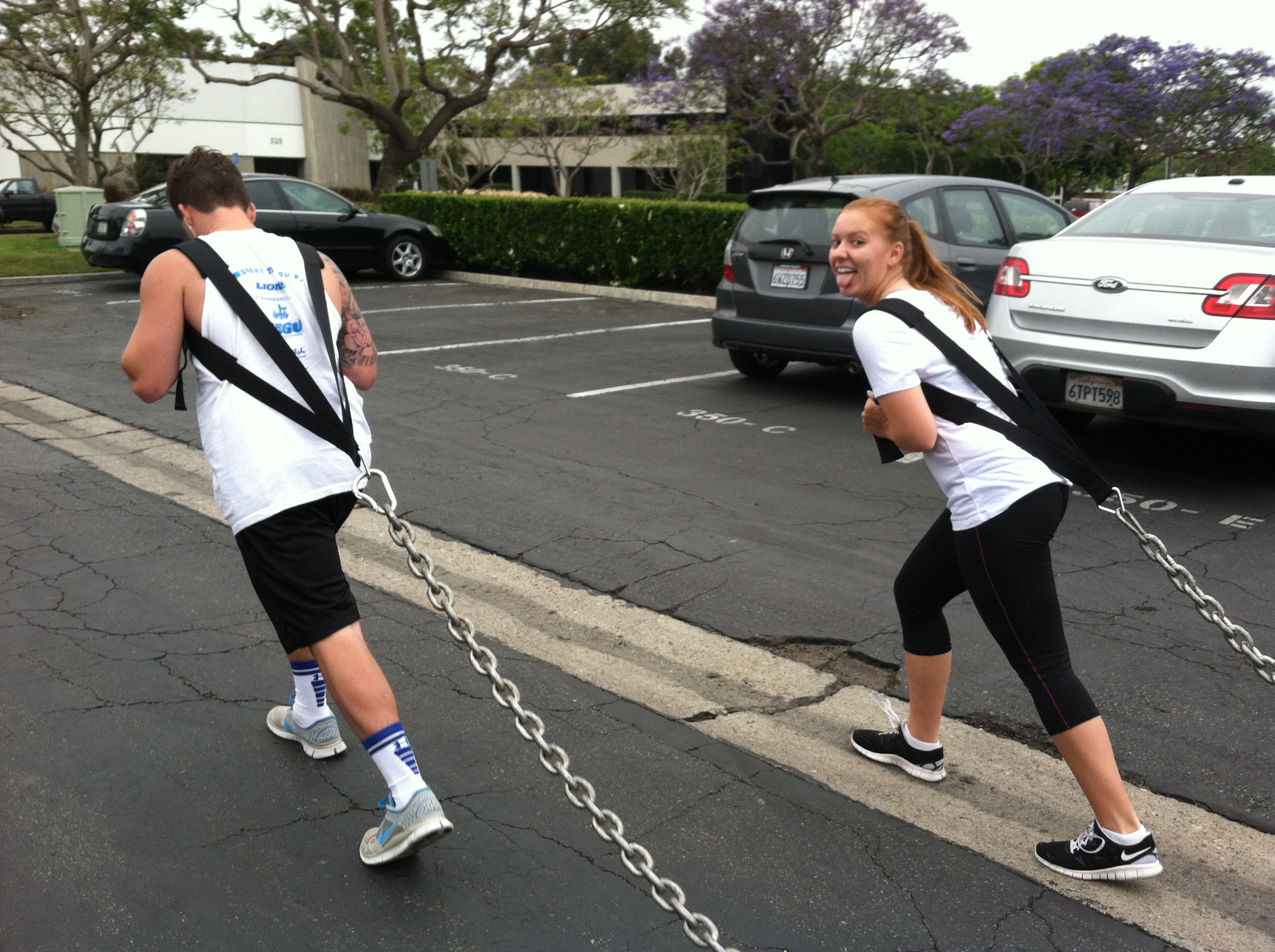
30 minutes and one killer workout…chain drags around the block…And one very happy Carla haha
So yea…That is my answer when it comes to how long your workouts should be.
Got another question? Let me know!
Accepting Pain aka STUPIDITY
So there are all sorts of “pain” related discussions that really get on my nerves.
One is when clients who are working hard for the first time in their life tell you that an exercise “hurts” when, upon further investigation, you find out that it is merely making their muscles fatigued and that they aren’t used to the burning sensation of a muscle working.
While I don’t like the phrase “no pain, no gain,” being sore and working hard isn’t always “comfortable.”
But at the same time having the attitude “no pain, no gain” and never recognizing when something hurts isn’t good either.
While I can get annoyed when someone can’t recognize the difference between “injury pain” and “discomfort from muscles working hard,” I get way more annoyed by the client who thinks they are cool because they push through the pain.
And honestly this “no pain, no gain” client WAY worse than the client that mistakes muscles working for pain.
You may be shaking your head and going, “Heck no! They aren’t near the same! You have to work through the pain sometimes! You are TOUGH if you just push through!”
Uhm no…I’m sorry….You don’t…and you aren’t.
You are stupid.
Period.
Yep that’s right…STUPID.

Oh yes…Let’s put some sexy people on a poster working hard and say “no pain, no gain.” That way when people get injured they will think it is all just part of the process to look and perform like the attractive people in the photo! ARGH!
I can say this as someone who has been stupid one too many times in her past. I have the torn muscles and scar tissue to prove it.
And guess what I have now?
Improperly rehabbed injuries that years later I’m now having to deal with.
Trust me…injuries aren’t cool.
You aren’t “bad-ass” if you push through.
Honestly, unless you are a highly paid athlete, there is never a reason to push through true pain and injury. And even if you are a highly paid athlete, there is a very fine line between stupid and something you push through because it is your job.
When you work through the pain, generally all you do is make the injury worse. And then you are either eventually going to have to take time off, and probably MORE time than if you had rested and rehabbed it immediately, OR you are going to have something that restricts your movement and causes pain for the rest of your life.
Doesn’t sound like great options if you don’t just DEAL with the pain immediately.
But rehab and pre-hab aren’t “cool.”
It is way cooler to be like, “I can’t do push ups because of my shoulder.”…Right!?!
AH!
I can’t tell you how many people recently I’ve encountered coming from other gyms who say they “can’t do” something because of an injury they’ve never dealt with and just “worked through.”
And every time I say to them the same thing, “Well what have you been doing for rehab?”
And I always get the same answer…NOTHING.
Can someone please explain this to me?
Why is pain cool and rehab not cool?
Don’t we workout to feel BETTER!?! Don’t we go to look BETTER? Perform BETTER?
If we want exercise to make us BETTER, how do we expect to do that if we are restricted and in PAIN?!
If you have an ankle injury, even one from decades ago, and you never rehabbed it, it may be causing problems up your leg. It may be why you have low back and hip pain. It may be why you have balance issues. It may be why you can’t lift as much as you want to. It may be why your butt isn’t as strong and perky as you would like!
It may be causing a whole load of problems that aren’t even related to the initial injury!
But it is better to just push through…huh?
Ok here is your chance to stop being an idiot and stop accepting pain.
Take five minutes at the beginning of your workout and add in an exercise or two to rehab or better yet “pre-hab” any weak points or areas of past injury. (Just because at one point in your life you did some rehab for an injury doesn’t mean you are just now done with it now. That area may always need some extra TLC.)
Here are a couple quick things you can do for four common areas of injuries…
- ANKLE/FOOT PAIN/INJURY (Heck these are even good for some knee and hip problems) – Roll out the bottom of your foot, your shin and your calf with a roller or small ball. Then work on your balance. My favorite balancing drill is when you either stand on one foot on the ground or on a foam pad and then you swing the other leg. Do swings forwards and backwards, side to side and even rotational (like you are lifting your foot to step back over a fence and then bringing it back forward over the fence without touching down). Then do glute activation drills. Pick one or two from this list and do 1-2 rounds of 10-20 reps.
- LOW BACK/HIP PAIN/INJURY – Low back pain is a super common problem. While rolling out the whole leg is ideal to find all trigger points, you can start with your hips, glutes and low back. A great way to roll out your hips, can be to take a bigger, foam ball and lay over it. The ball will actually be pressing into your abs right above your hip and beside your belly button. Relax over the ball as much as you can. You will also want to stretch your glutes and hips. Here are some more great trigger point release tips for your hip area. You will also probably want to do some stretches and trigger point release for your thoracic spine and lats. We can sometimes compensate and use our low back because our thoracic mobility is bad. A great thoracic stretch is one you do when kneeling. Kneel on the ground with one hand planted on the ground under the shoulder. Then reach your other hand back over your head with your finger tips pointing down your spine. Then rotate your elbow of the hand down your spine, under your arm that is down. Then rotate open, reaching the elbow up toward the ceiling. Again, glute activation exercises are key. If our glutes aren’t firing, we are going to use our low back and hamstrings more than we should!
- WRIST/ELBOW PAIN/INJURY – Yup…you can even roll out your forearms. If you have wrist or elbow pain, rolling our your forearms, triceps and biceps can help, especially if you target the areas of insertion. Wrist/forearms stretches are also important. We sit at computers all day with our wrists flexed and never really think to do anything to extend and release the muscles. One of my favorite wrist stretches is, when I kneel down and place my hands on the ground under my shoulders. I then turn my finger tips to face my knees with my palms flat on the ground. I then rock back and sit on my heels, keeping my palms flat on the ground, and then return back to kneeling and release. To also help activate the extensors of my wrist and forearm, I use a trick I was taught by Corey…The rubber band extension. Take a rubber band and place it around the outside of your fingers when they are all together. Then spread your fingers out as wide apart as you can before bringing them back together. This really helps with a lot of elbow pain!
- SHOULDER/UPPER BACK/NECK PAIN/INJURY – Roll out your traps, chest and lats. You will also want to stretch your chest and neck. You can easily stretch your chest using a wall or doorway. Place your hand and even your forearm on the wall or door frame and then step forward till you feel a stretch. To stretch your neck, lean your head to one side and gentle pull your head down toward your shoulder, making sure you keep your shoulders relaxed. To change exactly which muscles you hit, look up, down and straight ahead. Then you will want to do a scapular wall hold. If you do it correctly, you will activate your lower traps which will help you relax your upper traps and usually helps with neck pain. YTWLs are great too to activate the muscles in your upper back and strengthen your rotator cuff. Check out this video by Nick Tumminello on how to do them.
Here is another article with some essential mobility drills that can help you move better!
You don’t have to do these every day, but you do want to make sure that spots that need improvement get attention! So stop accepting pain and start doing something about it. It really doesn’t take that much time.
Be smart…It’s way more “bad-ass!”
NOTE: If you are suffering from an injury, it is best to get checked out by a doctor. Most of these drills are meant for already diagnosed injuries or minor recurring injuries/pains. Also, this list is by no means comprehensive. It is just to give you an idea that there are some quick things you can do before your workouts, to correct problems!
Coconut Oil – Good for Girly Girls and Tom Boys
So this weekend Ryan and I were out in Palm Springs with our parents trying to finish up wedding planning.
During the weekend, my mom and I went to a make-up artist since I thought it would be fun to have someone do my make-up for the wedding.
I was trying to explain to the guy that I never put on make-up but wanted something not too light. We then also somehow started talking about the fact that I work as a personal trainer.
He put the two together and then at some point mentioned that I was a “tom boy.”
I didn’t say anything, but I sort of thought…”Well not really…I like wearing heels and getting dressed up even if I do like working up a sweat and wearing loose t-shirts and picking up really heavy things.”
He then made another comment that I most definitely wasn’t a “girly girl.”
I guess so…But I mean what does that even really mean? Just because I’m an idiot when it comes to make-up I’m not girly? I’m a “tom boy?”
I wasn’t offended by his comments…I long ago stopped trying to be what I wasn’t. I’m a girl who enjoys sports and sweating and calluses (that’s right…no gloves for me…), but I’m also a girl who likes dresses, high heels and make-up (on occasion…when I feel like it…And am not too frustrated to do numerous applications).
I’m not a girly girl or a tom boy…I’m just a girl…I’m just a girl who is really stupid when it comes to make-up.
That’s it.
It has nothing to do with being feminine.
Anyway, he did tell me during our meeting that I needed to exfoliate and moisturize and that I had like “years” of built up dry skin on my face.
I’ll admit, I’m awful when it comes to that stuff. There are really no frills when I wash.
BUT I do want to feel amazing on my wedding day, so I was willing to do whatever he said to make my skin hold the make-up better.
And I was happily surprised when he told me I didn’t need to go out and get a ton of creams to exfoliate.
Instead he told me I could make one with two ingredients at home…coconut oil and sea salt.

Multi-purpose coconut oil!
YES!
Seriously coconut oil is a cure-all. It is good for you inside and out. Here is a link with two articles about the benefits of coconuts and one is even by Dr. Oz!
I mean of course I eat coconut flakes/milk/oil for internal health benefits – all that GOOD FAT! But I’ve also used coconut oil to prevent sunburns. To help heal sunburns. To treat Ryan’s dandruff (sorry Ryan).
And now, I can even use it to exfoliate!
I don’t need to go to a stupid drug or make-up store and stare at all the freaking different exfoliating options! I don’t need to spend 50 bucks on a tub of cream so small it last through only two uses.
I can simply use something natural that I always have at home!
Coconut oil…I love you!
What other ailments have you found that coconut helps with? Do you use it to exfoliate?
When was the last time you were called a “girly girl” or “tom boy” and thought to yourself…”HMMM…Are those really our only two options!?!”
Child’s Play – When does fitness become a chore!?!
So I’ve been asked to design a “fitness” obstacle course for this family event in June. Most of the kids doing the course will be between the ages of like 5 and 10 years old.
I was told it needs to be something FUN but at the same time active and fitness-related.
When she said, “FUN and FITNESS-RELATED” she almost said it as if the two together weren’t completely possible…Most adults don’t consider something fitness-related fun…they call it working out.
But what we call working out, kids call PLAY.
Seriously, when did it change?
When did accomplishing something physical NOT become something super exciting but instead something we avoid?
I mean I see all the children come into the gym and get so excited to swing and lift up heavy things. The kids get SO EXCITED when they can pick up something heavy or climb the rope.
They get so excited because they see it as expanding their boundaries and accomplishing something they either couldn’t do or hadn’t done before.
Their parents on the other hand, sometimes roll their eyes and groan when they have to climb the rope…Or they grab a lighter weight then they really should be doing.
Kids see the exercises as proving that they CAN DO something. Parents see exercises as something they have to do.
Which honestly makes me kind of sad.
Working out is something I GET TO DO. Something I look forward to. Something I love.
And I want to instill that same love in everyone I meet.
So I’ve now been considering, what obstacles/exercises should I include in the course at the event in June? What will make kids fall in love with exercising so that it always remains PLAY!?!
When I started doing some research, I stumbled across a ton of activities I LOVED when I was little. Like double-dutch, four square, kickball, hopscotch, climbing trees, Red Rover…and Skip It…Dude I want to do it right now…
And to think most adults think of “jumping rope” or “hopping” as exercise. Skip It was basically jumping rope, except you NEVER wanted to stop!

AHHH! I WANT ONE! A couple of years ago, I stumbled across one but the loop wouldn’t fit over my foot…So bummed!
What were your favorite outdoor games and activities?
Recovery Workout
So on days where I don’t feel like doing yoga and my body isn’t really ready to do a full workout, I will do a “Recovery workout.”
These workouts are usually hard but focus more on postural strength and balance then on developing maximal strength or burning a ton of fat. They work on activating all the correct muscles as you work on perfecting form.
These workouts are the prep that most people need to do so that they can move well and really get the most out of their metabolic or strength training workouts.
The recovery workout below can be done on its own or shortened into a warm up for a full body workout day.
The good part about the workout too is that you can easily do it at home with no equipment even when you don’t have much time!
Workout
3-5 rounds of all the exercises below. Perform a 1 minute hold of each exercise. Try not to rest between each exercise. Try only to rest after each round is complete.
Balance on toes (So literally stand up on your toes and hold. If this is easy, balance on your toes on one foot for 30 seconds and then switch to the other foot. Stay as high on your toes as you can and don’t rock to the outside of your foot.)
Squat Hold (Squat down to parallel, not below, and hold. Focus on keeping your chest up and not leaning forward. Push the butt back and really sit into your heels. This is a great time to really assess and work on your squat form.)
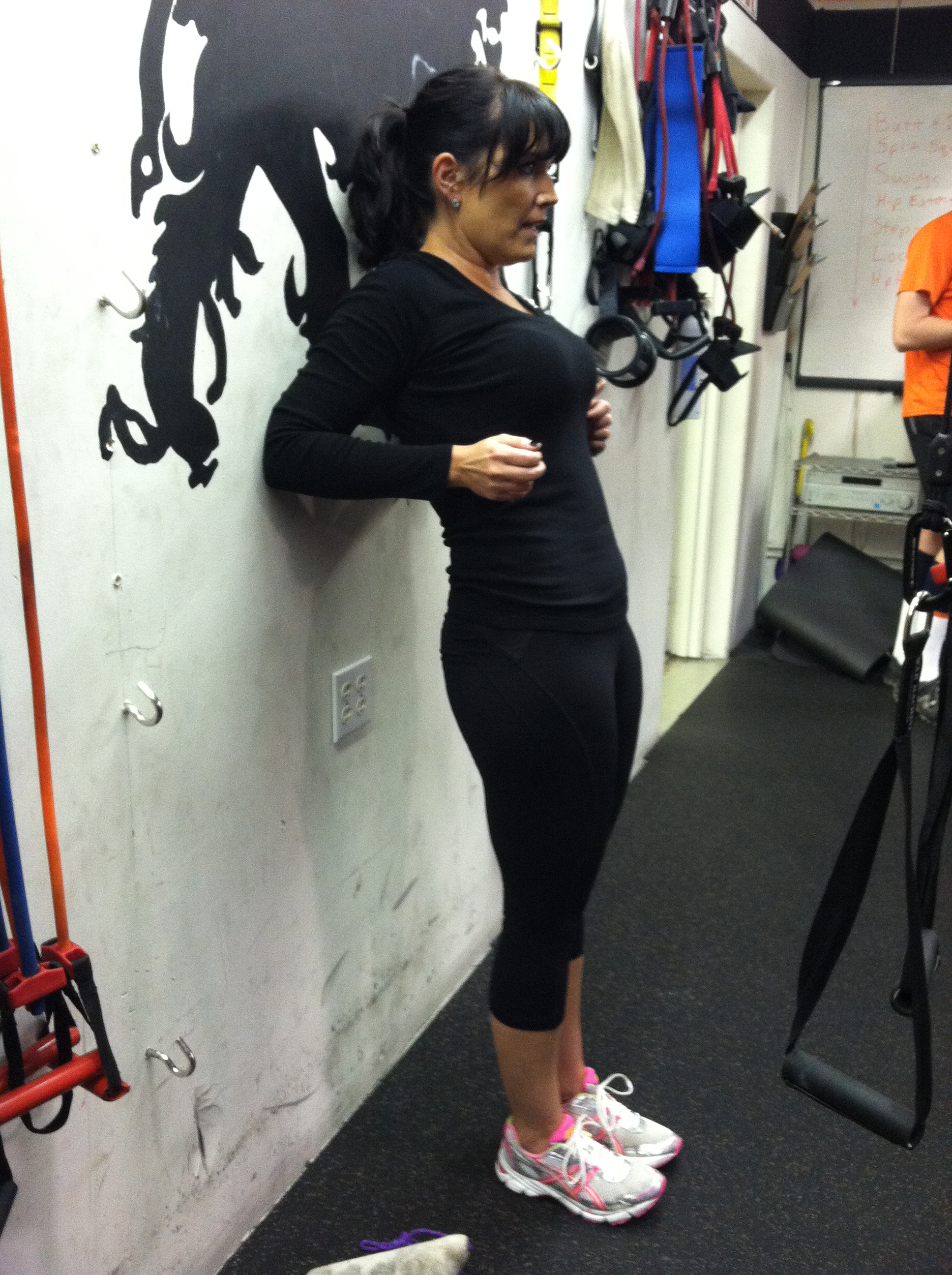
Scapular Hold (So you will “lean” back against the wall with only your elbows touching the wall. The further out you walk your feet away from the wall, the harder the move will be. As you lean back with only your elbows against the wall, you really want to press your chest out and pull your shoulder blades down and together.)
High Plank Hold (So hold at the top of the push up from your hands and toes if possible. You can make this easier by doing it from your knees. Make sure to brace your abs by pulling your belly button into your spine and tucking your hips under. Don’t arch your low back or round your upper back. Keep the shoulder blades retracted and everything tight from your shoulders to your core, butt and quads.)
Glute Bridge (Lie on your back with your knees bent and feet flat on the ground. Lift your hips up as high as you can and squeeze your butt cheeks. You shouldn’t feel this in your low back. You should feel it in your glutes and a bit in your hamstrings.)
With all of these moves, you should struggle within the first 20 seconds if you are really challenging yourself. Fight to squeeze as hard as you can as you hold the moves!
Are We Our Own Worst Enemy?
So Saturday I hosted two workshops at the Limitless Women’s Conference.
The slogan for the conference was “I can. I will. I AM.”

And the goal of the conference was to inspire people to have more faith in themselves…To make people believe in themselves!
Because let’s face it…most people never make changes or better their lives not because they don’t have the ability or resources, not because someone else holds them back, not even because someone else tells them that they can’t…
But because they tell themselves, “I can’t. I won’t. I’m not.”
Most people are their own worst enemies.
We shoot ourselves down before we even give ourselves a shot. We look at our long-term goal and see just how far off we are from it, and maybe even think about the times before when we’ve failed, and give up either before we even gotten started or at the slightest sign of struggle.
We have it in our mind that success is a straight line and we get so focused on the end result that we can’t see all the small successes we achieve every day.
I mean think about it…How many times have you gotten down on yourself because you aren’t there YET instead of thinking about all the great things you’ve done today and the last few days, weeks and months to get yourself increasingly closer to your goal?
LIke all the time right!?!
STOP!
Stop being your worst enemy and start believing in yourself!
And building that confidence doesn’t happen overnight. It also doesn’t happen just because you hit your big goal.
You actually build confidence through small victories.You need to celebrate even the tiniest of successes because even small successes build momentum and get you closer to your goal.
The small successes add up both in terms of actual results and MINDSET – actually most importantly in terms of MINDSET.
When you start to BELIEVE you CAN, you WILL.
When you set even the easiest, most simple goal and accomplish it, you will believe more in yourself.
It sounds stupid. But trust me it really really works.
When I have days where I’m stressed and I don’t even want to get started on work, I write down on my list some really stupid and simple tasks just so I can cross them off pretty early in the day and already feel like I’ve gotten a ton of stuff down.
For example, I check my email every morning when I wake up, but sometimes when I feel overloaded, I will actually write down on my daily task list, “check email” just so I can basically get up and cross something off my list. Seeing one thing done always motivates me to get started. And even then, I don’t necessarily do the things that NEED to be done first, I do the things that have the lowest barrier to entry first.
Why?
Because those small successes and accomplishments get the momentum going on days when I don’t even want to get started!
So start today. Make a list of easy and small things you can start doing that will at least prepare you to move forward on your goal.
Once you get the momentum going, the bigger changes won’t seem as daunting.
So stop telling yourself “NO..I can’t. I won’t. I’m not.”
Find even the smallest piece that you CAN DO today and start with that. Let everything else fall in to place as you progress.
One step at a time!!!


 Man Bicep