Category Archives: Man Biceps
How To Stay Young – Learn to do a new activity!
I firmly believe that age is just a number and that at any age you can feel great and be in shape – You can be a BEAST at any age.
I don’t think getting older has to mean feeling crappier, being less coordinated and suffering from illness and injury.
I think the key to staying young is to always keep learning. And that doesn’t necessarily mean reading text books or taking educational classes.
I think some of the most beneficial LEARNING we can do is the learning of new physical skills. And I don’t think learning new physical skills is just important because of all of the health benefits of exercise (which by the way…are quite numerous).
Learning how to do a new activity not only makes our body stronger….not only helps keep our mind young and agile….not only improves our coordination….not only improves our mind-body connection…
NOT ONLY!?!
Shoot learning a new activity KEEPS US YOUNG!

Kevin took a chance and gave battling ropes his all…And soon he was up on the wall for completing 10 minutes straight!
It gives us control not only over our body but also over our mind.
I think about every time I’ve learned a new skill – Olympic lifting, Powerlifting, Kettlebell Sport…Heck even boxing…actually, especially boxing….
Every time I’ve learned a new skill, I’ve learned to control my body in a new way.
Part of that physical control and strength that I feel, part of that feeling of being better in tune with my body, has to do with a better mind-body connection. And for that matter, more confidence!
That mind-body connection, that confidence in my ability, keeps me active. But not only does it keep me active, it keeps me MOVING WELL.
MOVING WELL, FEELING GOOD, is truly how we define youth.
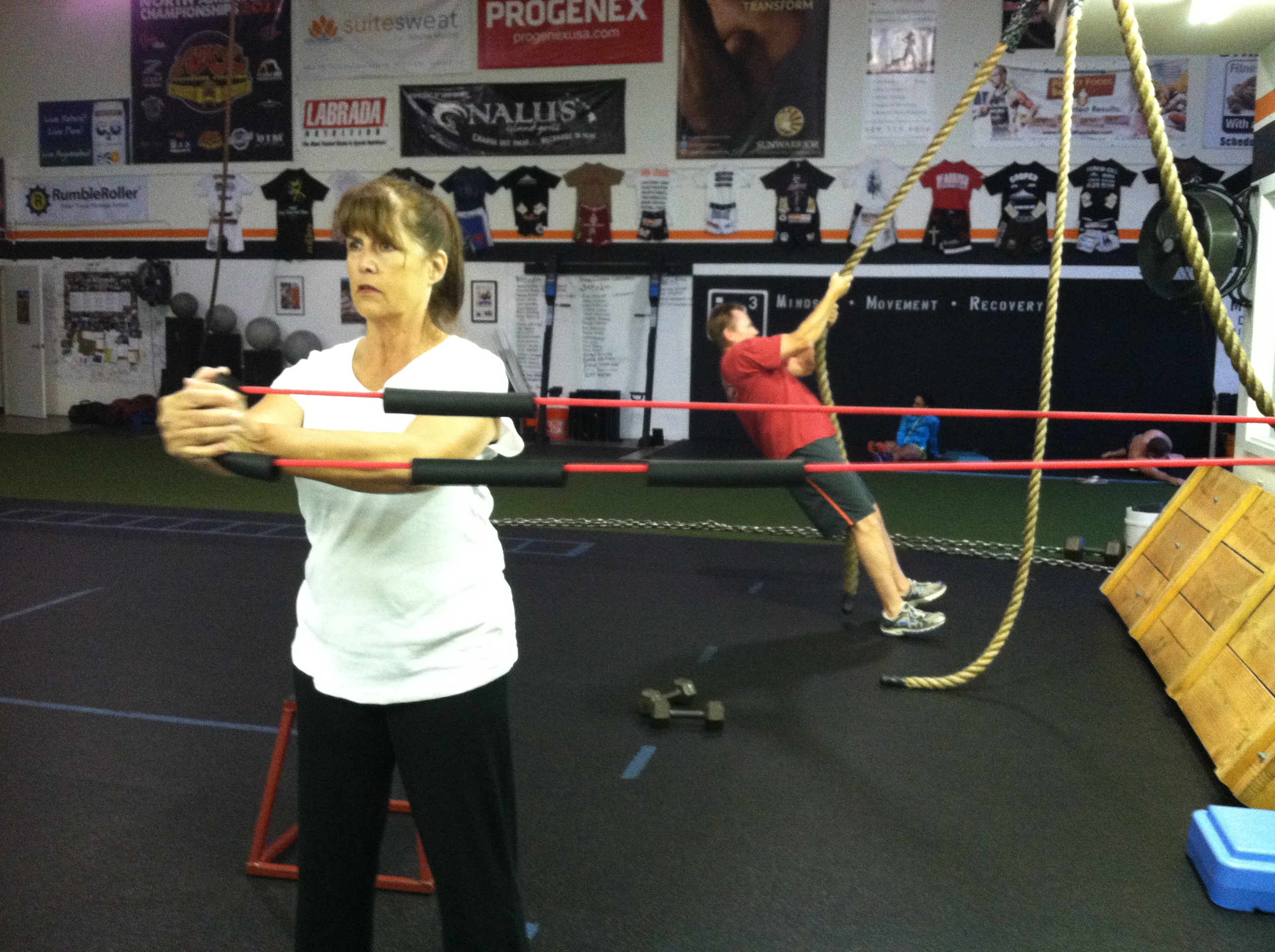
Doing some work and learning some new skills!
And the craziest thing is that we tend to STOP LEARNING new skills as we age.
We become more set in our ways and tend to stick to our routines and our comfort zones.
When we really should almost be putting ourselves out there to learn MORE as we age because it keeps us young.
So you know how you really wanted to try Zumba at the gym? You know how you really wanted to try powerlifting, kettlebells or boxing?
You know how you were afraid you would be clumsy or bad or uncoordinated and slow?
Well sure. Most of us are awkward when we first try to learn a new skill. BUT only through learning a new skill can we create a better mind-body connection so that we are MORE COORDINATED.
Age is just a number and you really can teach an old dog new tricks.
And the best part is, the more that “old dog” learns, the younger that “old dog” will really feel!
So stop thinking your age is holding you back.
Let yourself try a new activity and learn a new skill. It may just be what you need to feel younger and move better just like the Man Bicep Mom!
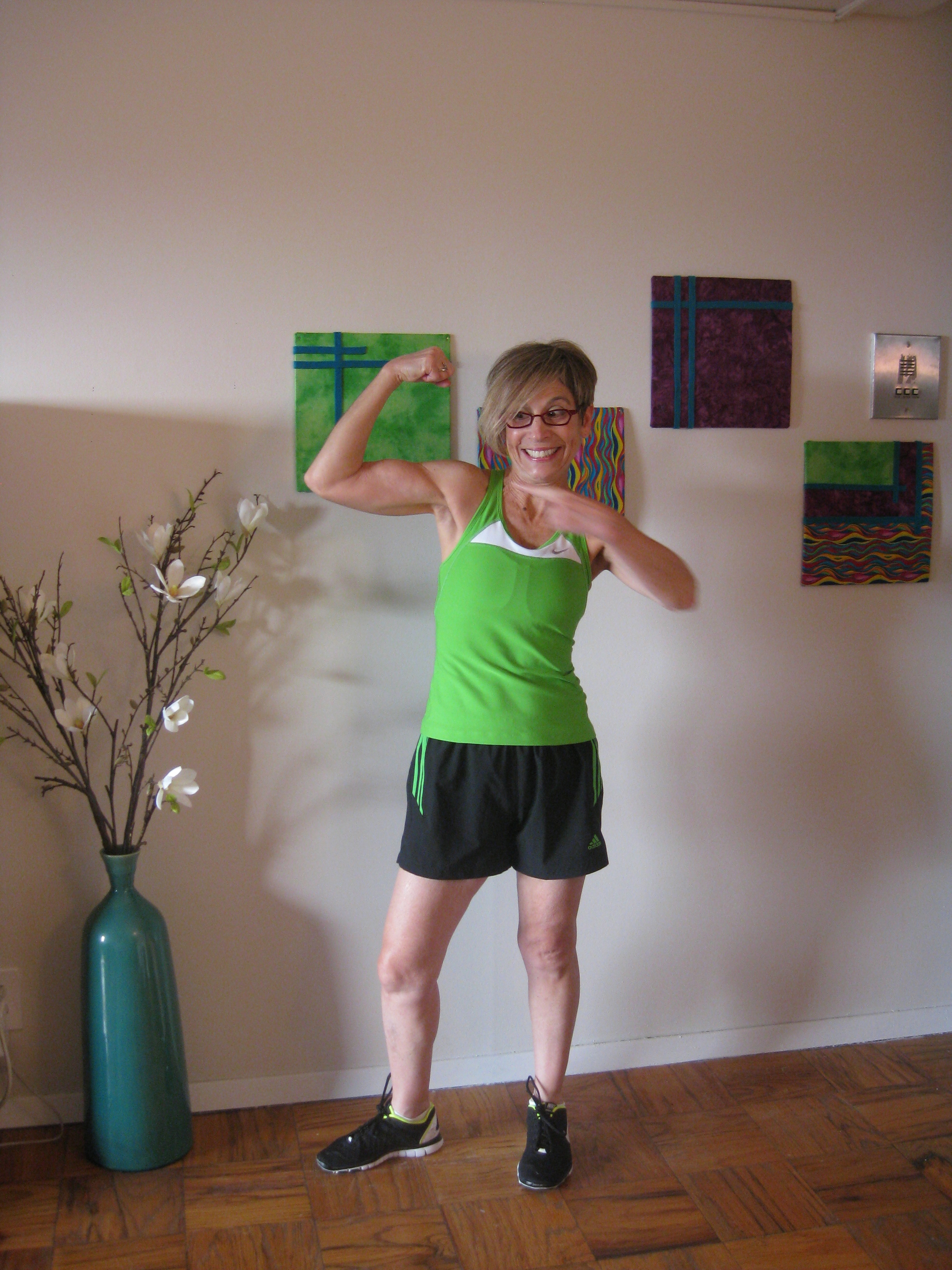
Showing off the man bicep!
P.S. If you are looking for some extra glute activation exercises, check out this new Redefining Strength post!
Wrist and Elbow Pain
Many of us sit at a computer for hours at a time, maybe even whole days, typing.
Which means our wrists are bent and flexed in an unnatural position for HOURS. And then when we are done typing, we go and “grip” things.
We carry grocery bags or go to the gym and lift weights or hold pencils and pens. We hold spoons to stir the dinner in the pan that we are also holding. (And it’s funny because most of us need to work on grip strength, which while important to improve, can also add to our pain).
Our hands and wrists are constantly in flexion (even our elbows are flexed a lot).
And this leads to a lot of hand, wrist, forearm and even elbow pain. (Shoot even if you play a sport like tennis and have some elbow pain…THIS CAN HELP!)
So what are some tips to help you alleviate the pain?
Where ever there are muscles, you can foam roll and probably should be foam rolling.
Take a golf ball and place it under your hand on a table or flat surface. Roll the golf ball around the palm of your hand. You can add a little bit of extra pressure by pressing down with your other hand.
You can then take the golf ball or a tennis ball (or small trigger point roller or foam roller) and roll out all of the muscles from your wrists to your elbow. Make sure to get the top and bottom of your forearm. To dig in deeper as you roll out, you can tense and relax your forearm on the ball or roller. To tense, make a fist and then relax over the roller. You can also dig in deeper by applying pressure with your other hand.
If you are suffering from elbow pain, you may also want to roll out your tricep and bicep right above your elbow. You can take a roller or ball and place it on a low table and roll your arm out on it. You can also place the roller or ball against a wall and press your arm into it (this works well for the tricep but not as well for the bicep unless you are in an opening or doorway). Again, you can apply more pressure and dig in deeper, by pressing down with your other hand. Make sure to rock back and forth and not only move the roller up and down.
STRETCHES
Wrist (and Hand) Stretches:
- Hand Circles – Clasp your hands together and draw circles and figure eights both ways with the hands together. Try not to tense your hands, but relax them through the range of motion.

- Under Forearm stretch – Kneel on the ground and place your palms down on the ground. Turn your fingertips back toward your knees. Then sit back on your heels and feel a stretch down the inside of your forearm. Sit back as far as you can without letting the heel of your palms come up. Rock back and forth. Do not hold the stretch but move slowly.

- Inside/Outside Stretch – Kneel on the ground with your palms on the ground and your fingertips pointing out away from each other. Lean forward a bit into your hands so that there is some pressure on your palms and wrists. Keeping the pressure on the hands, flip one hand and then the other so that the finger tips are pointing in and the back of your hands are down. Then, one at a time, flip the hands back out.
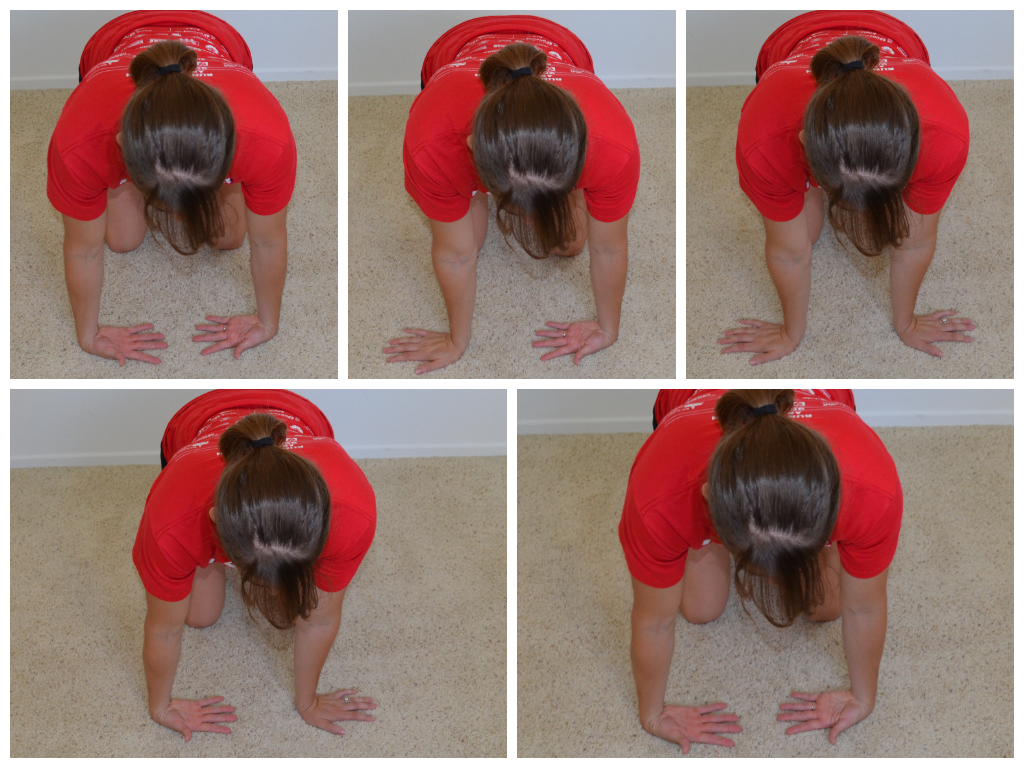
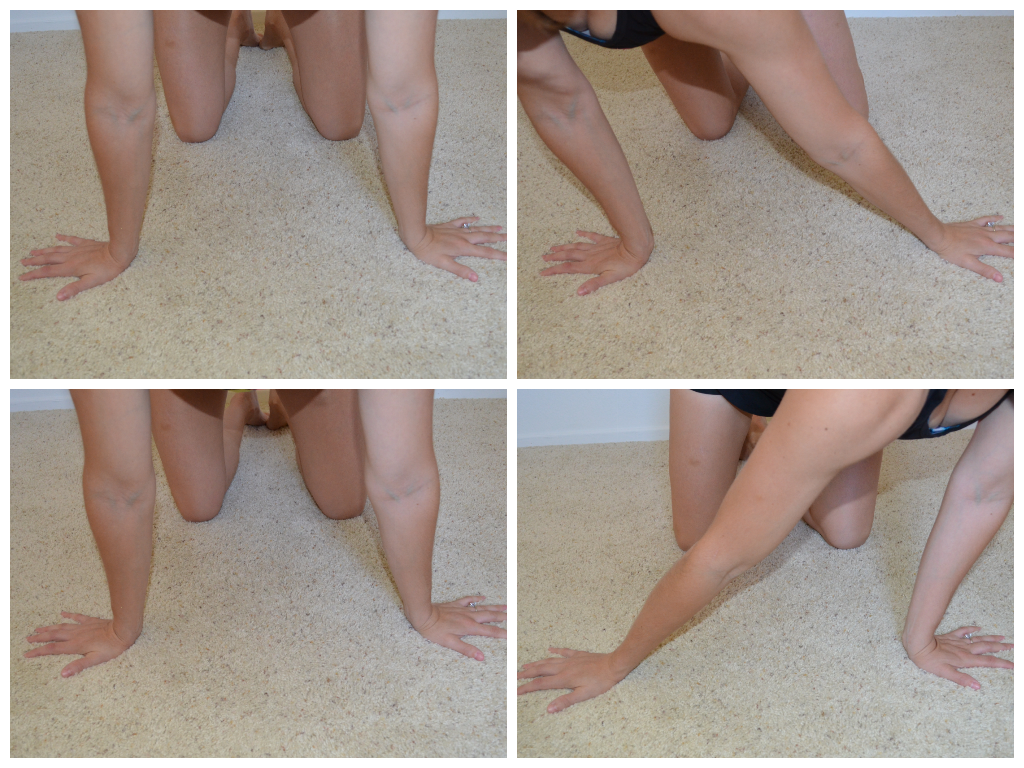
- Side to Side Extension – Kneel on the ground with your palms down and hands about shoulder-width apart. Fingers should be pointing outward away from each other. Then rock side to side slowly and smoothly.
- Prayer Stretch – Place your hands together. You can do this with the fingertips pointing up or down (do both if you have time). Press the fingertips together. If your fingers are pointing up, you are going to try to press the hands down as low as possible without the heels of the palms coming apart. If your fingertips are pointing down, you will try to raise your hands up as high as possible without your hands coming apart.

Tricep and Bicep Stretches:
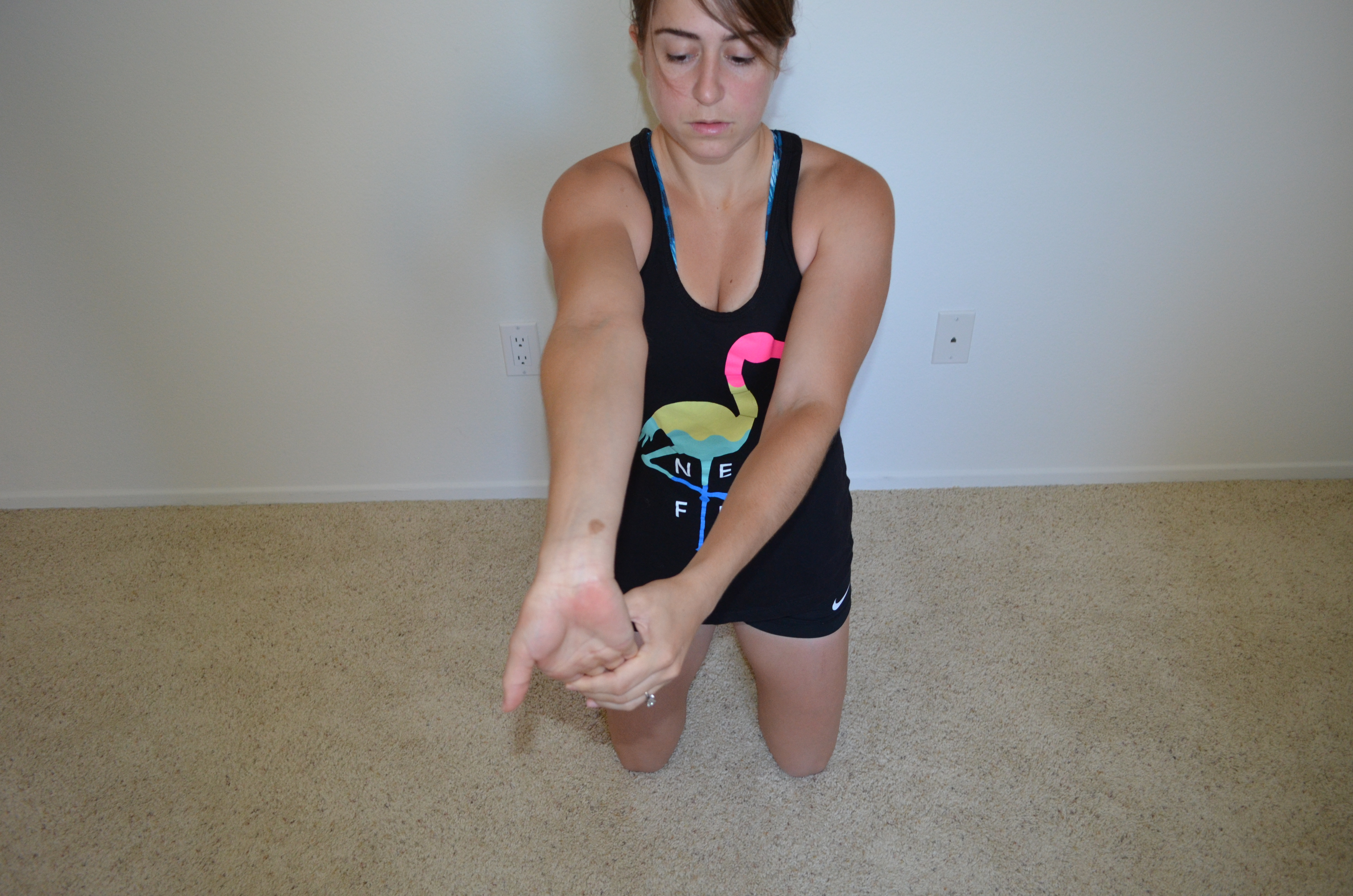
- Wrist and Bicep Stretch – Stretch one arm straight out in front of you. Take the other hand and press down on the fingertips, pointing them down toward the ground. As you press down, you should straighten your arm more so you feel a stretch down your forearm and up into your bicep.
- Hugs – Swing your arms open as wide as you can to feel a stretch through your chest and biceps. Then swing your arms across your body as if you are hugging yourself. Reach your hands around back as far as possible and then open up again as wide as possible. Repeat never really holding in one position.
- Overhead Tricep Stretch – Reach one hand up overhead and then down your back. Reach as far down your back as possible and then take the other hand and press down on the elbow to increase the stretch. Try not to arch your back as you do this stretch. You can also do this with a towel. Reach one hand over and down the back from the top. Hold a towel in that hand and then reach up the back to grab the other end of the towel. Pull down on the towel to increase the stretch.
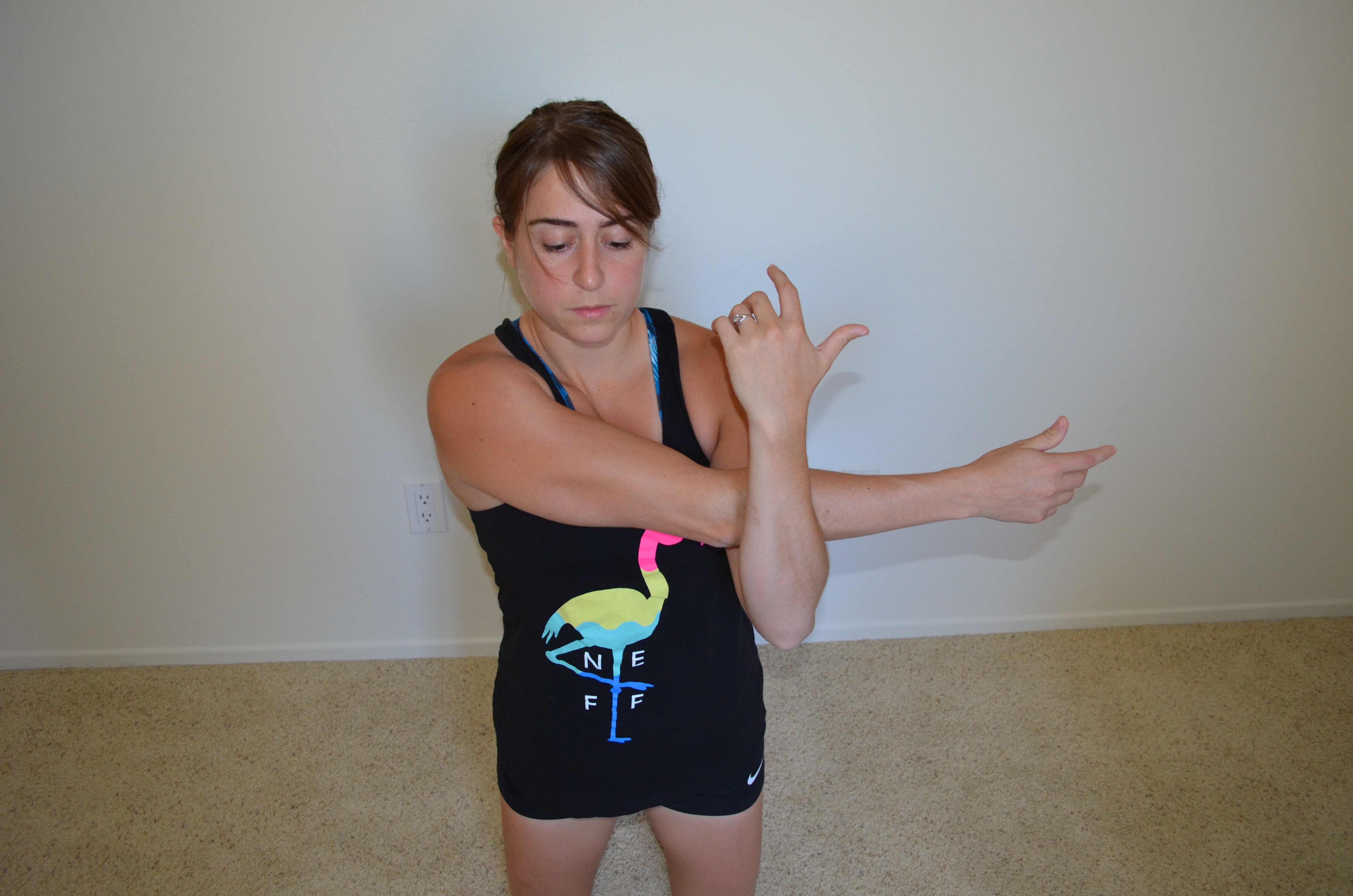
- Across the Chest Tricep Stretch – Reach one arm across your chest and take the other arm and pull it tighter to your chest. You can relax the arm across your chest down into the bent elbow of the other arm. Make sure to keep the shoulder of the arm across the chest relaxed down and back.
STRENGTHENING
Probably one of the best simple cure-alls for the lower arm is the rubber band finger extensions. It works all the way up your forearm to loosen everything that is constantly flexed.
To do it, get a rubber band (you can use a basic rubber band or get one of the thicker ones designed for this) and place it around the outside of your fingers. Place it around that middle knuckle. Then extend your fingers open as far as possible before bringing them back together. Do a number of reps (I recommend starting with like 30-50 depending on the tension of the band).

These are all quick fixes you can do to alleviate hand, wrist, forearm and elbow pain. None of them take a lot of time and can even be added to your workout warm ups.
If you sit at a desk all day, you can easily do some of these every few hours when you get up for a break. You could even add in the scapular hold and some neck and trap stretches too!…Hint…hint…
NOTE: If you have sever pain please see a Physical Therapist. These are meant to alleviate minor aches and pains. Ice can also be a great tool if an area is super inflamed.
Squat Variations – Mixing it up without weight
The basic bodyweight squat is a great move and often overlooked because it seems so simple and well….easy.
Most people add weight to the squat to make it more challenging.
But what if you don’t have weights at home yet have progressed past the basic bodyweight squat for reps?
Here are some variations of the squat that can help you work your legs in different ways that may just be the challenge you need even without adding weights
1. Bodyweight Squat Hold – Holding a basic bodyweight squat at the bottom (aka when your thighs are parallel to the ground and your knees are bent to 90) isn’t by any means easy even if you can squat with quite a bit of weight. Try holding for 30 seconds to 1 minute…or maybe even 2 minutes. Do not let your chest fall forward (aka do not lean forward) and make sure your weight is in your heels. Do not sink below 90 as that makes the squat easier. Beginners may need to perform a shorter hold or hold up a bit higher.
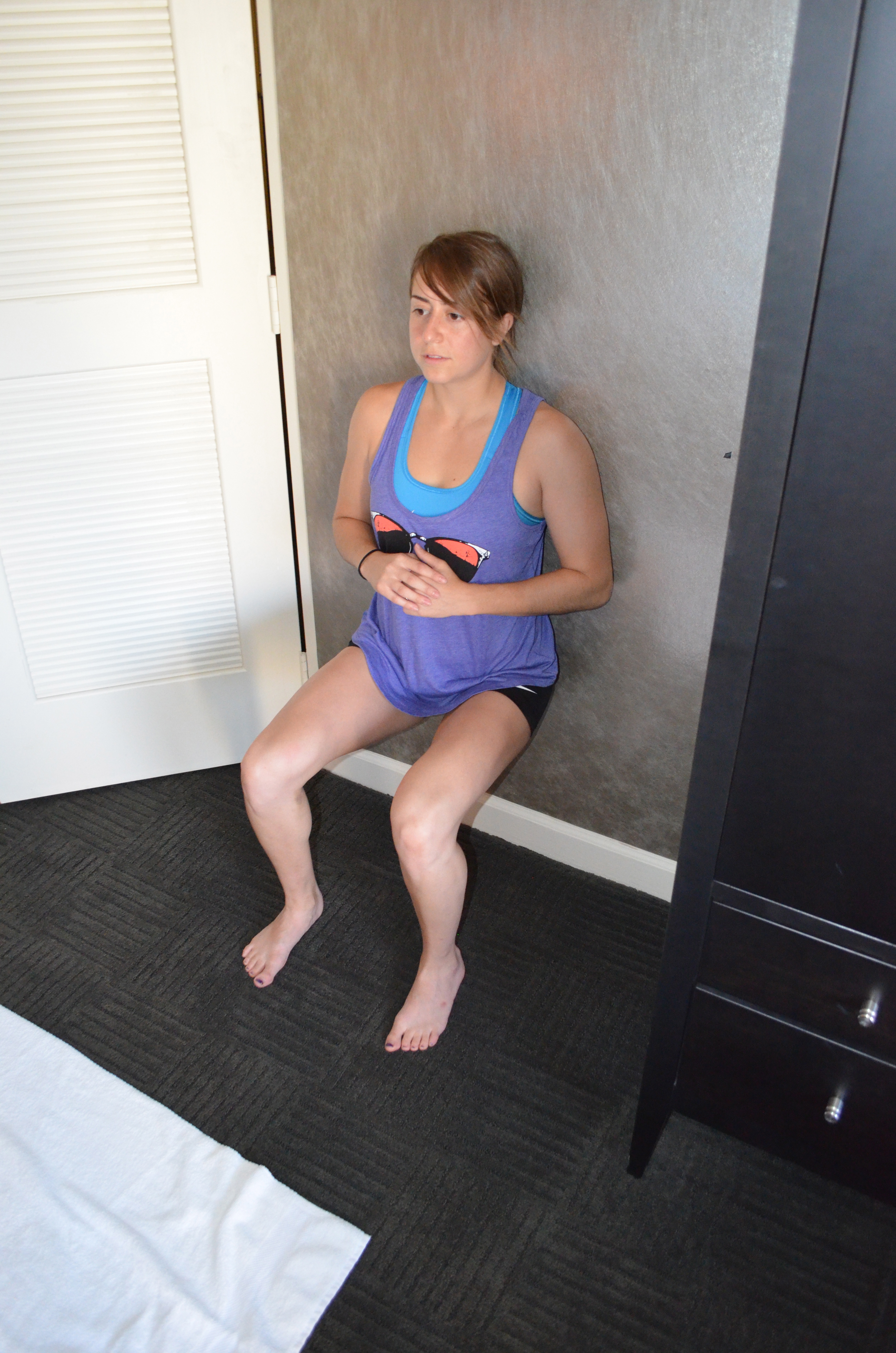
2. Wall Sit – This is a variation of the Squat Hold and equally as torturous. If you have trouble holding at 90 during the Squat Hold or if you lean forward, a wall sit will be the best option for you. Sink down to 90 and drive through your back into the wall. Sit up nice and tall. Hold for 30 seconds to 1 minute. If this doesn’t feel incredibly challenging, you can do a single leg wall sit. Raise one leg off the ground and hold it straight out in front of you (the straighter out in front of you that you hold the leg off the ground, the more you will work that quad as well). Try a 30 second to 1 minute hold on each side.
3. Squat Hold followed by reps – While bodyweight reps alone may not be challenging, bodyweight reps after a squat hold will be. Hold until your legs feel tired (30 seconds to 1 minute for most people). The longer you force yourself to hold before the reps, the harder the reps will be. Then do 10-20 reps after the hold and repeat. You can even advance this move further by doing a hold followed by reps of jump squats. (And to make this move extremely tiring, you can do a hold followed by basic reps followed by jump squats. OUCHIE!)
4. Slow Reps – Everyone always wants to go faster. No one ever wants to SLOW DOWN. And why is that? Because slow reps are AWFUL…aka REALLY HARD AND TORTUOUS! Try taking 5 seconds to lower down to the bottom of your squat before exploding back up to the top. Or try a 2-3 second lower, 5 second hold at the bottom and then a 2-3 second press back to the top. Mix it up. There are a ton of ways you can slow down the tempo. Just slow it down. Shoot you can even go quickly down, hold at the bottom for 5-10 seconds and then pop right back up!
5. Jump Squats – Just like slowing something down makes it harder, so does making something more powerful and explosive. With jump squats, it isn’t about performing a super deep rock bottom squat. You actually want just a little squat/hinge to load so that you can explode up. Squatting too deep can actually hinder your ability to be super explosive and jump high. So perform a more shallow squat and explode as high off the ground as possible. Beginners may need to rest between each rep. To make the move harder, jump up and sink right back into the squat to repeat. Really focus on a soft landing. You should never land with your legs completely locked out unless you want to hurt your knees. SOFT KNEES! Bend your knees to help you absorb the impact of landing.

6. 90 Degree Hops – A variation of the squat jump where you not only explode up, but also rotate 90 degrees to each side. With this move you can either focus on getting high off the ground OR on staying low and moving quickly. Both can really make the legs burn. I love this move because it isn’t just a simple sagittal plane squat! Just like the basic jump squat, you need to remember to focus on a soft landing.

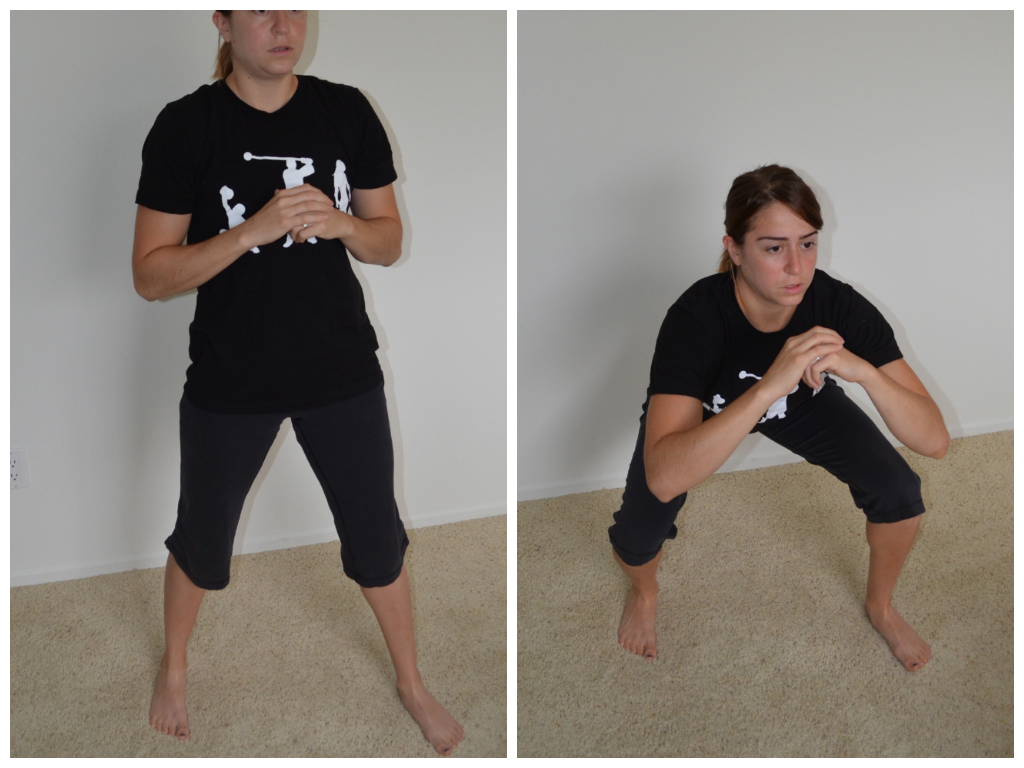
7. Staggered Stance Squats (and or Jumps) – A great way to work each leg individually without doing a single leg movement, is the staggered stance squat. Place one foot in front and the other foot about hip-width to shoulder-width apart and a bit behind the front foot (the back toe should be about even with the instep of your front foot). Squat down as low as possible, keeping your weight in your front heel. Do not worry if the back heel comes up. Do not lean forward or let your back round. Complete all reps on one leg and then switch to a staggered stance on the other side. To make this move harder, you can do one of two things – you can do a staggered stance squat jump or you can do a slow tempo staggered stance squat.
8. Single Leg Squats to Bench – This is a progression toward a pistol squat and a great way to correct any imbalances because the legs work individually. I did it with my IKEA table, but you can use a chair or bench or well…a step stool. Anything that is the proper height that you can sit down to. The lower the “box,” the harder the move. Start by sitting on the bench. Place one foot solidly on the ground with your heel right under your knee. Lift the other leg off the ground. I like to hold it out straight to make the quad work. Stand up straight. Try not to lean forward as you stand. Sit back down, controlling your decent as much as possible. As with all squat variations, you can slow down the tempo to make this move harder!

9. Single Leg Squats Using a Wall – This is more challenging than the squat to bench unless you have a super low box and have great control over your decent. Stand in a doorway with your hands on the each side. Straighten one leg out. Sit back into your heel and walk your hands down the wall as you squat as low as possible. Once you go as low as possible, walk your hands back up and drive through the heel back up to standing. Try to pull up with your hands as little as possible. Use the wall for support only as much as needed. Do not rock onto your toe. Drive off the heel as much as possible. Really keep your core engaged as you perform the move. Do not worry about your back being completely straight.

10. Pistol Squats – Basically this is a single leg squat with no support! Go as low as possible, holding the other leg out straight. Drive up through the heel to come back to standing.
Bonus:
5 minutes of bodyweight squats – A great way to get in some cardio and work the legs using the BASIC BODYWEIGHT SQUAT is to set a timer and do as many reps as possible in the time allotted. I like five minutes. It is just long enough to be awful, but not so long that you need to take long rests. Work your way up to five minutes if you are a beginner!
What is your favorite squat variation without weight?
Sandbag Workout
So Sarah over at Shh…Fit Happens wrote a post about working out with sandbags the other day and it got me to thinking about all the exercises that I use sandbags for.
Sandbags are a great way to add weight to any move because the weight is AWKWARD. They aren’t like barbells and dumbbells. They aren’t easy to grip and the weight can shift from side to side as you lift it. They are super functional and force your core to really engage to stabilize.
They are a great way to add variety to the same basic moves that you are already doing. Like I mentioned in my post Sunday…Mix up your resistance to make moves more challenging.
So below is a great Sandbag Workout:
WARM UP
Dynamic stretches and locomotion to get the entire body warm. Don’t forget to foam roll any tight areas!
STRENGTH:
3-5 rounds of each superset. Complete all rounds of each superset before moving on to the next one.
Reps: 5 for maximal strength (advanced lifters), 8-12 for hypertrophy (advanced and intermediate), 15-20 strength endurance (beginners, recovery week or just working on strength endurance)
1.
Squat (Do not round forward with the front loaded weight!)
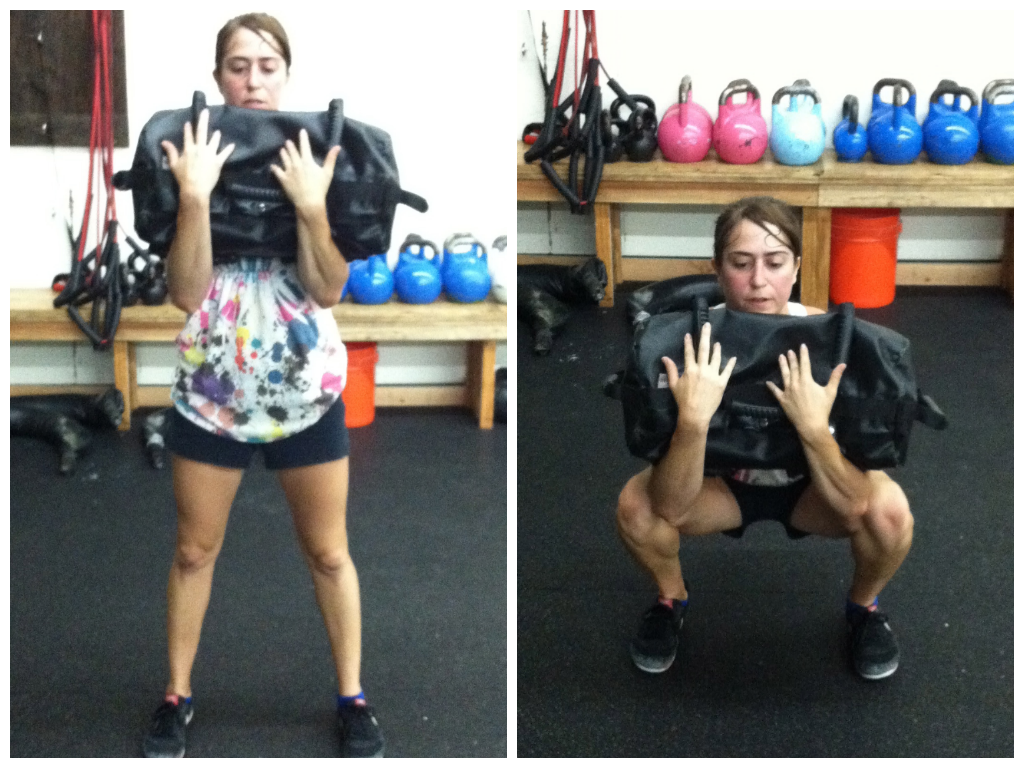
Overhead Press (Do not arch your low back)

2.
Lunge with Rotation (Do not let the sandbag go back too far on each side or it will catch and do not ROUND forward. Start on one side step the back foot forward and swing the bag to the other side as you lunge back.)

Row (Nice flat back. Knees soft.)

3.
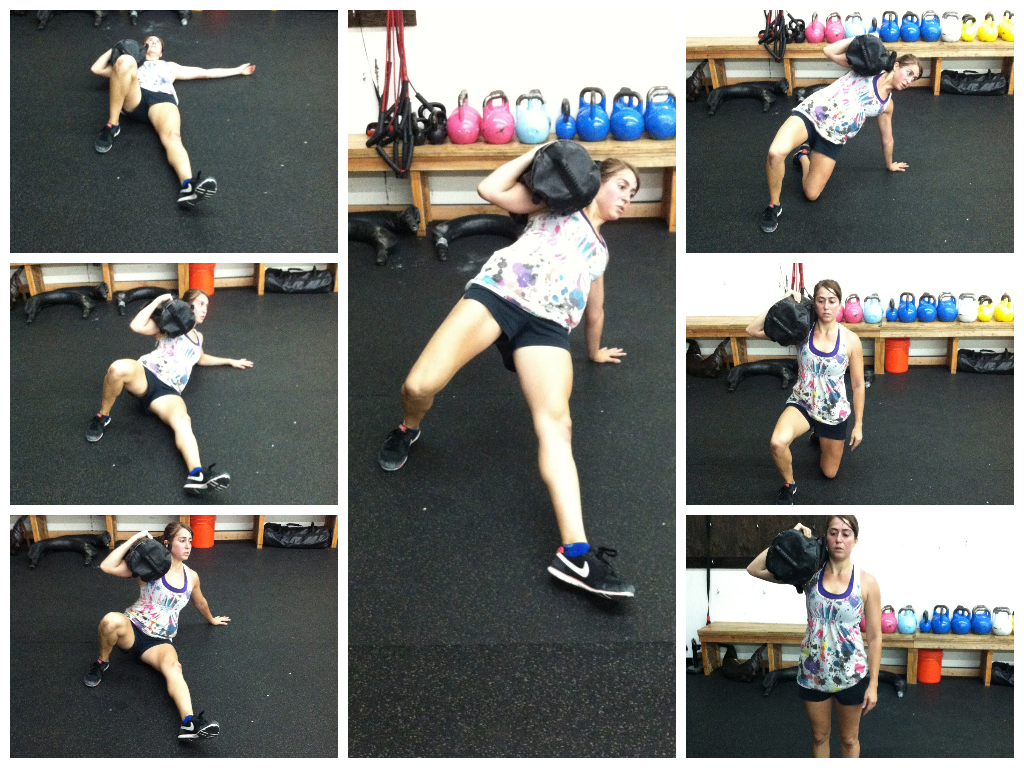
Sandbag Get Up (Will want to do 1-5 reps per side for everyone. The Get Up is doing all the steps to stand up and then following all the same steps to go back down.)
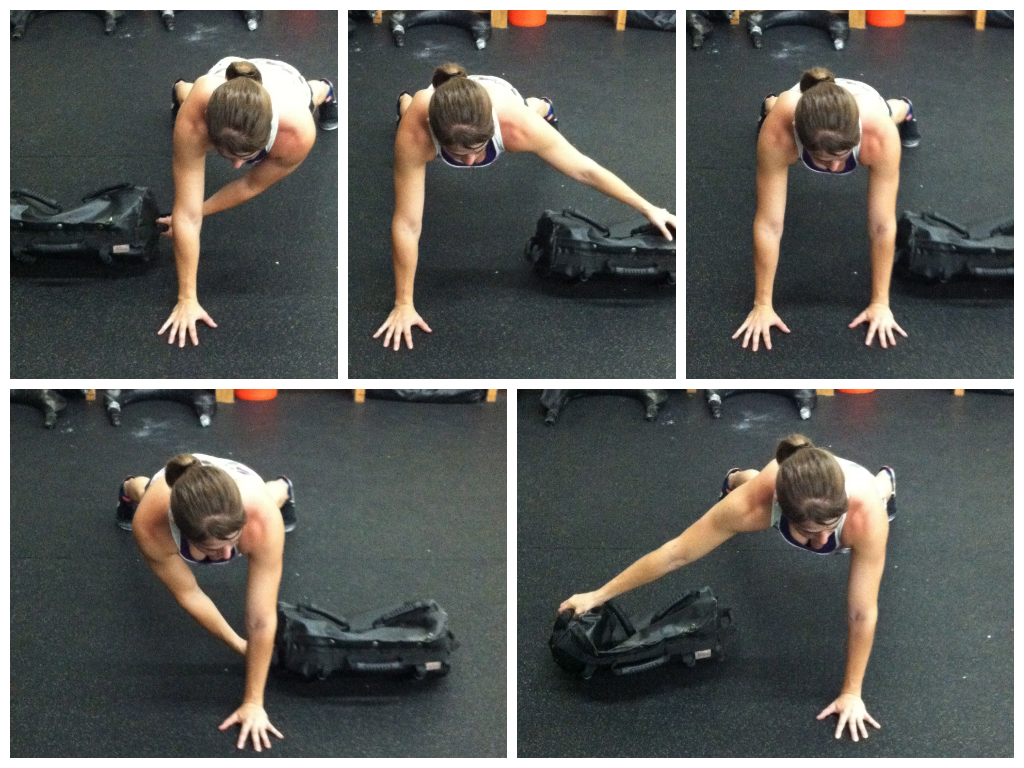
Plank with Pull Thrus (Keep hips from rotating or going up or down)
COOL DOWN
Stretch and foam roll all tight areas!
Bonus Moves:
Single Leg Deadlift (Keep the standing leg soft and your back flat)
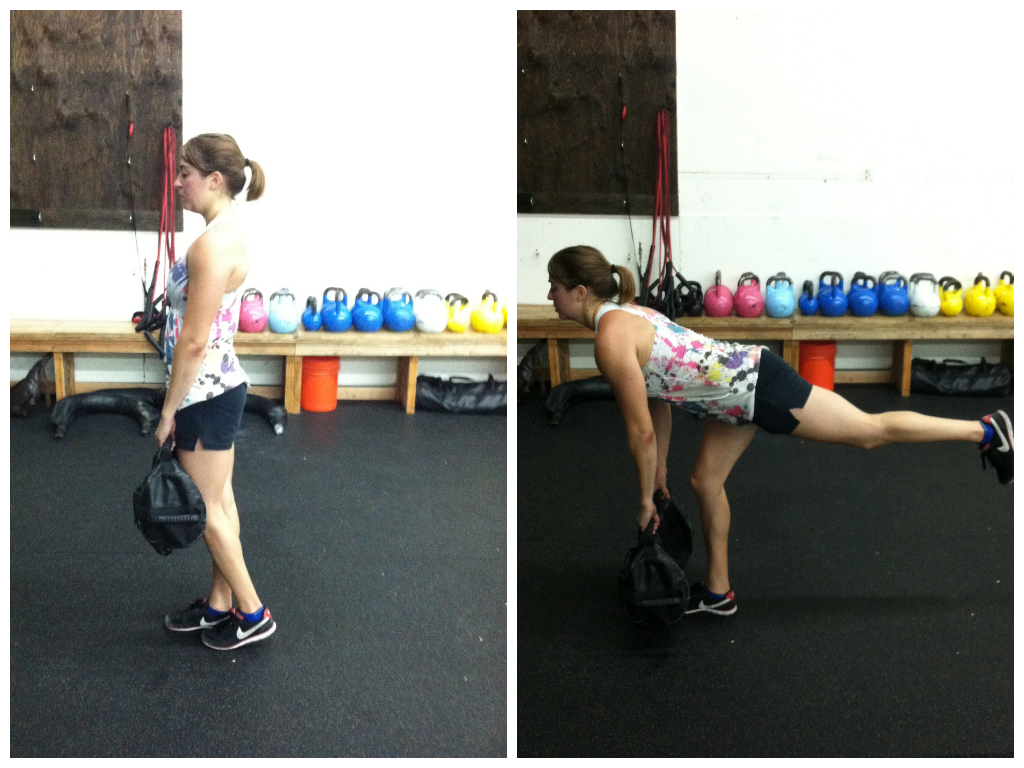
Goodmorning (Keep a flat back)
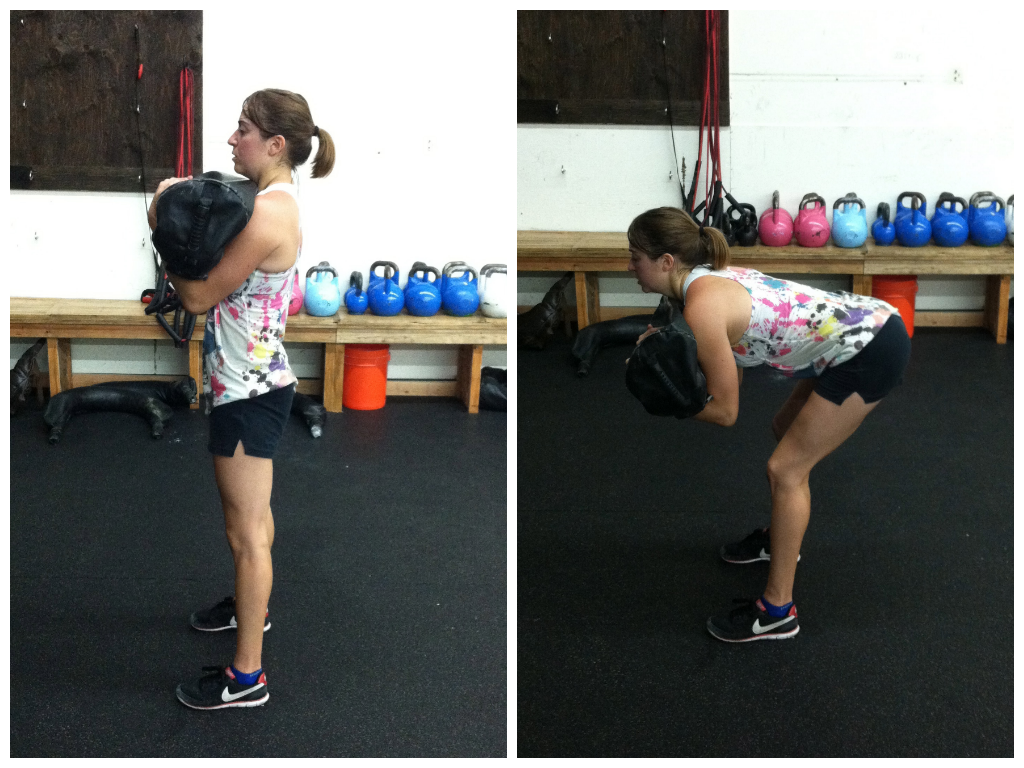
Crawling with Sandbag Pull (Sit back into your heels and perform a hip hinge to drive the sandbag forward. Don’t just pull with your arm.)

I also want to note that I’ve only demonstrated one variation of these moves. Squats can be done with the sandbag held the long ways up and down (Bear Hug) or even on one shoulder. Loading on one shoulder forces the core to engage even more (which as I mentioned on Sunday, asymmetrical loading is a great way to keep your workouts challenging!).
Deadlifts can also be done in a “suitcase” style where you hold it on one side. This is a great way to progress the single leg move (again ASYMMETRICAL LOADING!).
Note: Sorry for the pictures. I do not “glow” or “glitter” when I workout….I SWEAT!
BONUS WORKOUT:

Partner Exercises – Great workout to do as a couple (or with friends!)
Working out with friends and family can be super fun. Having a group of people, or a partner, to workout with can keep you motivated, having fun and constantly pushing harder.
Because I think that working out with others can be a great way to have fun WHILE getting in a killer workout, I wanted to share with you all a few of my favorite partner moves.
I generally use these moves on metabolic days as they can really get your heart pumping when you do them quickly for 20-30 seconds. You can also combine just a couple for a warm up and team-building exercise!
Partner Workout Moves!
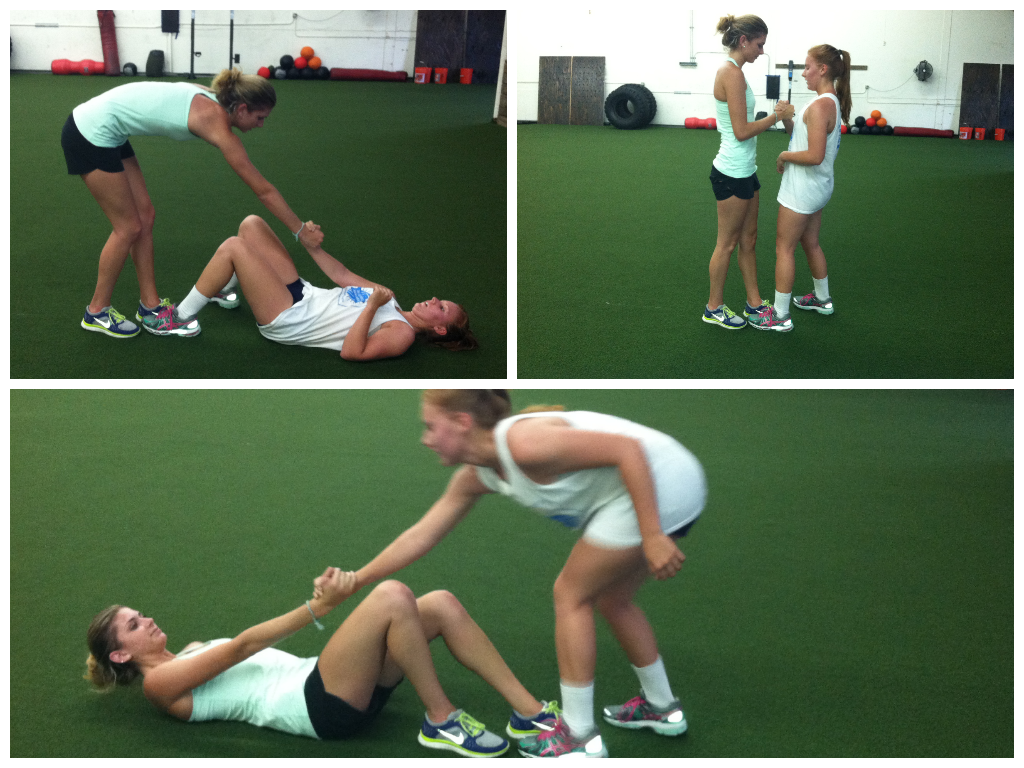
1. Partner Get Ups – The goal of this move is to try to stand of from lying down as much by yourself as possible. Your partner is just there for a little support. It is a great move to warm up the legs and core. To do this move, stand facing your partner with your feet between hip-width and shoulder-width apart. Your feet can be slightly staggered if you want. Grab hands so that you are holding right to right or left to left. One partner will then sit down on the ground and roll back onto their back. Without using their other hand, they will roll up and drive through their feet to come to a standing position. The other parter will have move forward with them as they rolled back so that they can help “pull” them back up to standing. Once the partner is standing, the other partner will roll back and then plant their feet and come back to standing. Keep alternating partners for the allotted amount of time and then switch to the other hand and repeat.
2. Partner Pulls – Grab your partner’s hand and step the opposite forward into a strong stance facing your partner. This move is a great upper body move that forces you to each act as the other’s resistance. Your goal is to keep tension the entire time you are doing this move and create a little arm “shake-age” (as I like to call it). You want to make each other really work for every inch of movement. HOWEVER, you do not want to resist so hard that the other person can’t move. There should be slow and steady movement back and forth. To do this move, set up and then one person should pull toward their armpit while the other slowly allows their arm to extend, resisting the pull. As soon as the partner is fully extended, they should start pulling back toward their armpit while the other person resists. A slight rotation as you pull is fine, but you shouldn’t rotate a lot. Also do not round the shoulders or really lean back. Keep a nice tall posture and a slight leg bend.
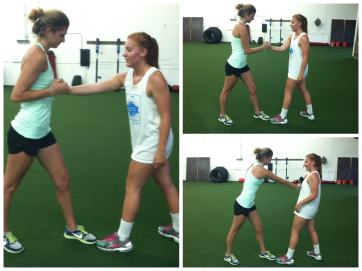
3. Partner Pushes – Partner pushes are just a push variation of the move above. Instead of actually holding hands though, you and your partner will put palm to palm with finger tips pointing up. This will force both of you to really PUSH and not pull at all back and forth.
4. Partner Crawls and Jumps – A great core move. Have one person set up in sort of a pike/downward dog position. They want to have their butt up in the air to give their partner plenty of room to crawl under. The other partner will crawl under. To make the crawl easier, have your knees on the ground. To make it harder, try not to allow your knees to touch the ground while still managing to crawl under your partner. Once you crawl under, your partner will drop to the ground (like at the bottom of a push up) so that you can jump over. To make the drop harder, hold at the bottom of a push up. To make it a bit easier, just rest on the ground. Hop laterally over your partner. Try to hop with both feet together, however, you can jump forward or hop one foot at a time if you are just beginning (Please just don’t land on your partner….they probably wouldn’t like that too much….). Once you’ve jumped over, drop to the ground and set up so they can crawl under you and then jump over. Keep repeating until the time is up.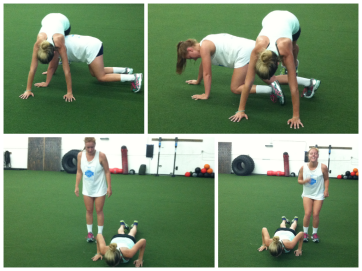
5. Partner Hamstring Curls – One of the toughest hamstring moves out there and one of my favorite from training in college. (Sorry I forgot to take a picture of this last night but will try to get one today.) One partner should kneel on a mat or slightly cushioned flooring and flex their feet. The other partner will kneel behind them. The partner behind will grab the ankles of the front partner and really hold them into the ground. The back partner is the anchor that helps the other partner curl back up. The harder the back partner presses into the ground, the more assistance they give the front partner. The front partner will then slowly fall forward toward the ground with their hands outside their chest to catch them once they hit the ground. Go as slowly toward the ground as you can to really work your hamstrings. Basically all that should be happening is that the front partner is straightening at the knees as they go over. Their body should stay in a nice straight line. Once the front partner hits the ground, they will then press themselves back with their hands only as much as needed and PULL themselves back up with their hamstrings. They should keep their body in a straight line. If their butt starts to go back first, they didn’t push up enough with their arms. This move (especially the curling back up part) is very advanced. Beginners may want to start with a wall in front of them. Control your decent toward the wall. Truly go as slowly as possible. Once you hit the wall, press yourself away, trying to curl yourself back up as much as possible with your hamstrings. Repeat all reps and then the other partner goes.
6. Partner Drags or Pulls – So this move can be done two different ways. My favorite is with the valslides/sliders/furniture movers just because both partners are working hard the entire time; however, if you are outside/at home/don’t have sliders, the other move is still challenging and fun! To do partner pulls, one partner stands with each foot on a valslide. They will sink into a squat (90 degrees) and extend their arms out in front, crossing one arm over the other. The other partner will grab their hands and then drag them, walking backward as quickly as they can. This kills the legs of both people and really works the core of the person on the sliders. Do not allow yourself to fall forward or round when on the sliders. Also do not let your knees cave in. Maintain proper squat form. (It may take a round to get used to the balance). If you are pulling, try to be steady and smooth in your steps. If you jerk your partner, they will have to work doubly hard to balance. Then switch and the other person pulls while the other is dragged. To do partner drags, one partner will stand with their back to the other partner. They will cross their hands over their chest. The back partner will then reach up under their armpits from behind them and the front partner will then lean back into the back partner. The back partner will then be holding the weight of the front partner. The front partner will not be supporting themself. Their feet will just be relaxed on the ground as the back partner is holding them. The back partner will then “drag” the front partner. After completing the round, the partner that was dragged will then be the “dragger.”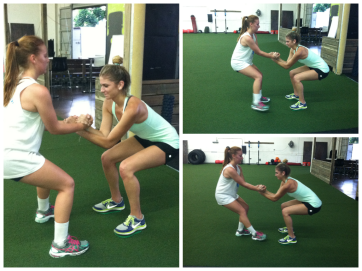
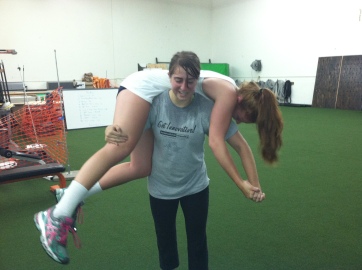
Poor Carla…having to be carried by the sweat monster! (Luckily I wasn’t even sweating that much for me!)
7. Partner Carries – This is an advanced move and a very full body one. Please be careful when attempting this as you must keep your core tight or risk back injury. To do this move, one partner will be carried. To pick up your partner, have them face you while you are sideways. You are going to reach through their legs and hook your arm around and up. As you reach through though, you should have their other hand over your back and in your other hand. Get the partner over your back right up by your shoulders. Brace your core and have your partner put their bottom, free hand, on your low back to help brace. Get them situated up high on your back and then walk. When done, switch and have them carry you.
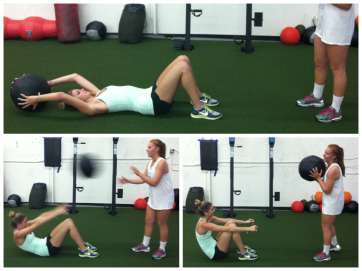
8. Partner Medball Sit Ups and Throw – Take a light medicine ball. One partner will be standing while the other is on the ground performing a sit up. The partner on the ground should bend their knees and lay back on the ground with the ball extended overhead. As they sit up, they are going to throw the ball to the partner that is standing. The partner standing will then pass the ball back to the partner that is seated and then will lie back down and repeat. Switch once the time or reps are completed.
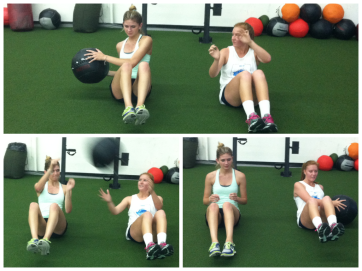
9. Partner Medball Russian Twists – Sit side-by-side with a foot or two of space between you. The farther apart you sit the more difficult the move will be since you have to pass it that distance. Both of you should lean back slightly and raise your feet off the ground to balance on your bums (if you are a beginner, you can keep your feet on the ground, but still remember to lean back to engage your abs). The partner with the ball will rotate the ball to the outside of the hip that is away from their partner. They will then toss the ball across their body to their partner. The partner will catch it and rotate the ball out to their side farthest from their partner and then throw it back. Repeat all reps and then face the other direction so that you can throw the other direction.
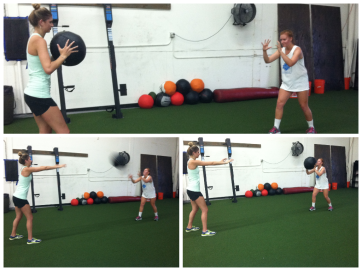
10. Partner Medball Chest Passes and Shuffle – Stand facing your partner. The farther apart you stand the harder the move will be because you will pass further. You can also use a heavier ball to make the move harder. We demonstrated this move as just a chest pass, however, I like it as the chest pass and shuffle. Beginners may want to start with just the pass though. To perform this move, you are going to pass the ball back and forth in a chest pass. As you pass the ball back and forth, you are also going to shuffle sideways down and back. The faster you shuffle and pass, the harder the move. Make sure to not get ahead of your partner. You want to work together not smash the ball at each other’s faces.
Bonus move: Partner sled complex….Because sometimes it is just fun to sit on a sled and go for a ride! (Do Tsunamis off the sled. Pull the sled toward you, push it back and then crawl backward back!)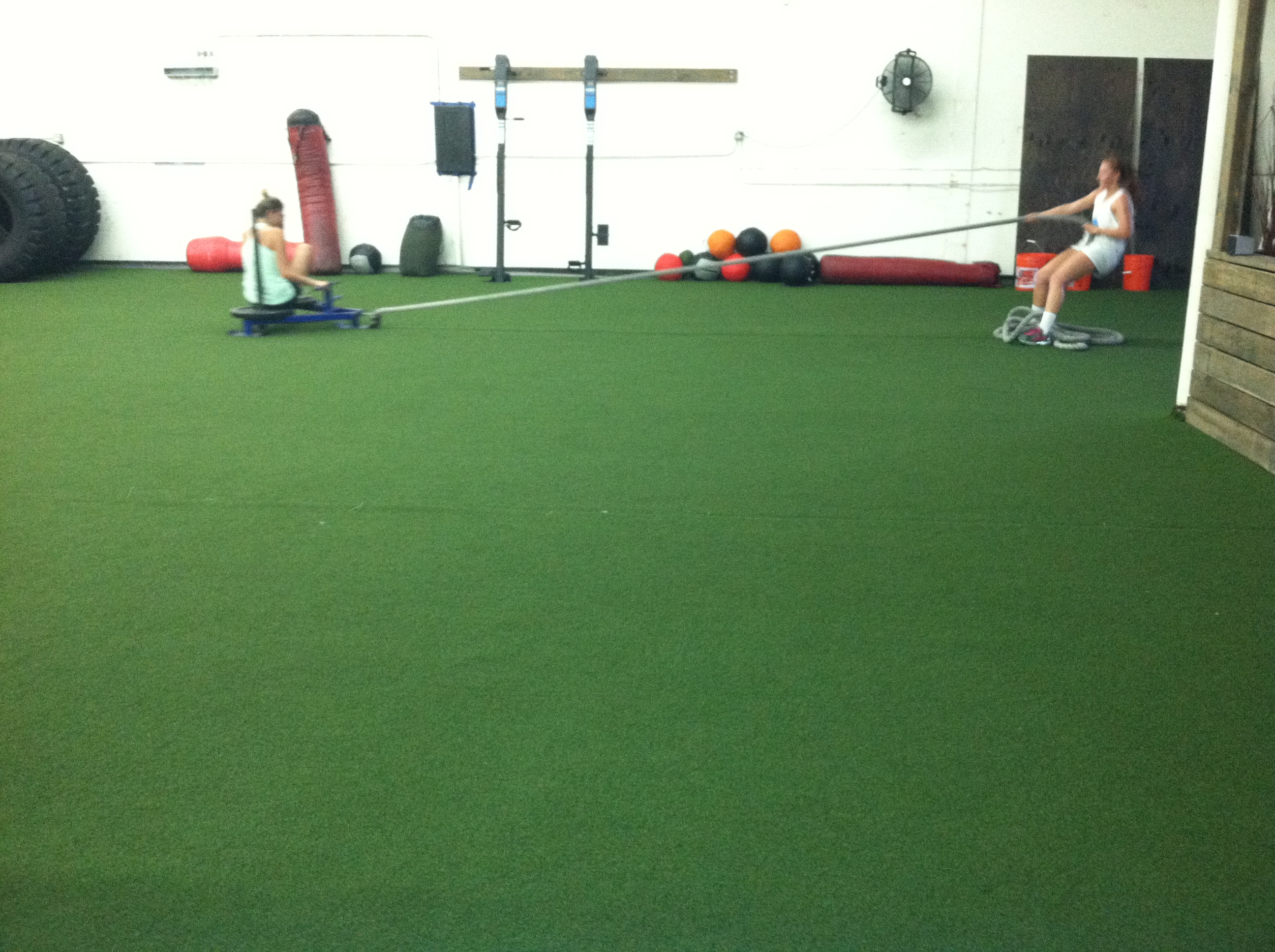
Note: A big THANK YOU to Carla and Jaydee of the Vanguard Volleyball Team for helping me snap some photos! These moves are best done with a partner at your similar fitness level and/or size (if you are short and working with a tall person the crawls will not be easy for that taller person).
Redefining Strength – Empowerment through exercise
So over the last year, I’ve thought a lot about what Man Bicep stood for in my life and the life of my clients.
It wasn’t about powerlifting. It most definitely wasn’t about running. And it wasn’t even about a specific diet.
It was about doing something….anything…that made you feel healthy and strong. It was about working out to feel empowered.
It was about taking on new challenges and feeling like you COULD do anything.
It was about redefining what strong really means.
And so I started considering what could really make us feel more empowered. And I began developing workout programs based around this principle.
I believe that working out can be an outlet, a release. I believe it can help us build confidence in a way few other things can. Overcoming physical challenges – lifting more or running further than we thought possible – is just about the most empowering thing you can do.
So I created “Redefining Strength.”
Right now the site has a few products that I’m giving away. I spent a lot of time considering what would be most helpful and supplement everything that I post here, on Man Bicep.
If you go over and subscribe, you will get 4 different reports. One is bodyweight exercises that can be done by beginners and advanced a like. They are basically exercises you can do anywhere and get a full body workout.

Handstand progression…I show you ways to progress up to one!
You will also get a list of 10 Simple Diet Changes. Be you vegetarian or Atkins dieter, there are tips on there that EVERYONE needs to follow.
I also spent a lot of time creating a foam rolling video library and cheat sheet. I believe that foam rolling is one of the most important things when it comes to moving well and feeling great. I even included some foam rolling videos that show you how to roll out even if you don’t have any of the fancy trigger point equipment.
And last, but not least, you will get a goal setting sheet. I debated about putting this one in since many of you will skip it. But honestly, goal setting is one of the best things you can do for yourself.
I know it’s cheesy. I know it’s boring and seems stupid. But trust me it’s worth the time if you really set goals that MATTER.
Goals that MATTER are what keep you committed even through the roughest of times. Goals CAN be motivating and keep us on course.
You just have to set goals in a way that don’t allow them to fall by the wayside like most people’s New Years resolutions!
So head over to Redefining Strength and check out those four guides and the video library. I hope it gets you as excited as I am for the programs launching in August!
As always, if you have any questions, feel free to email me at manbiceps@gmail.com.
Home Workouts – 10 Moves You Can Do With An Ikea Table
So yesterday when Ryan and I were doing some foam rolling stuff, I used a table for a couple of the moves.
It was just our little $10 Ikea table, but it was amazingly sturdy considering I put it together…Although that may be better than if Ryan put it together…Sorry Ryan…But it’s true…
Anyway, when I used the table, Ryan said to me, “I wonder if you could do a full body workout with just that table?”
My answer, “You totally could!”
Here are 10 moves you can do with just a cheap little Ikea side table! Love you Ikea! 🙂 (The moves are in no particular order)
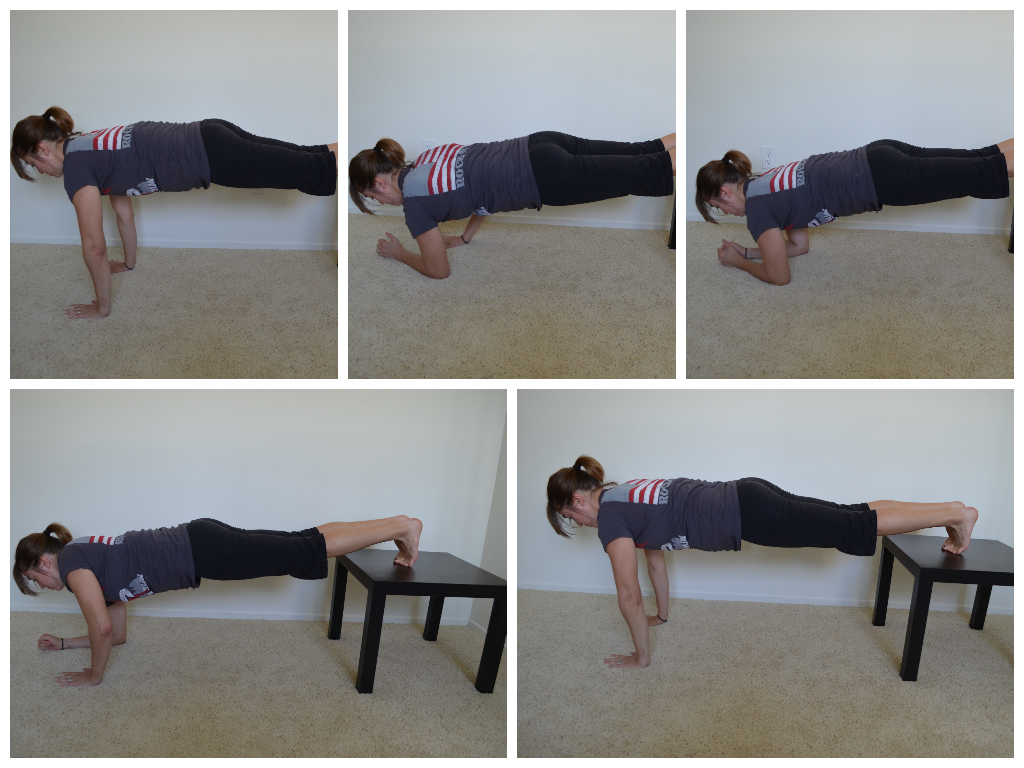
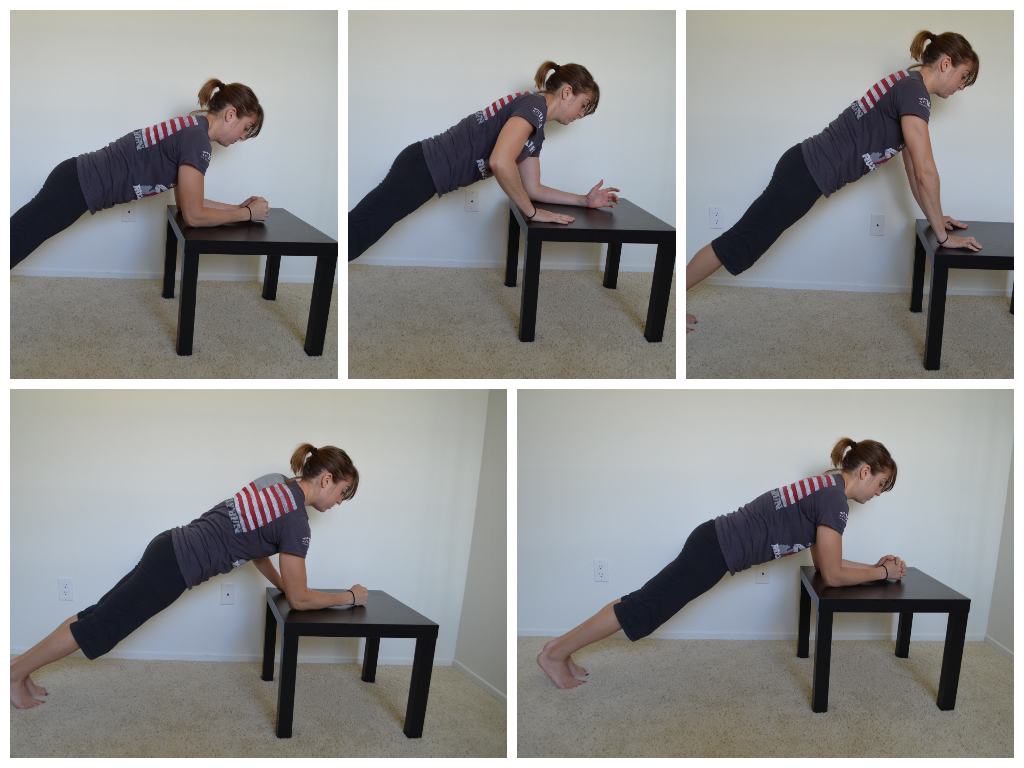
1. Decline or Incline Push ups – You can make the push up easier or more advanced using the table. To make the push up easier, put your hands on the table and then perform the push up from your knees or toes. Doing the push up from your knees will make it easier than from your toes. To advance the push up, put your toes on top of the table.
2. Balance Lunges – The balance lunge is a great leg move to do if you don’t have weights. Place your back foot up on the table and hop your front foot out so you are in a nice wide stance. Then lunge down, dropping your back knee toward the ground. Really sit back into the lunge. Make sure you aren’t going forward and that your front knee is not going past your toe. You should feel a nice stretch in the front of the leg that is back when doing this move.

3. Single Leg Squats – This table is a great way for beginners especially to start working on their pistol squats. It is also a great way to really correct imbalances since you are working legs individually. If the table is too low for you at the beginning, start with a two-leg squat to bench. Then progress to one leg. Beginners can completely sit down on the table. As you advance, try to only barely tap the table with your butt before standing up. Do not rely on sitting on the bench to stand back up.
4. Incline or Decline Climbers – These aren’t mountain climbers. With climbers you are working your shoulders and triceps. Beginners should start in a plank position with their forearms on the table. Next climb up one hand at a time until you are at the top of a push up position. Then climb back down to complete the rep. Advanced exercisers should do this move with their feet elevated on the table instead.
5. Glute Bridge off table – A great way to advance the glute bridge is by putting your feet up on the table. You can do either a double leg glute bridge, which is a bit easier, or a single leg bridge, which is a bit more difficult. Start by lying on the ground with your heels on the table. Your butt should be close to the table. Arms are bent to 90 with elbows driving into the ground. Squeeze the glutes and drive through the heels, lifting your hips as high as you can in the air. Keep your core tight and glutes squeezed. You should not feel this in your low back. To make the move even more beneficial, hold each rep at the top for 2-5 seconds.
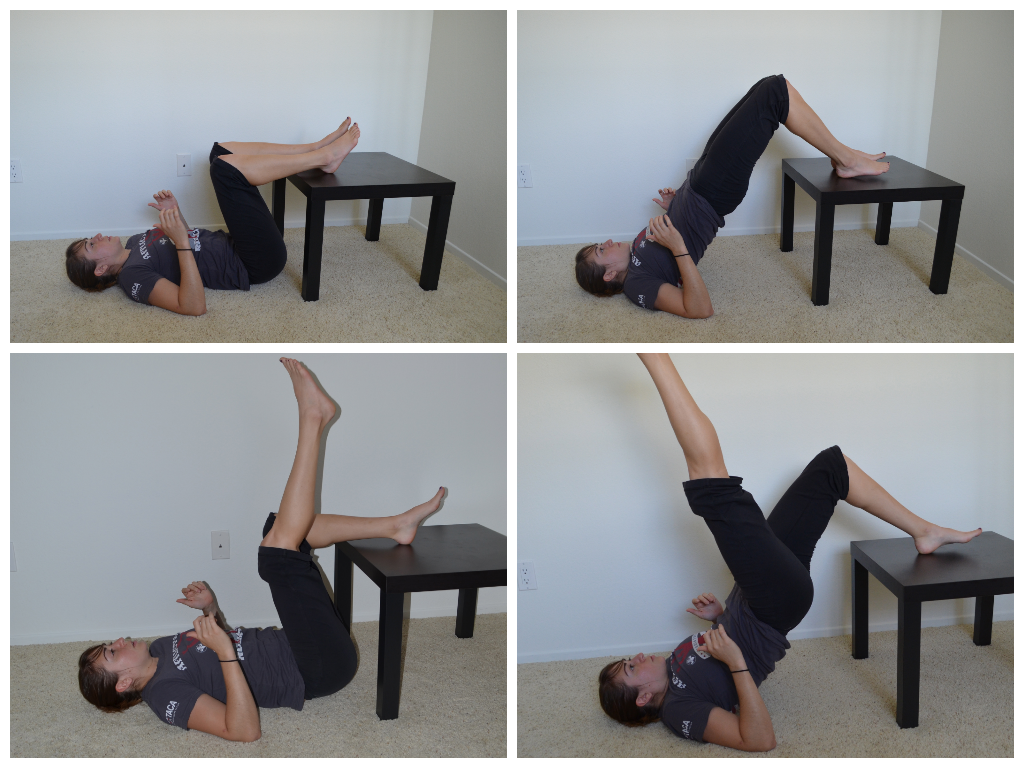
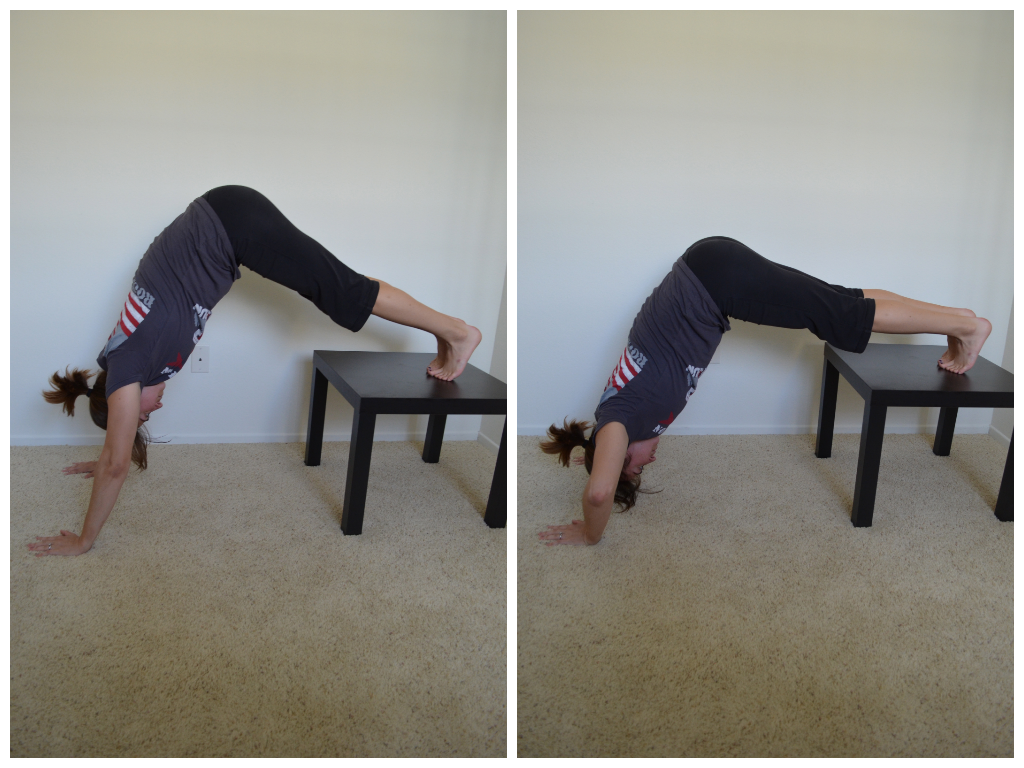
6. Handstands – Handstands are a great upper body move. Using the table you can either do a beginner handstand hold or you can make the move more advanced by adding in a push up. To do the hold, place your feet on top of the table. Walk your hands back a bit and push your butt up towards the ceiling. Push off your toes to get as vertical as possible, creating a nice straight line from your hands, up your arms and core to your tailbone. If this is easy, add the push up in while holding this position. Drop your head down to the ground and then lift back up.
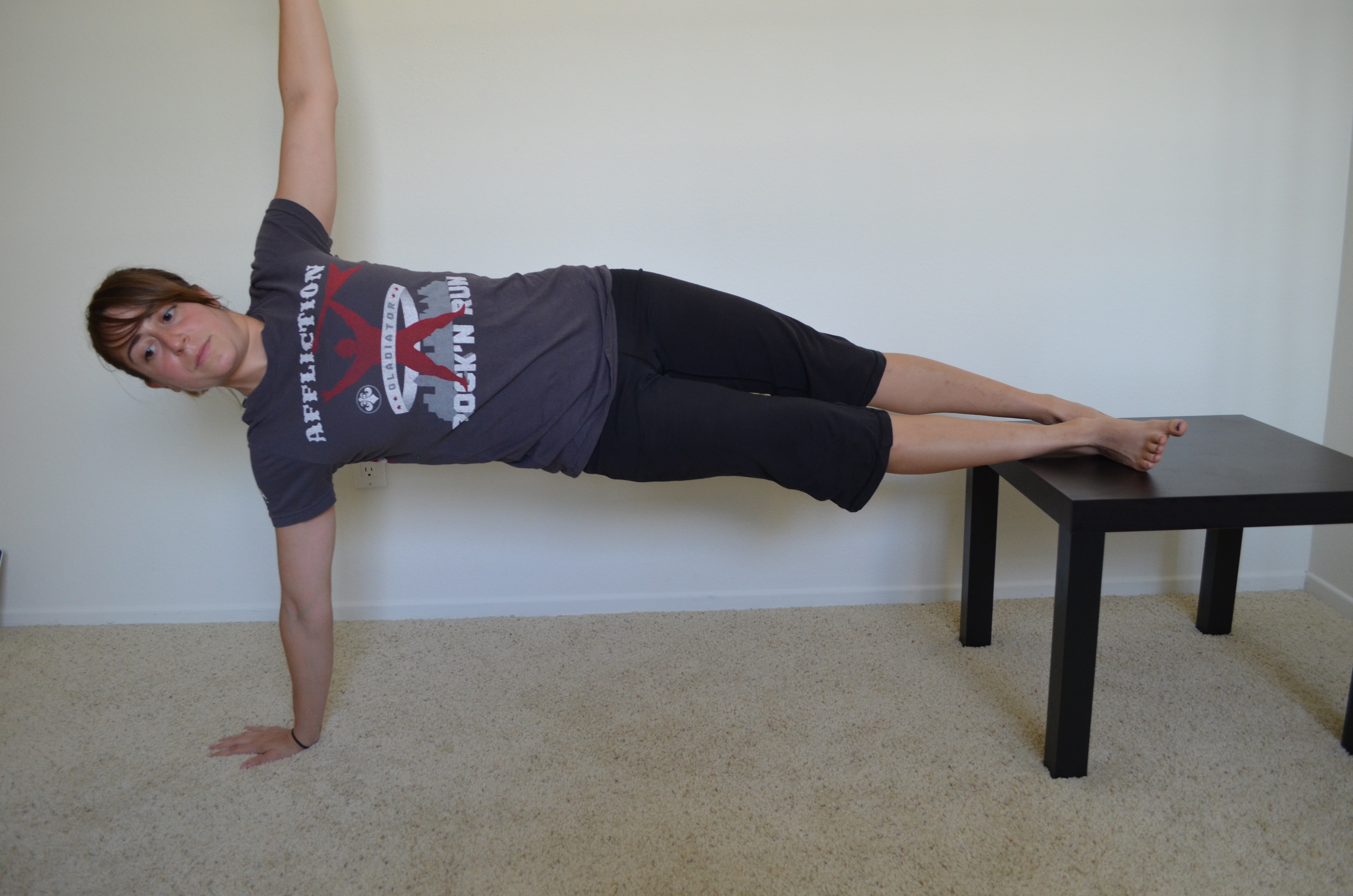
7. Plank Holds – Plank holds are a great overall core move and the table can be used to make the move easier and more difficult. Beginners can hold front and side planks with their hands on the table and feet on the ground while advanced lifters can have their feet on the table and hands on the ground.
8. Lying Bat Wings – One of my favorite moves is scapular wall holds. When playing with the table, I realized you could do the same hold while lying face down on the table. Lie down with your chest on the table. Bend your arms to 90 degrees and then pinch your shoulder blades down and back. Try to bring them together you are pinching back so hard. Hold that move. Beginners can hold for 30 seconds. Advanced can hold for up to a minute. If you want to make it even more challenging, you could add weight to each hand…even if it is just in the form of a book.

9. Reverse Hypers – A great move for the glutes and hamstrings and most easily done with a piece of equipment; HOWEVER, using a table is a PERFECT way to do reverse hypers at home. Lie face down on the table. Make sure your hips are right at the edge. Squeeze your legs together and lift your legs to basically parallel to the ground. Hold for 2-5 seconds and lower. You can do reverse hypers with either bent or straight legs. Both have their benefits. You should not feel either though in your low back. Keep the core tight and really squeeze the glutes.

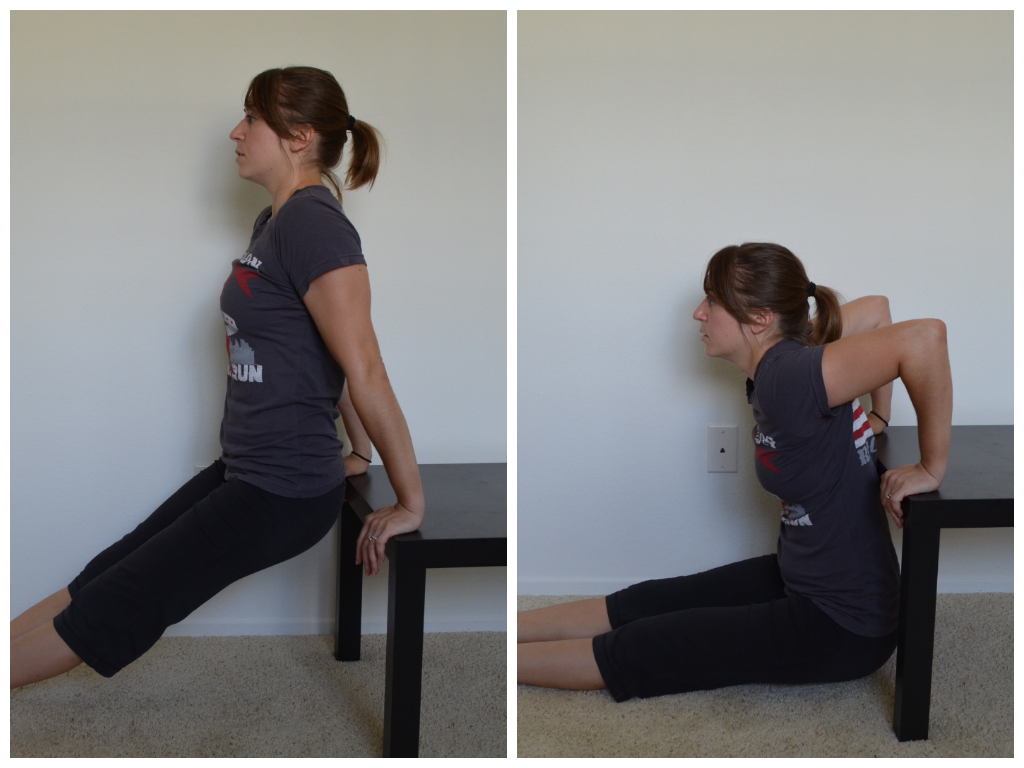
10. Dips – One of the most common home exercise moves, dips can’t be ignored. Place your hands behind you on the table with finger tips hanging over the side. Beginners can bend their legs while more advanced exercisers can keep their legs straight. Drop your butt as close to the ground as possible, bending your arms to 90 degrees and keeping your back and butt close to the table. You could even make the dips harder by doing two push ups followed by two dips for 3-5 rounds. Talk about a way to smoke your triceps….
If you like these moves and have enjoyed other Man Bicep posts, I suggest you head over to my new site Redefining Strength for a sneak peek and a few great workout freebies, including a COMPLETE FOAM ROLLING VIDEO LIBRARY!
P.S. Thank you Ryan for an amazing post idea!
Home Workouts
So I hear all the time that people don’t have the space OR the equipment to get in a great workout at home.
That is ABSOLUTELY ridiculous.
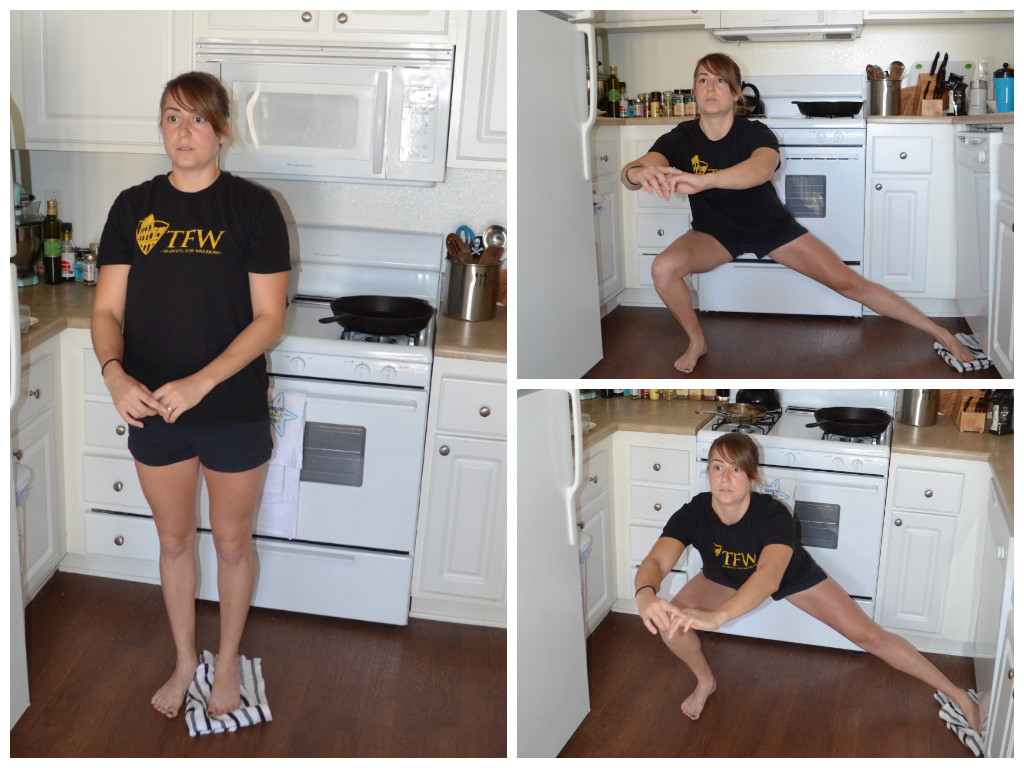
And I just did a workout in my kitchen to prove it….using just a little hand towel. (Which now is a bit dirty but at least I cleaned my floors!)
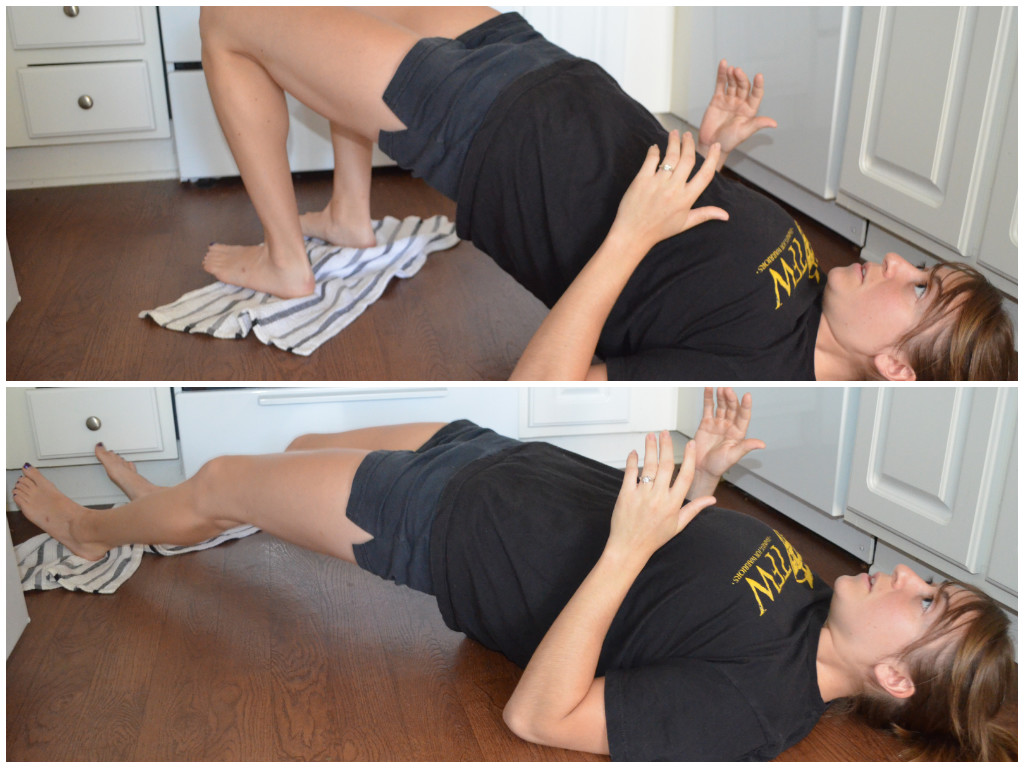
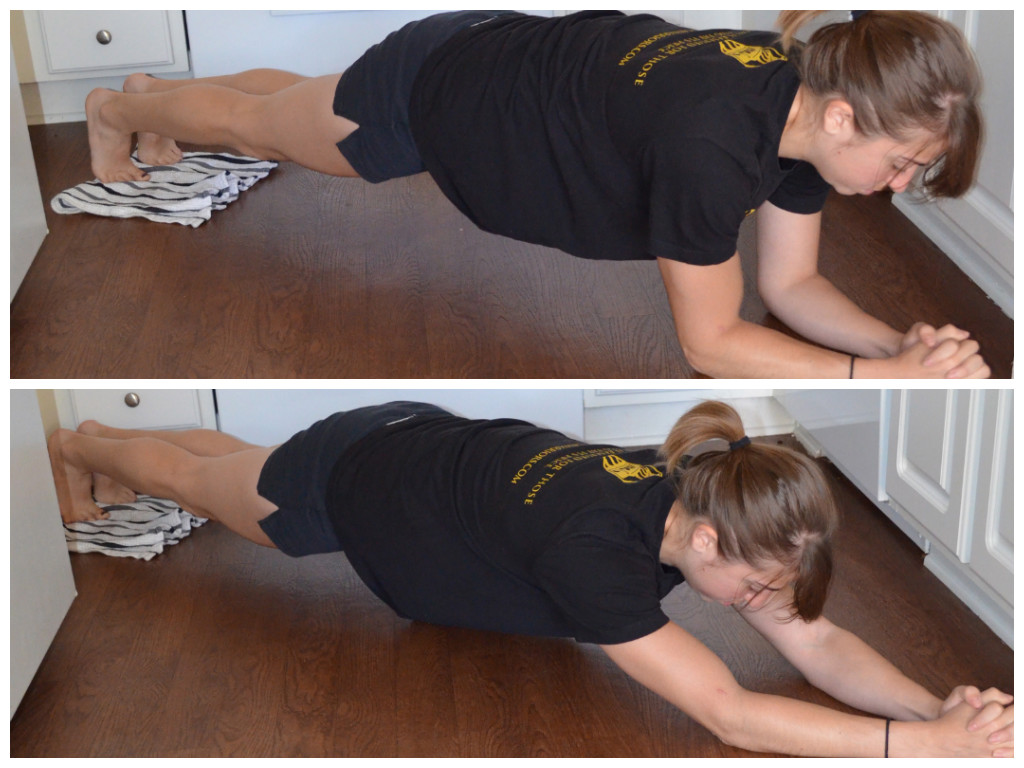
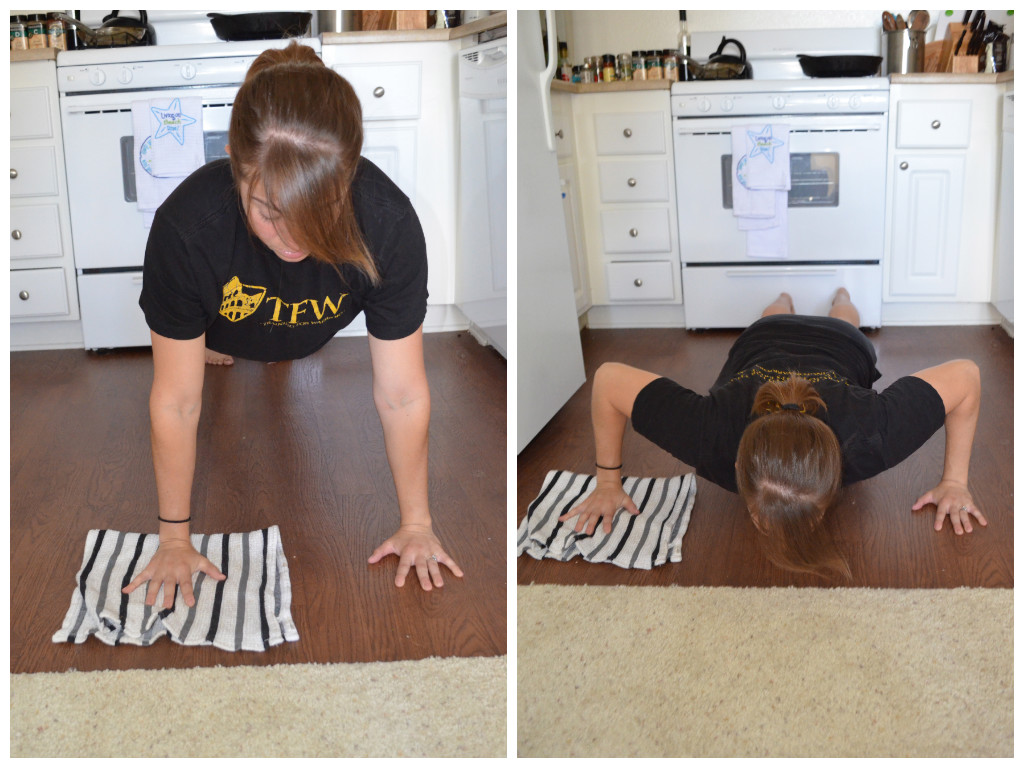
So here is my Small Space at Home Workout – 5 great moves you can do with just a hand/dish towel!
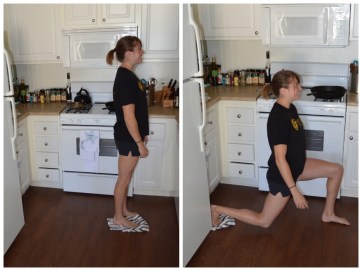
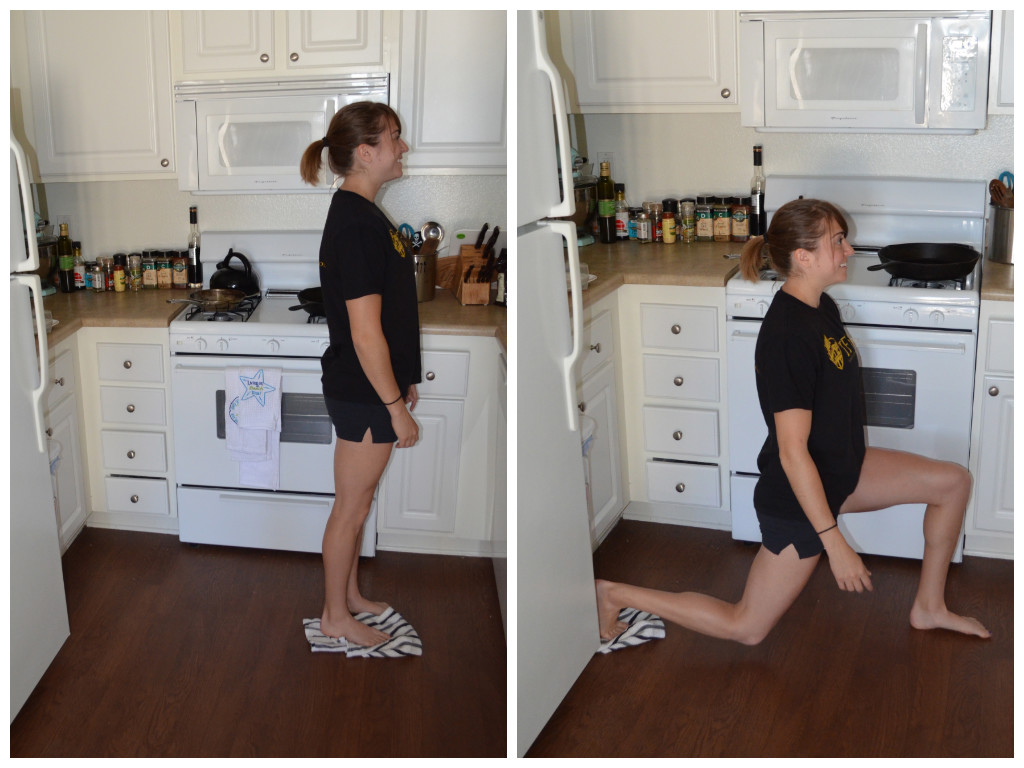
- Towel Backwards Lunge – The backwards lunge is a great move to work the glute and when you use a towel/slider, you increase the intensity AND engage the glute even more. Make sure to really squeeze the glutes as you come back to standing. To perform the move, place the towel under one foot and slide that foot back into as deep a lunge as you can handle. Make sure to really sit back on that front heel. Then driving through that front heel, come back to standing.
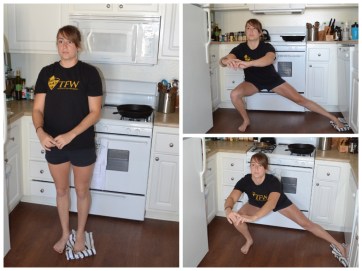
- Towel Side Lunge – This is a great move to work the glute and adductors. Please be careful the first time you try this lunge as it is easy to go too far out and not be able to get back up since there is no traction. To do this move, place the towel under one foot. Slide that foot out to the side, sitting back into the lunge. Then to stand back up, drive through the foot not on the towel. Do not allow yourself to go forward. Make sure to really sit back and then drive off the heel.
- Towel Bridge and Curl – This one is great although not a beginner move. A beginner may want to start with the towel under only one foot and slide out one leg at a time. To perform the two leg curl, place both feet on a towel about hip width apart. Start in the bridge position and slide your feet out. Keep your hips off the ground and your glutes engaged as you slide out. Then curl the heels back in, bringing the hips up again in a glute bridge.

- Body Saw – This is another advanced move. To regress this, perform the move without the towel. Walk your feet backwards and then back in, elongating through your triceps and core. To do this with the towel, keep your body in a straight line with your belly button drawn in. Slide back on the towel, lengthening your body out as much as you can. Then pull straight back in to the plank position. Do not let your hips sag toward the ground or your butt go up in the air. You should not feel this in your low back.

- Fly to Push Up – A great two in one chest exercise. This can be done from the knees or the toes. Start at the top of your push up with one hand on the towel. Then slide the hand out to the side and perform a push up. After the push up, slide the hand back into the starting position. Even though this is a wider push up, don’t let your elbows flare way out by your ears!
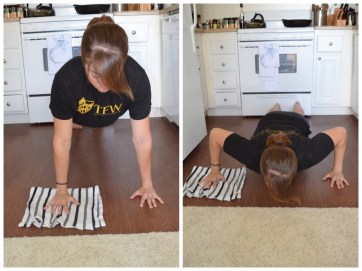
So there you have it. Five moves done with just a dish towel and space that I could barely lie down in.
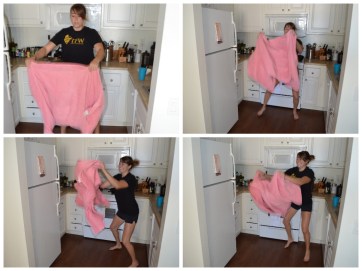
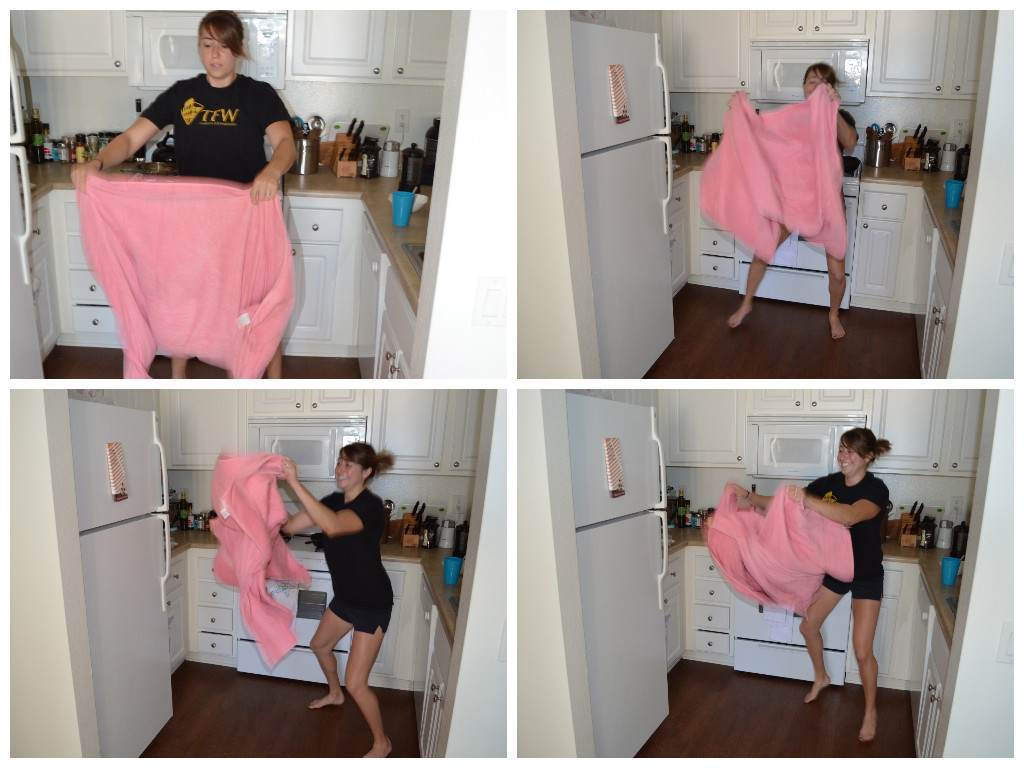
Here are two other bonus moves…Since I think most people do have a bath towel and two dish/hand towels lying around somewhere!
- Towel Taz – So basically anyone at any level can do this. And while challenging, it is rather fun. Move around as quick as you can in every direction and shake the towel down and up and in and out.
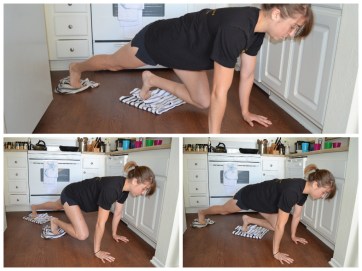
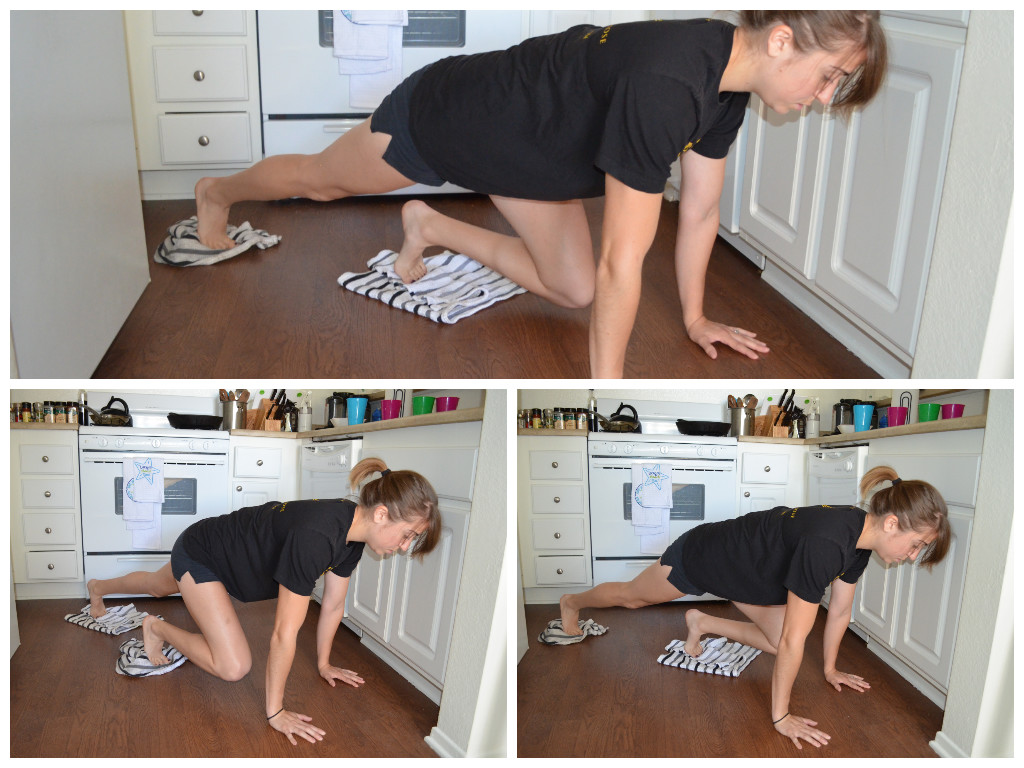
- Mountain Climbers – Place a towel under each foot and set up as if you are going to do a push up. Then, keeping your core tight, run your knees in toward your elbows, alternating legs.
AND if you are thinking…”Well my house is all carpet..”
Mine basically is too! To do all hand towel moves on carpet, all you need is a piece of cardboard…(I tore mine off of a box we used recently to move!)
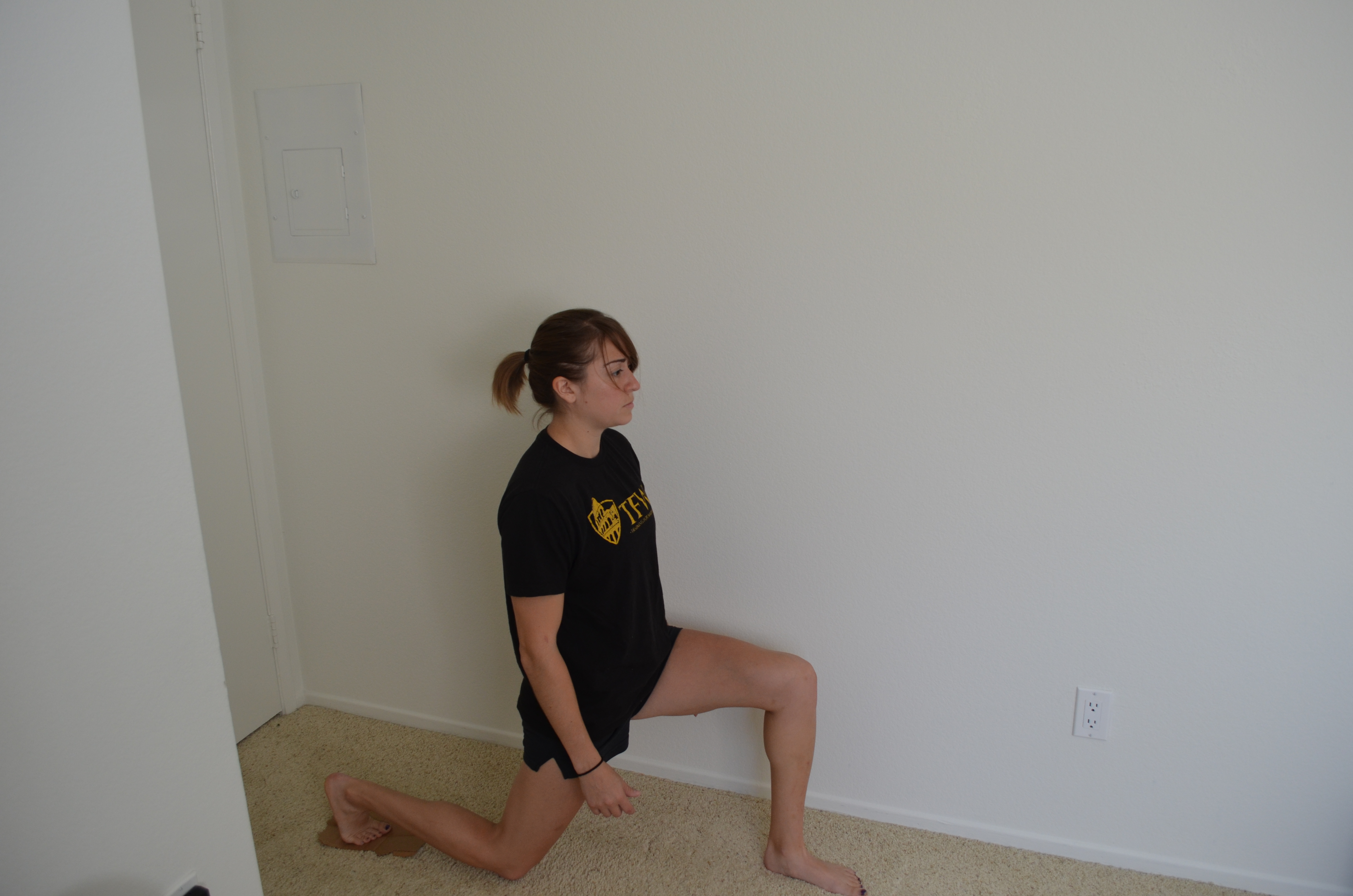
What moves do you love that require no space and use things you just have lying around the house?
What weights should I use?
So I get asked all the time by clients, what weight should I use?
A challenging and heavy one!
My answer is always “A challenging one!”
No matter what rep range you do, you want to select a weight that makes those last few reps of every round a struggle.
If you aren’t using a weight that truly makes you struggle, you aren’t going to get near as much as you could out of the workout.
So how do you determine if the weight is the “right” weight? How do you know if you are struggle “enough?”
Well for one, as you workout more and more, you will begin to understand what weights feel challenging.
You will also be able to track your weights and then add more weight based on what you did the week before. Small incremental changes are best. Don’t do a drastic jump especially if you are new to lifting.
BUT if you haven’t done a lot of working out and don’t have a great idea of where to start, I suggest you first perform the exercises with bodyweight to get down the form.
Then ask yourself, “How easy did that feel?”
If it was super easy, add weight. Try to perform the same number of reps. If you can easily do the same, up the weight again. If you can only do fewer reps before form breaks down or you can’t do any more, you may want to drop the weight just a bit until you can perform your desired amount of reps.
If you felt a burn on the last couple of reps and stopped at 10 reps BUT at the same time felt you could have done a bit more, maybe try doing 12 reps with the same weight and see if that is more challenging.
While you do want to pick a rep range to work in based on your level and your goals, the reps you plan to do shouldn’t be set in stone. (Here is a great post about rep ranges.)
If you pick a weight that is a bit too easy for the reps you chose to do that round, do a couple of more.
It is more important to feel the weights challenging you than it is to do 12 reps instead of 15 even though those numbers are technically in different ranges (hypertrophy vs. endurance).
When I workout, even though I track my numbers I sometimes still have to play around with weight depending upon how I feel that day.
And a lot of the time, I will go up as I do sets or rounds even though I started with a challenging weight. I will usually try to increase each round until I hit a weight where I can no longer perform the desired amount of reps. And then I will either hold at that weight or drop down to the one right below it for the next round.
It all depends on what rep range I’m shooting for. Say I’m working in the hypertrophy range of 8-12 reps. I may start out with a weight and say that I’m going to shoot for 10 reps.
That weight may be easier than I thought on that day, so I’ll do 12 or even 13 or 14. I’ll go until that last rep is really a struggle.
Then the next round I’ll go up to the next weight. I’ll again shoot for as many as possible in that hypertrophy range. If I hit 12, I’ll go up again.
I’ll keep going up through all my sets UNLESS I find a weight that I can barely do 8 with (a weight I don’t think I can add to without falling below my desired rep range). If I hit a weight that is a struggle for 8, I will hold at that weight for the last set (or two) and even try to force out a 9th or 10th rep if I can.
The point is that rep ranges are only as beneficial as the weight you use. If you do 5 reps with easy weight or 15 reps with weight you don’t even feel, you aren’t going to get results.
The weights you use should challenge you if you want results! The “heavier” the feel to you, no matter what weight they actually are, the more likely you will be to reach your goals of fat loss, muscle gain, muscle tone, strength, endurance, weight loss…..ANYTHING!
NOTE: If you are a beginner, increase weight slowly even if it feels easy! Your body needs to adjust to the new demands. And even though your muscles may be able to handle the weight, your joints and connective tissues might not be ready!
Stronger Than Yesterday
So yesterday I participated in a team mud run with a few clients from the gym.
One of the women I convinced to participate was super nervous…and I mean super nervous.
She kept saying, “I don’t want to get hurt. I don’t think I can do this. I’ve never done anything like this…”
But guess what!?!
She did it!
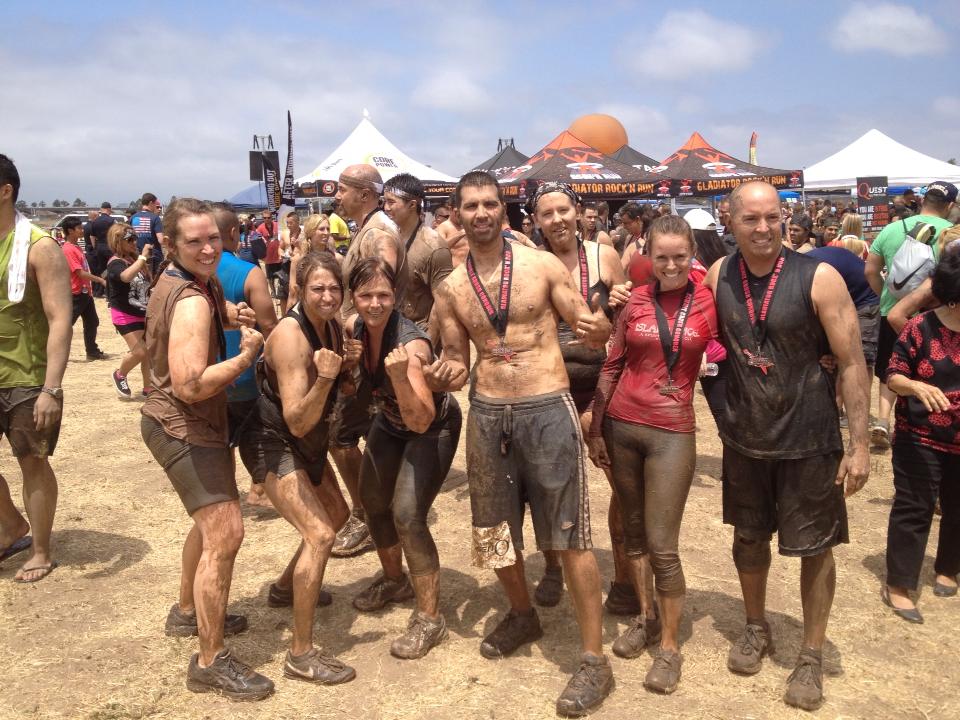
Post run haha
She even said to me at the end that she had to work on certain things for NEXT TIME.
NEXT TIME!
She had been so scared that I basically had to beg her to show up today and now she was talking about NEXT TIME.
YES!
While I was glad she had fun, I was even more excited that she had gained a new respect and confidence in her own abilities. She had done something outside her comfort zone and became more empowered because of it.
Very often, like in Patti’s case, we hold ourselves back. We tell ourselves we CAN’T do it so we don’t. We feel way more COMFORTABLE in the safe little realm we’ve built for ourselves.
We shy away from things that may leave us exposed and vulnerable – that may bring failure and defeat. Many of us fear failure and a blow to our ego more than we enjoy success.
But if we never risk failure, we will never truly know success.
Plain and simple.
Which is why I always push myself and those around me to push the boundaries of their comfort zone…
Just like Patti did.
Just like Patti has done since she started at the gym as an intimidated newbie because she didn’t want to end up like her aunt who was immobile and ill.
Patti, you are an inspiration to us all! Fifty three and looking sexy and strong!


 Man Bicep